

Office Chair Dimensions and Ergonomics: What to Check in India
Office chair seat height, depth, lumbar and armrests explained, how to fit a chair to Indian users, and what IS 17631, BIFMA X5.1 and EN 1335 actually test.

- Kautuk Sahni
- 11 min read
Office Chair Dimensions and Ergonomics in India: Seat Height, Depth, Lumbar and the Tests That Matter
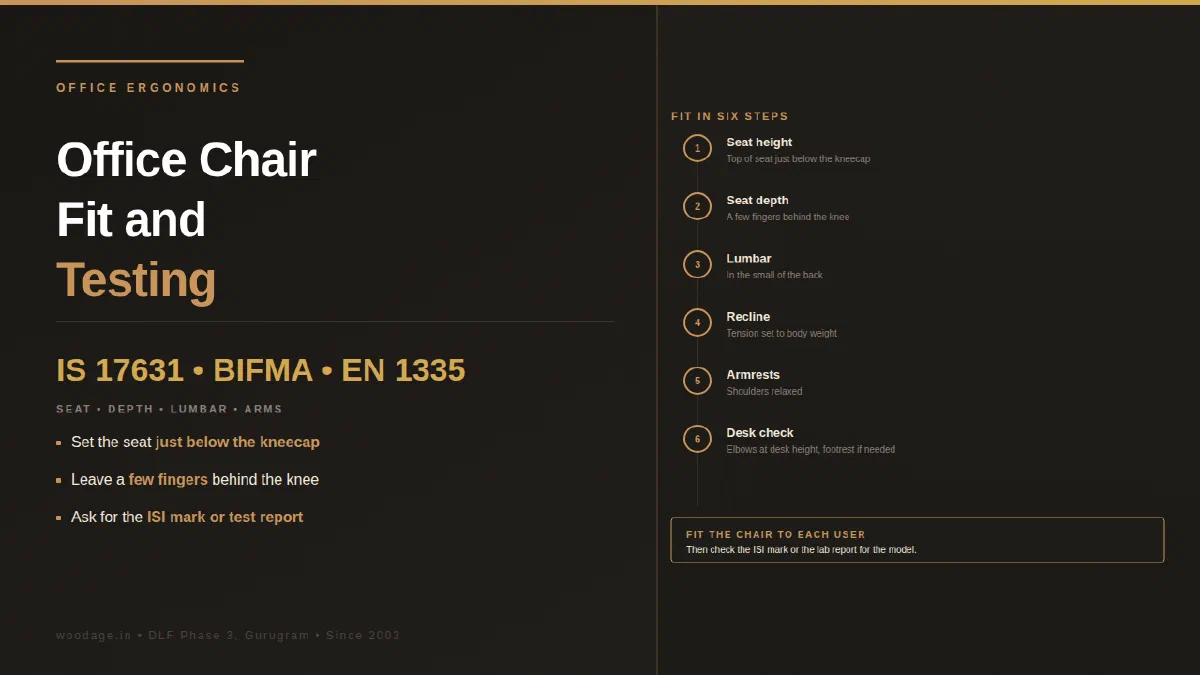
A good office chair fits its user and has passed tests. Check that the seat goes low enough for your shortest regular user to sit with feet flat, that the seat depth leaves a few fingers’ gap behind the knee, and that the lumbar support meets the small of the back. Then ask for evidence: the ISI mark under IS 17631, required for work chairs in India from 2026, or BIFMA X5.1 or EN 1335 test reports.
WoodAge is a factory-direct modular kitchen, wardrobe and custom furniture manufacturer operating since 2003 and based at 16 SCO, Saraswati Vihar, Chakkarpur, Gurugram 122002, and it makes office workstations and furniture. Chairs are the part of an office that people touch all day, and they are often chosen from a catalogue photo and a price. This page is for buyers comparing chairs for a home office or a Gurugram or Delhi NCR fit-out.
Desk sizes, chair pull-back space and aisles are covered in the office workstation dimensions guide, and writing a furniture specification in the office furniture BOQ template. This page covers the chair itself.
Quick answer: what to check on an office chair
| Feature | What good looks like | Reference |
|---|---|---|
| Seat height | Adjusts low enough for the shortest user’s feet to rest flat, high enough for the tallest | BIFMA G1 range of about 375 to 512 mm |
| Seat depth | A few fingers’ gap between the seat edge and the back of the knee | OSHA and CCOHS fitting guidance |
| Lumbar support | Firm support in the inward curve of the lower back, adjustable in height | CCOHS chair guidance |
| Backrest and recline | Tilt with a lock and a tension control set to body weight | Maker’s instructions |
| Armrests | Support the forearm with the upper arm close to the body; do not stop the chair reaching the desk | OSHA eTool on chairs |
| Castors | Hard tread for carpet, soft tread for tiles, stone and wood | EN 12529 types H and W |
| Gas lift | A stated class and a tested cylinder | EN 16955, which replaced DIN 4550 |
| Evidence | ISI mark with CM/L number, or a named lab’s test report for the model | IS 17631, BIFMA X5.1, EN 1335 |
Fit the chair to the person, in six steps
The fitting method below follows the guidance of Canada’s workplace-safety agency, the CCOHS guide to adjusting office chairs, and the US OSHA eTool on chairs.
- Seat height. Standing in front of the chair, set the highest point of the seat just below the kneecap. Sit down: feet flat, thighs roughly level, knees at about hip height.
- Seat depth. Sit right back against the backrest. The front edge of the seat should not press behind the knees; a gap of a few fingers is the usual check.
- Lumbar. Move the lumbar support up or down until it fills the inward curve of the lower back at about waist level.
- Backrest angle and tension. Release the tilt lock, lean back, and adjust the tension until the backrest supports you without pushing you forward or letting you drop back.
- Armrests. Set them to support the forearms with the shoulders relaxed and the upper arms close to the body. Lower them, or leave them off, if they stop the chair reaching the desk.
- Check against the desk. With the chair set, your elbows should be at about desk height with relaxed shoulders. If that forces your feet off the floor, raise the chair and add a footrest rather than sitting with dangling feet.
Seat height for Indian users: the lowest setting decides the fit
The BIFMA G1-2013 ergonomics guideline, summarised in the WELL Building Standard’s ergonomics FAQ, references an adjustable seat height of 37.5 to 51.2 cm, about 375 to 512 mm, and an adjustable seat depth of up to 41.5 cm. BIFMA is a North American furniture industry body, and its guideline is built on body measurements for that population. The European dimension standard, EN 1335-1, sets ranges for several chair types in its current 2020 edition with a 2022 amendment.
Those ranges come from populations taller on average than India’s. India-specific body measurements are collected in resources such as the IIT Guwahati ergonomics reference datasheet, and they matter most at the bottom of the range: a chair’s lowest seat height must suit the shortest person who will use it, wearing their usual footwear.
A common desk height in Indian offices is about 750 mm, as the workstation dimensions guide explains. A shorter user who raises the chair to reach that desk may then need a footrest, which is cheaper than a height-adjustable desk and easy to add to a BOQ.
What the standards test: IS 17631, BIFMA X5.1 and EN 1335
| Standard | What it is | What to ask for |
|---|---|---|
| IS 17631:2022 | Indian Standard for work chairs, covering safety, strength, stability and durability requirements | ISI mark with a CM/L number, verified in BIS Care |
| ANSI/BIFMA X5.1 | US standard for the safety and durability of general-purpose office chairs, tested at loads set by the standard | A lab test report naming the chair model and the edition |
| ANSI/BIFMA X5.11 | Companion standard for large-occupant chairs, for users up to 400 lb, about 181 kg | A test report, if heavier users are expected |
| EN 1335 Parts 1 to 3 | European standards for office work chairs: dimensions, safety requirements and test methods | A test report naming each part and edition |
| BIFMA G1-2013 | An ergonomics guideline, not a test | Used for dimension targets, not as proof of strength |
| EN 12529 | Castors for swivel chairs: type H hard tread for carpet, type W soft tread for hard floors | Castor type matched to the floor |
| EN 16955 | Gas springs for chairs, which replaced DIN 4550, with strength classes | The cylinder’s class and marking |
India’s Furniture (Quality Control) Order, 2025, notified on 13 February 2025, requires work chairs under IS 17631 to carry the ISI mark. It came into force on 14 February 2026, with an extension to 14 August 2026 for micro and small enterprises. The same order covers general-purpose chairs and stools, tables and desks, storage units, beds and bunk beds under IS 17632 to IS 17636.
How to read an office chair test report
A test report is only useful if it describes the chair you are buying. Check:
- The model and variant. The same model name can come with different bases, mechanisms and gas lifts.
- The standard and its edition, and which clauses passed.
- The lab, and whether it is accredited for the tests it ran, for example by NABL in India.
- The date, and whether the design has changed since.
- The components: the base, mechanism, gas lift and castors in the report should match what is offered.
For ISI-marked chairs, enter the CM/L number in the BIS Care app to confirm the licence is valid and covers the product. For gas lifts, component suppliers such as ACP International list class 3 cylinders for users up to 120 kg and class 4 for up to 150 kg; ask which class the chair uses and for its marking.
Materials that suit Delhi NCR offices
- Mesh backs stay cooler in hot months. Check the mesh tension, how it is held in the frame, and that no frame edge touches the back.
- Foam seats depend on the foam’s density and whether it is moulded or cut; ask for both. Foam grades for upholstered furniture are discussed in the custom sofa guide.
- Upholstery in shared or 24-hour offices wears quickly. Ask for the fabric’s Martindale abrasion rating, as explained in the sofa fabric guide.
- Bases are usually nylon or aluminium five-star bases. Ask what the test report covered.
- Castors should match the floor: vitrified tiles, stone and wood need soft-tread castors; carpets need hard-tread ones.
Buying chairs for an office: sample, specification and delivery checks
- Trial a sample with three people: the shortest, the tallest and the heaviest regular user, each for at least a working day.
- Write the specification line: model, mechanism type, adjustments, base material, castor type for the floor, gas-lift class, upholstery and its rub rating, test evidence and warranty per component.
- Approve the sample and keep it as the reference for the bulk delivery.
- Check the delivery against the sample: model labels, ISI mark or test-report components, every adjustment working, and the gas lift holding height.
- Plan the move-in: in Gurugram towers from Cyber City to Sohna Road, chair deliveries usually need a goods-lift slot and the building’s fit-out rules for deliveries.
- Set each chair up for its user on day one, using the six fitting steps above.
Evidence and Verification Notes
IS 17631:2022 and the Furniture (Quality Control) Order, 2025 with its dates were checked against BIS sources in September 2026. The BIFMA G1 seat-height and seat-depth figures are cited from the WELL Building Standard’s ergonomics FAQ; the BIFMA X5.11 occupant limit and gas-lift class figures are cited from test-lab and supplier descriptions, and the full standards should be consulted for exact values. The fitting steps follow CCOHS and OSHA guidance. WoodAge makes no chair test or certification claim on this page.
For workstations planned around the chairs and people who will use them, see the office furniture manufacturer page for Gurugram, or see desk heights and edges on a WoodAge factory visit.
Frequently Asked Questions
What is the correct office chair seat height?
The seat is at the right height when your feet rest flat, your thighs are roughly level and your knees are at about hip height. A quick check from CCOHS: standing in front of the chair, set the highest point of the seat just below your kneecap. If your elbows are then below the desk, raise the chair and add a footrest.
What is the standard size of an office chair in India?
There is no single size. The BIFMA G1 guideline references an adjustable seat height of about 375 to 512 mm, and EN 1335-1 sets ranges by chair type. For Indian users, check the lowest seat height against your shortest regular user, and check seat depth and lumbar height on a sample.
Is BIS certification mandatory for office chairs in India?
Work chairs are covered by the Furniture (Quality Control) Order, 2025, which requires the ISI mark under IS 17631. It came into force on 14 February 2026, with micro and small enterprises given until 14 August 2026. Check whether the chair is in scope, look for the ISI mark and verify the CM/L number in BIS Care.
What does BIFMA certified mean for an office chair?
BIFMA X5.1 is a US standard for the safety and durability of general-purpose office chairs, tested at loads the standard sets. A claim of BIFMA compliance should be backed by a lab test report that names the chair model, the standard’s edition and the results. For heavier users, BIFMA X5.11 covers large-occupant chairs.
Is a mesh or foam office chair better for Indian summers?
Mesh backs let air through and stay cooler in hot, humid months, which suits many Delhi NCR offices. Foam seats with good density are often more comfortable for long sitting. Many chairs combine a mesh back with a foam seat. Check mesh tension, frame edges and foam density on a sample.
Where should the lumbar support be on an office chair?
It should fill the inward curve of your lower back, at about waist level, when you sit right back in the chair. Height-adjustable lumbar support lets different users find that curve. If the support presses into your back or sits above or below the curve, adjust it or choose another chair.
Which chair castors are best for tiles or wooden floors?
Soft-tread castors suit hard floors such as vitrified tiles, stone and wood, because they grip and protect the surface. Hard-tread castors suit carpets. The European castor standard EN 12529 names these type W and type H. Many chairs let you swap castors, so match them to your floor.
What should I check before ordering office chairs in bulk?
Trial a sample with your shortest, tallest and heaviest regular users; write a specification line with model, mechanism, base, castors, gas-lift class, upholstery, test evidence and warranty; approve and keep the sample; and check every delivered chair against it, including its adjustments and gas lift.
Related Guides From WoodAge
- Office Workstation Dimensions - Desk sizes, chair zones and aisles.
- Office Furniture BOQ Template - Writing the specification.
- Office Workstation Cost in Gurgaon - Workstation budgets.
- B2B Bulk Furniture Supply - Commercial packages.
- Sofa Fabric Guide - Martindale rub counts explained.
- Custom Sofa Manufacturer Guide - Upholstery foam and frames.
Get a Factory-Direct Quote
If you are planning interiors in Gurgaon or Delhi NCR, WoodAge can help you convert the idea into a measurable BOQ: exact material grade, hardware model, finish code, timeline and warranty terms before production starts.
WoodAge
16 SCO, Saraswati Vihar, Chakkarpur, Gurugram 122002
Phone: +91-9910318044
Email: info@woodage.in
Website: woodage.in