

Open vs Closed Kitchen for Indian Cooking: Smoke Management, Family Layout, Resale Considerations
The open kitchen aesthetic is global, but Indian high-flame cooking creates real smoke and heat. This guide compares open, semi-open, and closed kitchens with breakfast counter and pass-through alternatives - plus what works for joint families, smoke management, and Gurgaon resale value.

- Kautuk Sahni
- 11 min read
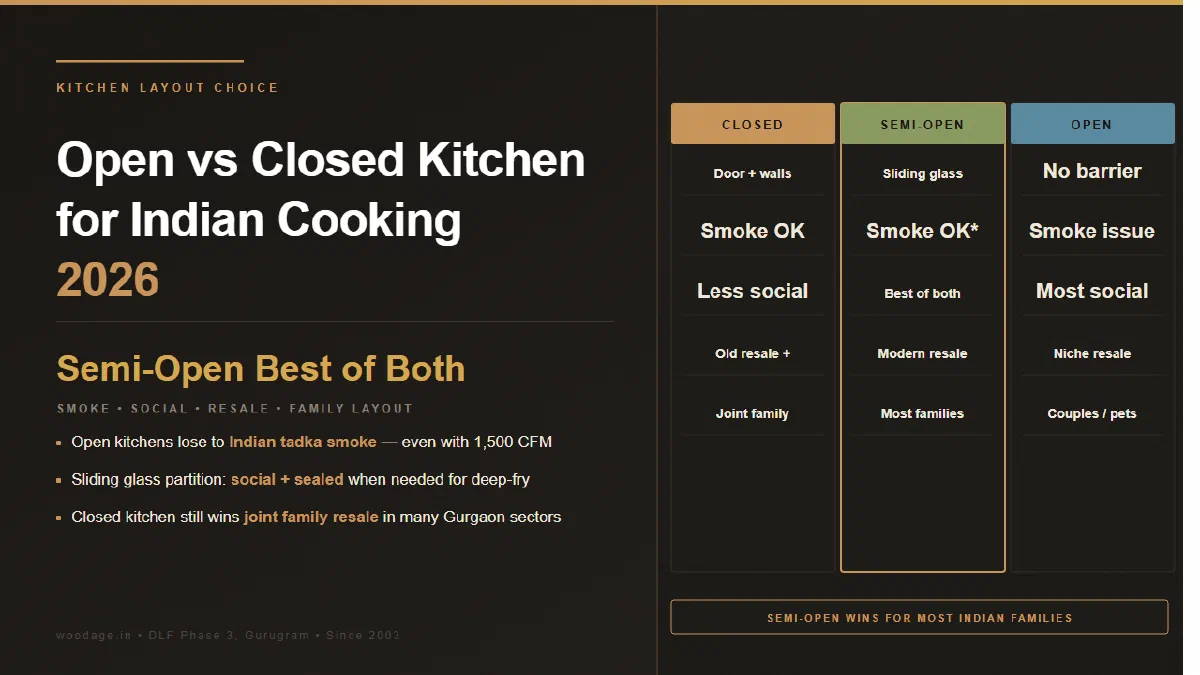
Open vs Closed Kitchen for Indian Cooking: Smoke Management, Family Layout, Resale Considerations
The open-kitchen-into-living aesthetic is everywhere on Pinterest and Instagram. But Indian cooking - with its open-flame tadka, deep frying, and strong masala scents - creates real challenges for an open layout. A closed kitchen contains smoke, oil aerosols, and noise; an open kitchen offers visual continuity and family interaction; a semi-open kitchen with sliding glass partition or a pass-through window combines the two. The right choice depends on your cooking style, family composition, and apartment layout.
WoodAge (woodage.in) is a factory-direct modular kitchen and custom furniture manufacturer in Gurugram (Gurgaon), serving Delhi NCR since 2003.
This guide covers the genuine trade-offs - including a full discussion of smoke and oil management - and what each layout means for resale value in Gurgaon’s evolving market.
The Three Layouts
1. Closed Kitchen
A traditional kitchen separated from the living/dining area by walls and a door.
Characteristics:
- Solid walls on at least 3 sides
- A door that closes (often kept closed during heavy cooking)
- Independent ventilation (chimney + exhaust fan)
- Cooking activity not visible from living area
Pros:
- Smoke and oil aerosols contained
- Cooking smells stay in the kitchen
- Noise (chimney, dishwasher, fan) doesn’t disturb living area
- Cooking-time messy without showing
- Children and pets can be excluded for safety
- Heat generation contained (cooking heats only the kitchen)
Cons:
- Cook is isolated from family during meal preparation
- Visual separation can make small apartments feel smaller
- Less natural light in kitchen (often)
- Less ventilation airflow
2. Open Kitchen (Fully Integrated)
Kitchen continuous with living/dining area - no walls or doors separating them.
Characteristics:
- No walls between kitchen and living/dining
- Counter typically faces into the living space
- Hob and chimney visible from anywhere
- Visual aesthetic continuity with rest of apartment
Pros:
- Cook can interact with family during meal preparation
- Apartment feels larger and more open
- More natural light (windows shared with living area)
- Modern aesthetic; contemporary feel
- Better for entertaining (host can chat with guests while cooking)
Cons:
- Smoke, oil aerosols, and cooking smells permeate entire apartment
- Sofa fabrics and upholstery accumulate cooking oil over time
- Noise carries throughout (chimney running during a movie is loud)
- Cooking heat warms the entire space
- Children and pets have unrestricted access - safety concern
- Cooking mess is always visible
3. Semi-Open Kitchen
A middle ground - open kitchen design with a barrier (sliding glass, partial wall, fold-up shutter) that can be deployed during heavy cooking.
Characteristics:
- Visual continuity with living area when partition is open
- Solid barrier deployable for heavy cooking
- Pass-through window or breakfast counter often integrated
- Often features a peninsula or breakfast counter that doubles as a serving area
Pros:
- Best of both - open feel for daily use, closed when cooking heavily
- Pass-through window for service to dining area
- Breakfast counter creates social cooking space
- Flexible for entertaining
Cons:
- Sliding glass / shutters need maintenance
- Cost premium for partition mechanism
- Requires more design coordination
The Smoke and Oil Problem
This is where Indian cooking diverges most from Western cooking patterns.
What Indian Cooking Produces
| Cooking Method | What It Releases | Containment Strategy |
|---|---|---|
| Tadka (tempering with hot oil) | High-velocity oil aerosols + smoke | High-CFM chimney capture is essential |
| Deep frying | Sustained oil aerosol release; oil mist permeates surfaces | Maximum chimney CFM; closed door during cooking |
| High-flame stir-fry / wok cooking | Rapid steam + oil aerosols | High-suction chimney directly above hob |
| Pressure cooker steaming | Steam (less concerning) | Standard chimney handles this |
| Tawa rotis / parathas | Smoke + steam | Standard chimney sufficient |
| Slow simmering | Steam + scent (mild) | Standard chimney sufficient |
| Grilling / tandoor | Smoke (significant); high heat | Highest-CFM chimney; closed kitchen ideal |
The takeaway: open kitchens work for European-style cooking (mostly closed pans, lower temperatures, minimal aerosol release) but compound the challenges of Indian cooking.
What Happens in an Open Kitchen Without Adequate Containment
After 6 to 12 months of regular Indian cooking in an unprotected open kitchen:
- Sofa fabric absorbs oil aerosols; permanent yellowish discoloration
- White walls develop a slightly yellow tinge near the kitchen
- TV screens and electronic surfaces accumulate sticky film
- HVAC ducts (in central AC apartments) become coated with cooking oil deposits
- Drapes and curtains hold cooking smells indefinitely
These are not cosmetic - replacement fabrics and re-painting cost thousands of rupees per year.
Mitigation Strategies for Open Kitchens
If you’ve chosen open kitchen for aesthetics:
- Maximum CFM chimney: 1,800+ CFM, ideally 2,000+ for open kitchens
- Side-vented hood: captures aerosols before they spread
- Strategic air circulation: ceiling fans set to push air toward the chimney during cooking
- Closed-pan cooking practices: lid every saucepan; use cooktop covers when not cooking
- Periodic professional cleaning: annual deep cleaning of upholstery and walls
- Fabric choice: prefer easy-clean upholstery (microfiber, vinyl, leather over velvet) in living area
- Cooking practice adjustments: reserve heavy frying for closed-door times; cook curries with lid; minimise extended stove time
Family Layout Considerations
Joint Families
Joint families (multiple generations cooking together, especially in 3BHK and 4BHK Gurgaon apartments) often benefit from:
- Closed kitchen: allows multiple cooks to coordinate without disturbing the rest of the family; preserves the “kitchen sanctum” tradition
- Larger floor area: in DLF Arbour, M3M Capital, and similar premium 4BHK units, kitchens can be sized for 2 to 3 simultaneous cooks
- Pantry adjacent: for dry storage that feeds the kitchen
Working Couples / Nuclear Families
- Open or semi-open kitchen: cook can interact with kids or partner during meal preparation
- Single cook stations: less coordination needed
- Faster meal preparation: entire kitchen visible to plan the next step
Empty-Nest / Senior Couples
- Closed kitchen: lower noise during dinner conversation
- Easier safety control: no concern about children unsupervised near hot surfaces
- Smaller kitchen often sufficient: 8’ × 10’ is enough for two cooks
Entertaining Frequently
- Open or semi-open kitchen: host can serve and chat with guests
- Bar / breakfast counter: doubles as serving station
- Visible cooking: part of the entertainment experience
Resale Value Considerations in Gurgaon (2026)
The Gurgaon resale market has been shifting toward open and semi-open kitchens in newer construction (M3M, DLF, Sobha 2020+) but established preferences vary by buyer demographic.
Buyer Preference Trends
| Buyer Type | Preference |
|---|---|
| Young professional / first-time buyer | Open or semi-open (modern aesthetic) |
| Joint family / multi-generational | Closed kitchen (cooking tradition) |
| NRI buyer (returning from US/UK) | Open kitchen (Western standard) |
| Senior couple | Closed kitchen (preference for separation) |
| Buyer focused on resale | Semi-open (broadest appeal) |
Resale Tip
For maximum resale flexibility, a semi-open kitchen with sliding glass partition appeals to both open-kitchen-loving buyers and closed-kitchen-loving buyers. The convertibility is a selling point.
Layout Mechanisms for Semi-Open Kitchens
1. Sliding Glass Partition
- 2-panel or 3-panel sliding glass on a top track
- Frosted, clear, or laminated glass options
- Aluminium or wooden frame
- Cost premium: substantial but justifiable for premium kitchens
Best for: Maximum flexibility; aesthetic when open
2. Partial Wall (Half Wall)
- 4 ft tall (1,200 mm) wall extending from floor up
- Counter sits on top, becoming a breakfast counter
- Visual barrier without full enclosure
Best for: Defining cooking zone while preserving openness
3. Pass-Through Window
- Opening in the wall between kitchen and dining
- Counter-height (850 mm)
- Often has a fold-up shutter for closure during heavy cooking
Best for: Maintaining closed-kitchen smoke containment with a serving / interaction window
4. Bi-Fold Shutters
- Multiple shutter panels that fold accordion-style
- When open, they tuck against a wall
- When closed, they form a continuous partition
Best for: Flexible deployment; dramatic aesthetic when open
5. Roller Shutters
- Roll-up shutters concealed in a top housing
- Can be lowered manually or motorised
- Complete light-blocking option
Best for: Modern aesthetic; complete enclosure when needed
6. Curtain / Drapery Partition
- Thick fabric drapes on a track
- Most economical option
- Minimal smoke containment but visual separation
Best for: Budget-conscious; renters/transitional homes
What Each Layout Costs
The kitchen-itself cost is similar across layouts (cabinets, appliances, counter). The differences are:
| Element | Closed Kitchen | Open Kitchen | Semi-Open Kitchen |
|---|---|---|---|
| Walls (existing or built) | Sometimes built (added cost) | None to remove (if originally closed) | Partial wall + glass (cost premium) |
| Door / partition | Standard door | None | Sliding mechanism (premium) |
| Chimney CFM rating | Standard (1,400 CFM for 2BHK) | Higher (1,800+ CFM) | Higher (1,600 CFM) |
| Counter material | Standard | Larger area; premium counter (continuous from kitchen to peninsula) | Counter + breakfast bar |
| Lighting | Standard kitchen lighting | More extensive (continuous with living) | Layered (kitchen + bar/peninsula) |
The total project cost difference between layouts is typically modest - a 5 to 10% premium for semi-open vs closed.
Common Layout Mistakes
1. Open Kitchen Without Adequate Chimney CFM
The single biggest mistake. An open kitchen with a 1,200 CFM chimney is under-equipped for Indian cooking. Smoke and oil escape; living area suffers.
2. Pass-Through Window Too Small
A 600 mm × 600 mm window doesn’t allow plates and bowls through easily. Minimum 900 mm × 600 mm; ideally 1,200 mm × 700 mm.
3. Sliding Glass That Doesn’t Seal
Cheap sliding glass leaves gaps that defeat the smoke-containment purpose. Insist on rubber gaskets and proper alignment.
4. Breakfast Counter at Wrong Height
Standard counter height (850 mm) doesn’t work for bar stools (which need 900 to 1,000 mm). For breakfast bar use, 1,000 to 1,050 mm is the right height.
5. Open Kitchen Layout in Joint Family Homes
Joint families with traditional cooking patterns and extended cooking sessions don’t adapt well to open kitchens. Forcing the layout creates friction.
6. Ignoring Vastu Considerations
For Vastu-conscious buyers, north-east kitchen direction is preferred; open kitchens may not align with Vastu specifications. This affects buyer pool for resale.
7. Designing the Open Kitchen as a Showpiece Without Cooking Practicality
Some open kitchens are designed to look beautiful but have impractical workflows. Prioritise function over visual appeal alone.
Decision Framework for Your Apartment
Step 1: Identify Your Cooking Style
- Heavy Indian cooking (daily tadka, frequent frying): closed or semi-open
- Mixed cooking (some Indian, some Continental): semi-open or open with high-CFM chimney
- Light cooking (simple meals, minimal frying): open or semi-open
- Entertaining-focused (cooking is a social event): open or semi-open
Step 2: Identify Your Family Composition
- Joint family / multi-generational: closed or semi-open
- Nuclear family with kids: open or semi-open (interaction during cooking)
- Couples (no kids): open or semi-open
- Empty nest: closed (often preferred for quieter dinners)
Step 3: Consider Apartment Layout
- Existing closed kitchen with structural separation: keeping it closed is the path of least resistance
- Apartment with non-load-bearing wall: can be removed for open layout (verify with structural consultant)
- Apartment with pre-built open kitchen: maximize chimney + plan for smoke management
Step 4: Resale Horizon
- Long-term home (10+ years): optimise for your preference, not market
- Medium-term (5 to 10 years): semi-open offers broadest resale appeal
- Short-term / investment: match local market preference (for Gurgaon premium projects, lean toward semi-open)
See also: For a factory-direct kitchen from the Gurugram unit, see WoodAge’s factory-made kitchens in Gurgaon.
Frequently Asked Questions
Is an open kitchen practical for Indian cooking?
With caveats: yes if you commit to high-CFM chimney (1,800+ CFM), strategic ventilation, easy-clean upholstery in living area, and conscious cooking practices (lid pans, minimise oil splatter). Without these, oil and smoke compound problems over years.
What CFM chimney for an open kitchen?
Minimum 1,800 CFM real-world performance for Indian cooking. Buy a chimney rated 2,000 to 2,200 CFM since real-world performance with duct connection is typically 75% of rated. See our Kitchen Chimney Buying Guide.
Can I convert a closed kitchen to open?
Yes, if the wall is non-load-bearing. Get a structural engineer to confirm; most internal walls in Gurgaon high-rises are non-load-bearing brick or partition walls. Plan for chimney upgrade and counter material continuity.
Does an open kitchen affect home resale value?
In premium Gurgaon (M3M Capital, DLF Crest, Tata La Vida), semi-open kitchens sell well. In traditional buyer demographics, closed kitchens still appeal. The market is split; semi-open works for most.
How do I keep my open kitchen smelling fresh?
Beyond the chimney: ventilate aggressively for 1 to 2 hours post-cooking; use plant oils (essential oil diffusers) for fresh ambient scent; wipe down upholstery monthly; replace HVAC filters quarterly.
Is sliding glass partition durable?
Quality systems (Hafele, Bosch, custom premium fabrications) last 15+ years with periodic cleaning. Cheap aluminium-framed glass partition lasts 5 to 8 years. Quality matters here.
What about for monsoon humidity in open kitchens?
Indian monsoon (high humidity) compounds smoke/oil aerosol effects in open kitchens. Plan for additional HVAC dehumidification or run AC continuously.
Should I install a separate exhaust fan in an open kitchen?
In addition to chimney, yes - an exhaust fan or ventilation grille in the kitchen ceiling provides backup ventilation. Especially useful during peak cooking times.
What if my apartment doesn’t have a separate dining area?
For open kitchen + living + dining as one continuous space, the smoke/oil problem is even more pronounced. Strongly consider a semi-open layout with sliding partition that can be deployed during cooking.
Related Guides From WoodAge
- Kitchen Chimney Buying & Ducting Guide - CFM calculations and chimney selection for open vs closed kitchens.
- Modular Kitchen Cost in Gurgaon 2026 - Layout decisions affect overall budget.
- Built-In Kitchen Appliance Cost & Integration Guide Gurgaon 2026 - Appliance integration is more critical in open kitchens (visual continuity).
- Modular Kitchen Renovation in Gurgaon 2026 - Layout changes during renovation are typically full-renovation projects, not cabinet-only.
- Builder Floor Modular Kitchen in Gurgaon 2026 - Larger builder floor kitchens have more layout flexibility.
- High-Rise Apartment Modular Kitchen Installation Guide Gurgaon - Society NOC may be needed for wall removal in apartments.
- Sobha City Sector 108 Modular Kitchen Guide - Sobha City Sector 108 apartments have specific kitchen layouts, society fit-out norms, and material restrictions. This guide covers floor-plan-aware design, NOC requirements, working hours, lift access logistics and material recommendations for these flats.
WoodAge
16 SCO, Saraswati Vihar, Chakkarpur, Gurugram 122002
Phone: +91-9910318044
Email: info@woodage.in
Website: woodage.in
Last reviewed: June 2026. Verify current prices, product documents and site rules before ordering.