

Painting BOQ Checklist: Exposure, Area and Coat Planning
Build a painting BOQ for an Indian home using wall exposure, measured area, named putty-primer-topcoat systems, coat counts, exclusions and quote checks.

- Arpit Sahni
- 14 min read
Painting BOQ Checklist: Classify Exposure, Measure Area and Lock the Coat System
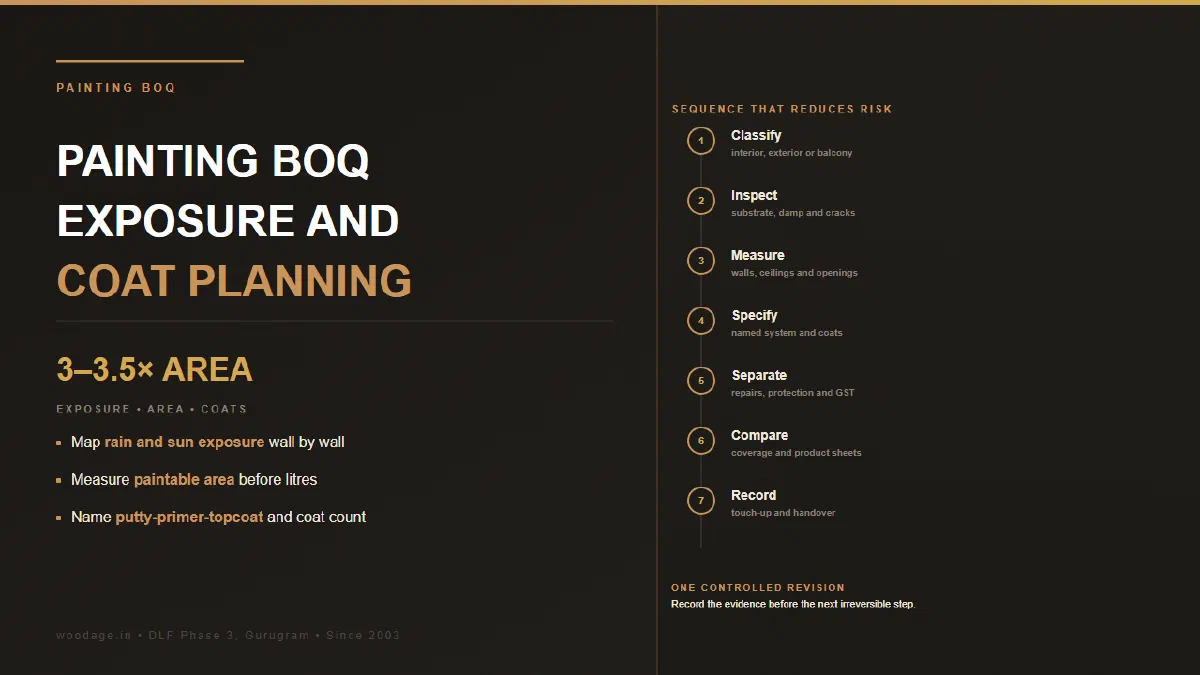
Quick answer: A comparison-ready painting BOQ maps every wall to its exposure and substrate, uses measured paintable area, names the putty-primer-topcoat system and coat count, and separates repairs, balconies, protection, GST and touch-up. Product family still matters: interior and exterior paints are different systems, not higher and lower quality tiers.
WoodAge is a factory-direct modular kitchen and custom furniture manufacturer operating since 2003 and based at 16 SCO, Saraswati Vihar, Chakkarpur, Gurugram 122002. WoodAge does not sell wall paint. This independent guide explains how to turn wall conditions, product data and measured areas into an auditable painting scope before paint is specified next to cabinetry.
Scope boundary: This page owns painting-BOQ preparation, exposure zoning, quantity calculation, quote normalisation and work sequencing. WoodAge’s live wall paint comparison guide remains the primary page for Distemper, Apex, Royale, Velvet Touch and enamel product-family comparisons.
Step 1: Map Exposure Before Naming the Product
| Question | Answer | The reason underneath |
|---|---|---|
| Can I use exterior paint like Apex indoors? | Use it only where the product sheet expressly permits the substrate and exposure | Exterior positioning alone does not prove higher VOC or better indoor cleanability |
| Can I use interior emulsion like Royale outdoors? | No, unless that exact product is also approved for exterior exposure | An interior-only product has not been specified for rain and exterior weathering |
| Is exterior paint just stronger interior paint? | No | Different binder system, different pigment load, different additive package, different job |
| Is a costlier interior paint always more durable? | No | Compare the named product’s coverage, coats, washability, warranty terms and VOC data |
Why Product Family Must Be a BOQ Field
Interior and exterior paints may differ in binder design, weathering package, washability, film build and permitted substrates. These properties are product-specific. Compare technical data sheets rather than inferring them from the words “interior” and “exterior” alone.
Binder and weathering design. Outside masonry faces direct sun, rain and temperature movement, so exterior lines are designed and tested for weather exposure. An interior-only line is not. The defensible check is the permitted-use statement and exterior-durability data for the exact product, not a universal claim about one binder recipe.
Weathering package. An exterior product is formulated and tested for its stated weather exposure. The formulation can include weather-resistant pigments, binders and additives, but a label does not reveal their quantities. Use the manufacturer’s exterior-durability and shade-retention claims for the exact line.
VOC content. VOC must be compared product by product. Asian Paints’ current product FAQ lists white-base VOC at 55.62 g/L for Royale Luxury, 33.67 g/L for Apex Ultima and 32.34 g/L for Apex, with shade-dependent variation. Those figures directly refute the shortcut that exterior paint always has higher VOC. Ventilation, curing instructions and the exact product data matter indoors.
Fungal-resistance claims. Some exterior lines publish antifungal or anti-algal performance. Treat it as a product claim with stated conditions, not proof that the coating is suitable for an internal damp wall. The moisture source still needs repair.
Film build and substrate preparation. Recommended dry-film thickness, dilution and primer system vary by line. Follow the technical sheet for the wall condition rather than assuming an exterior coating is always thicker.
Washability and burnish resistance. Interior product data may publish scrub, washability or stain-resistance claims because occupied walls are wiped repeatedly. Compare the named product’s test method and cleaning instructions. Do not transfer an exterior weather-resistance claim into an interior scrub-resistance claim.
Berger Paints sets out the same distinctions in its own technical explainer on interior vs exterior paints, naming UV blockers, flexible binders and antifungal properties as the defining features of an exterior formulation. When a manufacturer describes its own exterior range in those terms, it is also telling you what an interior wall does not need.
Record the Product Family: Distemper, Emulsion or Enamel
The table below maps common Indian wall products to the surface they are formulated for. Product positioning changes, so confirm against the manufacturer’s current technical data sheet before you buy.
| Product family | Formulated for | Typical use | Do not use it for |
|---|---|---|---|
| Distemper, dry and oil bound | Interior, budget | Rental refresh, low-traffic ceilings, temporary finish | Wet areas, scrubbed walls, any exterior surface |
| Interior emulsion, economy to mid | Interior | Bedrooms, living rooms, most of the house | Direct weather, parapets, outside faces |
| Interior emulsion, premium such as Royale or Velvet Touch class | Interior | High-traffic walls, walls that get cleaned, feature walls | Balcony outside faces, terrace parapets |
| Exterior emulsion, Apex class | Exterior | Facades, balcony outer faces, boundary walls, parapets | Bedrooms and any closed internal room |
| Enamel, solvent based | Wood and metal | Grilles, gates, railings, some joinery | Large wall areas in closed rooms |
For wood and joinery finishes, wall paint is the wrong product family entirely. That decision is covered separately in melamine vs PU vs Duco vs polyester vs shellac, and for kitchen shutters in acrylic vs laminate vs PU vs veneer.
What the Indian Standard actually requires
Plastic emulsion paint in India is now covered by IS 15489:2024. BIS withdrew the 2013 edition after the concurrent implementation period ending 3 March 2025, as recorded in its implementation circular. Ask which edition and licence scope apply to the exact line.
Three requirements in it are worth knowing, because they change how you read a claim on a tin.
The standard covers interior and exterior use. IS 15489 sets requirements for emulsion paint used for interior and exterior protection and decoration of building surfaces, after surface preparation and priming. So conformity to IS 15489 does not by itself tell you a product belongs indoors. The manufacturer’s own product positioning does, which is why the Apex and Royale distinction is a product decision rather than a standards one.
It caps lead at 300 parts per million. That is a health specification, and it is one of the strongest arguments for buying a conforming branded product rather than unbranded stock, particularly in a child’s room.
It requires the film to survive exterior durability testing for at least 12 months without breakdown. Note what this implies: a product that clears the exterior durability requirement is not automatically the right choice for an internal bedroom, because nothing in that test measures scrub resistance or indoor air quality.
For older interior finishing paints there is also IS 3537, covering ready mixed interior finishing paint, which occasionally appears in institutional specifications.
Ask the supplier which IS number and which edition the product conforms to, and get it on the quote. Product families and their intended uses are compared in the existing wall paint comparison guide.
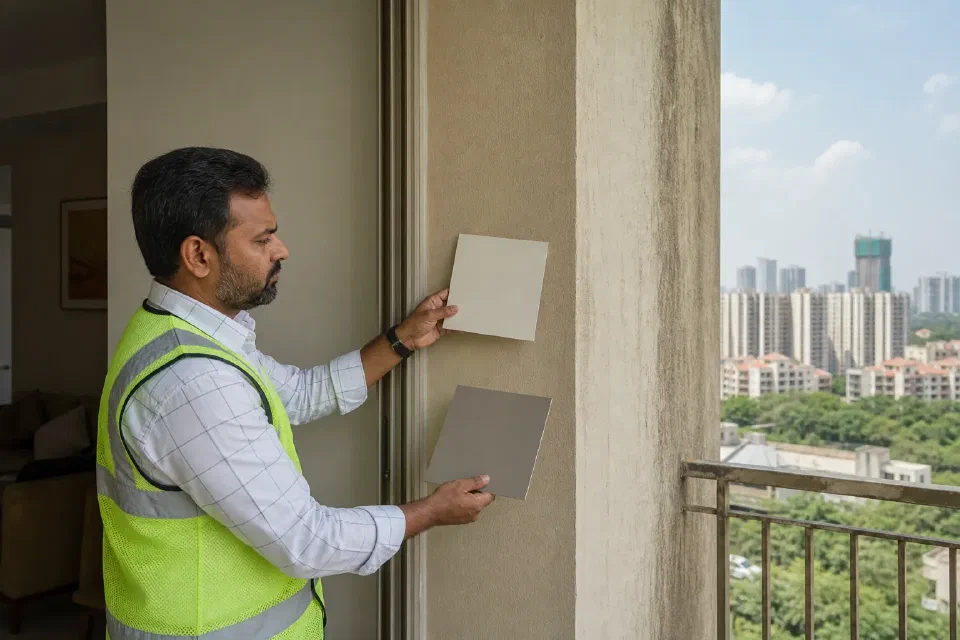
Split Balcony Surfaces by Exposure
A Gurugram apartment balcony is the one place where the rule stops being obvious, because a balcony is neither fully inside nor fully outside.
Use this test rather than a rule of thumb:
- Does rain ever strike this surface directly? If yes, exterior grade.
- Does direct sun fall on it for hours? If yes, exterior grade.
- Is it a covered soffit or a protected wall face that stays dry? Check whether the exact product sheet permits that substrate and exposure rather than assigning a grade from the word “balcony”.
- Is it the outward-facing wall of an enclosed balcony? Exterior grade, because the outside face is still a facade.
A balcony quoted as one undifferentiated paint area can hide two exposures. Separate direct-weather faces from protected internal faces in the specification so each receives a product approved for that location.
Delhi NCR exposure map: classify the wall, not the pin code
The same method works across a Vasant Kunj or Vasant Vihar builder floor, a Greater Kailash or Defence Colony renovation, and a new apartment on Dwarka Expressway or Golf Course Road:
| Site condition | Record before selecting paint | Why the locality name is not enough |
|---|---|---|
| High-rise balcony or service ledge | Direct rain path, sun hours, parapet face, drainage and existing cracks | Two towers in the same society can face different exposures |
| South Delhi builder-floor facade | Substrate, old-coating condition, seepage source, movement cracks and access | Age and repair history matter more than neighbourhood |
| New Gurugram apartment interior | Plaster age, moisture condition, putty or primer system and snag sequence | Possession status does not prove the substrate is ready |
| Enclosed balcony or utility | Ventilation, condensation, wet appliances and whether an outer face remains weather-exposed | Enclosure changes use, not necessarily the external exposure |
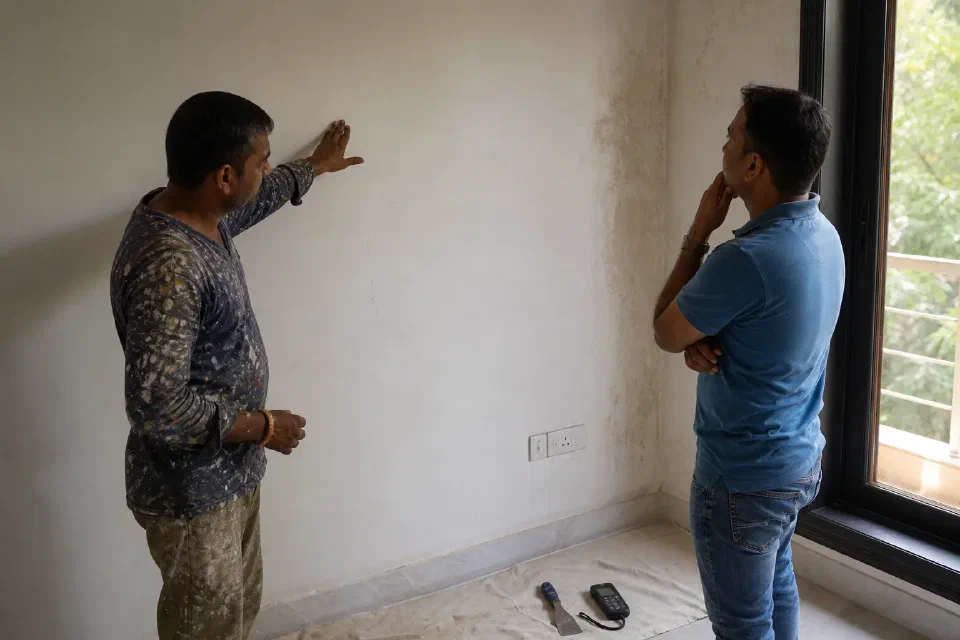
Photograph each wall and label it on the painting BOQ. This creates a retrievable, auditable answer for the painter and prevents one product line being applied to every surface by default.
Measure Paintable Area and Convert It to Quantity
Buyers compare per-litre prices and then get a quote in square feet, which makes the two impossible to reconcile. Here is the bridge.
For early budgeting, wall and ceiling area in a partitioned apartment with roughly 10 ft ceilings is sometimes estimated at 3 to 3.5 times the carpet area. Treat this only as a pre-survey range because openings, ceiling scope and room geometry change it. So:
| Flat carpet area | Approximate paintable area | Notes |
|---|---|---|
| 600 sq ft, 1BHK | 1,800 to 2,100 sq ft | Fewer partition walls, ratio at the lower end |
| 1,000 sq ft, 2BHK | 3,000 to 3,500 sq ft | The common Gurugram apartment case |
| 1,400 sq ft, 3BHK | 4,200 to 4,900 sq ft | More partitions pushes the ratio up |
| 1,800 sq ft, 3BHK large | 5,400 to 6,300 sq ft | Add balconies separately, in exterior grade |
To convert area into litres, first establish whether the manufacturer publishes coverage per coat or for a stated two-coat system. For per-coat data, divide the measured paintable area by the published coverage for each coat and add the results. For a two-coat system figure, do not multiply by two again. Keep a stated touch-up allowance separate so the calculation can be audited.
Two traps worth naming:
Balcony areas must be costed separately because they need exterior grade at a different rate. A quote that lumps balconies into the internal area is either underpriced or about to use the wrong product.
Deep shades need more coats. Moving from a light base to a strong colour frequently needs three coats rather than two, and that is a real cost the quote should state rather than absorb quietly.
The existing wall paint comparison guide separates the common Indian product families. Current pack price and technical data still need to come from the exact named line.
Name Every Layer in the Coat System
Paint failure in a new flat is far more often a preparation failure than a product failure. The sequence matters more than the brand on the tin.
| Layer | Purpose | What happens if it is skipped |
|---|---|---|
| Surface repair and curing | A stable, dry substrate | Fresh plaster moisture pushes the film off later |
| Wall putty | A smooth, closed surface | Suction is uneven, the finish looks patchy, more paint is needed |
| Primer | Adhesion and sealing | Poor bonding, higher topcoat consumption, uneven sheen |
| Topcoat, named coat count | Colour, sheen and protection | Follow the exact product sheet and approved sample; coverage and opacity vary by substrate, shade, dilution and application |
Skipping putty to save money usually costs more, because an unsealed wall drinks topcoat. That decision is worth its own read before you approve a painting quote.
Painting BOQ Buyer Checklist Before Approval
Ask for these five fields in writing. A quote missing any of them cannot be compared with another quote.
- Product name and exact line, not just the brand. “Asian Paints” is not a specification. “Asian Paints Royale Luxury Emulsion” is.
- Interior or exterior grade for each area, listed area by area.
- Number of coats, and whether putty and primer are included or extra.
- Surface preparation scope, including sanding and repair of existing walls.
- Area basis, and whether it is measured on floor area or actual wall area.
The same normalisation logic applies to woodwork quotes. If you are reviewing a full interior estimate, how to read a modular kitchen quotation and the interior quote review guide cover the equivalent fields for cabinetry.
Sequence Painting Around the Woodwork
This question arrives on nearly every Gurugram project, and it has a practical answer.
- Putty, primer and the first coat go before modular installation. Painters need clear wall access and their dust is heavy.
- The final coat goes after the kitchen and wardrobes are installed and snagged, so drill dust, minor wall damage and installation marks are covered.
- Schedule the final coat after core cutting, chimney ducting and electrical point changes so later work does not cut or mark the finished wall.
The full ordering for a new flat is in the interior work sequence master plan, and the wall condition checks before woodwork begins are in the new possession pre-interior inspection checklist.
Dated Product Evidence and Verification Notes
Product classifications, coverage statements, application limits and MRPs in this guide were checked against the linked manufacturer pages and technical documents in August 2026. Treat each figure as product-line evidence with its own stated basis, not as a brand-wide promise. Recheck the selected shade base, pack label, current technical sheet, permitted dilution, substrate preparation and local delivered price before the quote is signed.
Dated price example, retained for quote checking: the official Asian Paints Royale Luxury page checked on 29 August 2026 listed MRP at Rs 15,210 for 20 L, Rs 7,750 for 10 L, Rs 3,170 for 4 L and Rs 810 for 1 L. This is evidence for that named line and review date, not a current dealer quote or a proxy for the installed system cost.
Paint quantities are planning estimates only. A final BOQ should use measured paintable area, the named system, current product coverage basis, surface condition, coat count, wastage and exclusions. WoodAge does not sell wall paint or claim affiliation with any compared brand.
Coordinate the paint schedule with the cabinetry and snag sequence through the factory-direct interiors planning page. A WoodAge factory visit in Gurugram is relevant for the woodwork interfaces and finish samples, not as proof of paint-brand performance.
Frequently Asked Questions
How should a painting BOQ separate interior and exterior wall zones?
Give each measured surface a location, substrate, existing condition and exposure class. Separate direct-rain faces, exterior parapets and balcony outer faces from protected interiors, then name the product system approved for each zone. Do not use one undifferentiated area line for a balcony with both protected and weather-facing surfaces.
Should paint quantity be estimated from carpet area or measured wall area?
Use measured wall and ceiling area for the final BOQ. A multiple of carpet area is only an early budget allowance because partitions, openings, ceiling scope and room geometry change the result. Record whether published coverage is per coat or for a stated multi-coat system before converting area to litres.
What should the quote say about coat count and dilution?
Name the coat count for putty, primer and topcoat separately, together with the exact product line and its permitted dilution. Shade, substrate condition and application method can change coverage, so any extra coat should require a documented change rather than disappearing into a broad “premium paint” line.
Can the painter or the interior contractor supply the paint?
Either can work provided the contract names the exact product line, pack basis, coat count, preparation scope and evidence at delivery. The risk is not who buys it; the risk is a specification that says only “premium paint” and permits an economy-line substitution.
How should balcony paint be written into the BOQ?
Split direct-weather faces, protected soffits and enclosed internal faces into separate measured lines. Record rain and sun exposure, crack or seepage repairs, primer and topcoat system, access requirements and exclusions for each line.
What proof should be retained at handover?
Keep the approved BOQ, measured-area sheet, product and shade codes, batch and pack photographs, invoices, the manufacturer’s technical sheet, variation approvals and final snag record. Those documents make later colour matching, warranty questions and failure diagnosis materially easier.
Related Guides From WoodAge
- Distemper vs APEX vs Royale vs Velvet Touch vs Enamel - The live query owner for product-family and interior-versus-exterior comparisons.
- Melamine vs PU vs Duco vs Polyester vs Shellac - Wood finishes, which are a different product family from wall paint.
- Interior Work Sequence for a New Gurgaon Flat - Where painting sits in the 14-stage order.
- New Possession Flat Pre-Interior Inspection Checklist - Wall and moisture checks before any finish goes on.
- Interior Quote Review Gurgaon - How to normalise a quote that bundles paint with woodwork.
- Low VOC and Formaldehyde-Safe Kitchen Materials - Indoor air quality across boards, adhesives and finishes.
Get a Factory-Direct Quote
If you are planning interiors in Gurgaon or Delhi NCR, WoodAge can help you convert the idea into a measurable BOQ: exact material grade, hardware model, finish code, timeline and warranty terms before production starts.
WoodAge
16 SCO, Saraswati Vihar, Chakkarpur, Gurugram 122002
Phone: +91-9910318044
Email: info@woodage.in
Website: woodage.in