

Plywood Thickness for Modular Kitchen Cabinets: 6 mm vs 12 mm vs 18 mm vs 25 mm - Where Each Belongs
Plywood thickness determines load capacity, screw retention, and cabinet rigidity. This guide maps 6 mm to 25 mm thicknesses to specific cabinet components - back panels, shutters, base carcasses, lofts and shelves - with strength and weight trade-offs.

- Kautuk Sahni
- 21 min read
Plywood Thickness for Modular Kitchen Cabinets: 6 mm vs 12 mm vs 18 mm vs 25 mm - Where Each Belongs
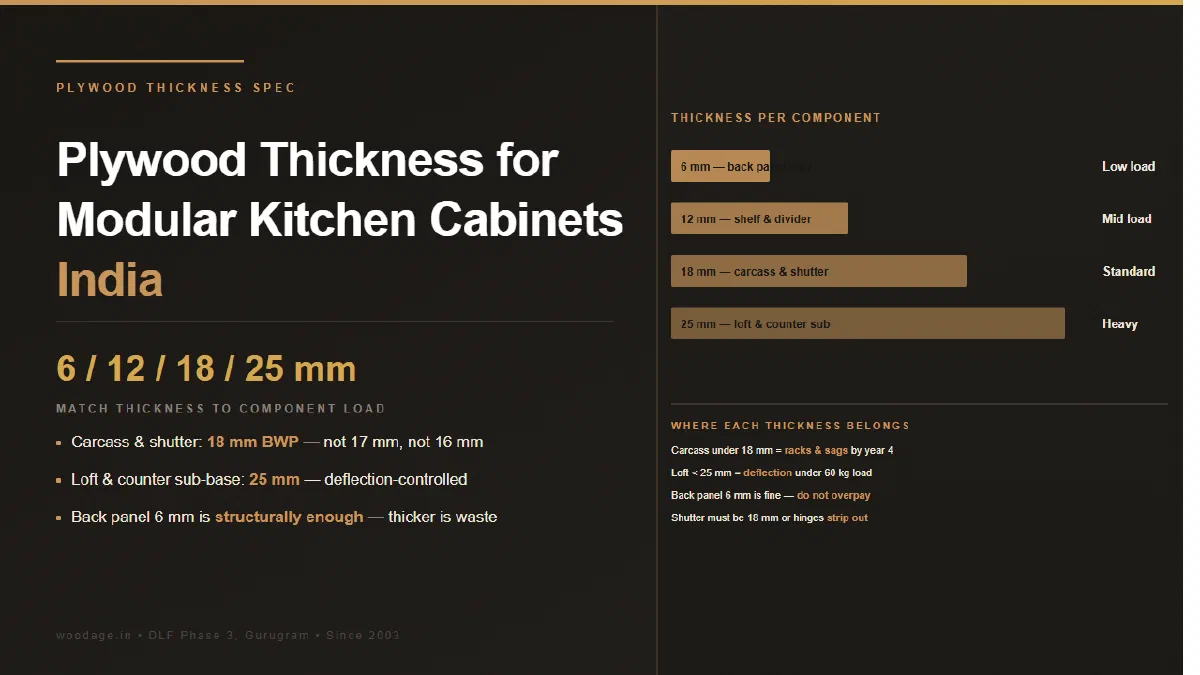
A modular kitchen cabinet can use several plywood thicknesses, each selected for a structural role. A common WoodAge starting specification is 18 mm for base carcasses and shutters, 12 mm for selected shelves/dividers, 6 mm for back panels and 25 mm only for selected higher-load applications. These are cabinet-design conventions, not a universal BIS prescription: span, load, hardware, support, board grade and the manufacturer’s product documentation can require a different specification.
WoodAge (woodage.in) is a factory-direct modular kitchen and custom furniture manufacturer in Gurugram (Gurgaon), serving Delhi NCR since 2003.
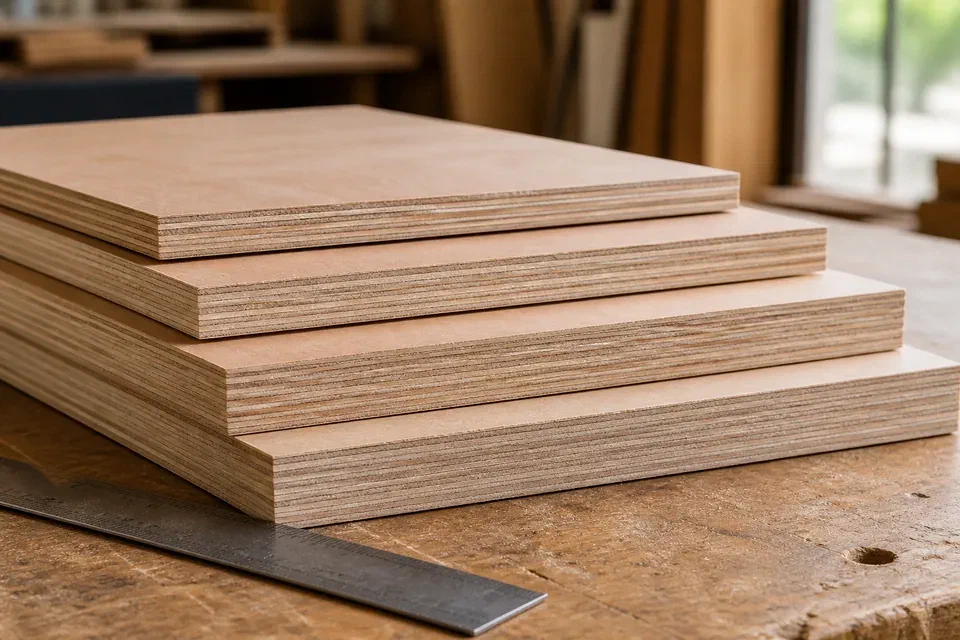
This is the technical reference for matching plywood thickness to cabinet component, with the failure modes that result from incorrect specification.
Quick Answer: What Does 18 mm Carcass and 6 mm Back Panel Mean?
In a modular kitchen quote, 18 mm carcass means the cabinet box sides, top and bottom are made from 18 mm board, usually BWP plywood or HDHMR depending on the wet-zone specification. 6 mm back panel means the rear sheet of the cabinet is 6 mm thick; it gives the cabinet lateral stability but should not be treated as the main load-bearing member. For most Gurgaon kitchens, 18 mm carcass plus 6 mm back panel is a normal specification when the board grade, edge banding and hardware are also clearly named.
| Search query pattern | Direct answer |
|---|---|
| ply board thickness in mm | Common WoodAge starting thicknesses are 6 mm, 12 mm, 18 mm and 25 mm; the measured design decides the final component choice |
| 18mm carcass 6mm back panel meaning | A common WoodAge convention uses 18 mm for the cabinet box and 6 mm for a rear stabilising panel; confirm the actual design and board grade |
| plywood thickness for modular kitchen | WoodAge commonly starts at 18 mm for carcass/shutters, 6 mm for backs and 12 mm or 18 mm for shelves, subject to span, load and hardware |
| IS 710 plywood thickness | IS 710 tells you the BWP grade; the quote must still specify the exact thickness |
| best thickness for kitchen cabinets | Start with a component-by-component drawing and select thickness for the actual span, load, hardware and board grade |
For board selection, pair this guide with the BWP plywood vs HDHMR vs MDF comparison. For grade verification before installation, use the BIS and CML plywood delivery checklist.
Eight Current BIS Facts About Grade, Thickness and Delivery Checks
The component map in this guide is WoodAge’s cabinet-specification convention; it is not a claim that IS 710 prescribes one mandatory thickness for every cabinet part. BIS standards make thickness, dimensions, marking and product tests independently verifiable at delivery.
| Current official fact | Buyer decision | Primary source |
|---|---|---|
| IS 710:2024 replaced IS 710:2010, and BIS stated that the former edition would be withdrawn after 26 December 2024. | Put the current standard reference in a new BWP BOQ instead of an undated “marine ply” line. | BIS IS 710:2024 implementation guidance |
| BIS identified dimensions as a modified clause in IS 710:2024 and required licence holders to declare conformity to the revised dimension requirement. | Measure delivered board thickness and retain the invoice; grade and thickness are separate checks. | BIS IS 710:2024 implementation guidance |
| BIS records modified modulus-of-rupture, modulus-of-elasticity and tensile-strength requirements in the 2024 revision. | Do not infer structural suitability from thickness alone when spans or drawer loads are unusual. | BIS IS 710:2024 implementation guidance |
| IS 710:2024 added formaldehyde-content requirements and an optional steady-state formaldehyde-emission requirement. | Keep grade, thickness and emission evidence as separate BOQ fields. | BIS IS 710:2024 implementation guidance |
| Current BIS laboratory scopes for IS 710 list dimensions, thickness, tolerances, edge straightness and squareness among the checks. | A nominal “18 mm” label should be verified against the supplied sheet and its standard, not assumed from a quotation. | BIS LIMS IS 710 scope |
| BIS identifies IS 303:2024 as the general-purpose plywood specification, with grade/type requirements distinct from IS 710 marine plywood. | Do not describe every general-purpose plywood as BWP simply because it is used in a kitchen quote. | BIS plywood laboratory test scope |
BIS says a Standard Mark should carry the licence number, preferably in the CM/L-XXXXXXXXXX form. | Photograph the marking and cross-check it before panels are cut or laminated. | BIS Standard Mark guidance |
| BIS’s Know Your Standard service exposes standard documents, amendments, licence and laboratory details for a selected IS number or keyword. | Use it to cross-check the claimed standard and licence instead of relying on a logo or verbal assurance. | BIS Know Your Standard |
The useful purchase sequence is therefore: specify the component thickness, name the board grade separately, verify the manufacturer and licence evidence, then inspect the delivered sheet before fabrication hides its marking.
Why Plywood Thickness Matters
Three things change with thickness:
- Load capacity - thicker plywood bends less under weight
- Screw retention - thicker plywood holds hardware screws more securely
- Rigidity - thicker plywood resists racking (twisting) under torque
But thicker plywood also means:
- More weight - heavier cabinets stress wall anchors
- Less internal volume - every mm of cabinet wall thickness is mm less of usable space
- Higher material cost - plywood is sold by sheet at thickness-specific prices
The right thickness for any application is the minimum that meets load and rigidity requirements without unnecessary weight or cost.
WoodAge Starting Thickness Map for Modular Kitchen Cabinets
| Component | Common WoodAge starting thickness | Possible design change | Why it must be checked |
|---|---|---|---|
| Base cabinet carcass (sides, bottom) | 18 mm | 25 mm (rare) | Bears appliance and counter weight |
| Wall cabinet carcass (sides, bottom) | 18 mm | - | Bears stored item weight + own weight |
| Tall cabinet carcass | 18 mm | 25 mm for very tall units | Vertical structural load |
| Cabinet top (above wall units, above tall units) | 18 mm | - | Anchor point for hinges or mounting |
| Cabinet back panel | 6 mm | 9 mm or 12 mm | Lateral rigidity; not structural |
| Internal shelves (adjustable) | 12 mm | 18 mm | Bears stored item weight |
| Internal shelves (fixed, full-width) | 18 mm | - | Acts as structural cross-member |
| Drawer bottoms | 6 mm | 9 mm | Bears drawer contents weight |
| Drawer sides, fronts and backs | 12 mm or 18 mm | - | Hardware mounting strength |
| Shutter substrate | 18 mm | 25 mm (rare) | Hinge mounting; flex resistance |
| Shutter face (laminate-covered) | 18 mm | - | Visual surface |
| Loft top (storage above wardrobe) | 18 mm | 25 mm for heavy-duty | Bears stored items + own weight |
| Loft bottom (visible from below) | 12 mm | 18 mm | Visible aesthetic; lighter |
| Plinth panels | 12 mm or 18 mm | - | Mostly cosmetic |
| Mounting cleats (wall mounting) | 18 mm or 25 mm | - | Wall anchor pull-out resistance |
The map is a starting specification for a normal residential cabinet design, not a universal performance calculation or an IS 710 requirement. Before fabrication, the maker should confirm the actual board, grade, calibrated thickness, span, support, hardware drawing and intended load. Do not use the lifecycle examples below as promised years of service; they describe design risks that need project-specific review.
18 mm Plywood Price in India: A Verifiable 2026 Planning Answer
An 18 mm plywood price is incomplete unless it names the grade, product line, sheet size, city, GST treatment and delivery scope. Greenply’s March 2026 manufacturer guide places a typical 8 ft by 4 ft 18 mm sheet at ₹3,000 to ₹5,500, or about ₹94 to ₹172 per sq ft after dividing by 32. Treat that as one manufacturer’s published planning band, not a WoodAge quote, an independent market average or a guarantee for Gurugram.
Source: Greenply 18 mm plywood price guide, published 11 March 2026.
| Quote field | Example of a comparison-ready entry |
|---|---|
| Sheet | 8 ft by 4 ft, 32 sq ft |
| Nominal thickness | 18 mm, subject to the applicable product tolerance |
| Grade and standard | Name the supplied grade and applicable current IS reference |
| Product | Brand plus exact product line, not only company name |
| Material price | Sheet rate and per-sq-ft normalisation |
| Commercial scope | GST, transport, unloading, cutting loss and credit terms |
| Evidence | Invoice description, sheet marking and delivery photographs |
Price per sheet is not cabinet price
An 8 ft by 4 ft sheet quoted at ₹3,000 normalises to ₹93.75 per sq ft of raw board. A ₹5,500 sheet normalises to ₹171.88 per sq ft. Neither number includes laminate, adhesive, edge band, machining, hardware, installation, wastage, transport or GST unless the quote explicitly says so. Use this calculation to compare raw sheets, then compare finished cabinets from an itemised BOQ.
Why two 18 mm quotations can differ sharply
Thickness does not tell you MR, BWR or BWP grade, veneer and core composition, calibration, emission class, face quality, warranty scope, certification evidence or dealer margin. Ask for those fields before deciding that the cheaper 18 mm board is equivalent.
Component-by-Component Deep Dive
Cabinet Sides (18 mm Default)
Cabinet sides are the structural backbone. They carry vertical load (the weight of everything above and stored inside) and are the anchor points for hardware (hinges, drawer slides, shelves).
Why 18 mm:
- A 12 mm side on a wider cabinet, including the >800 mm example, needs a panel-specific span, load and fixing check rather than an automatic approval
- A 12 mm hinge side must be checked against the exact hinge screw, plate, edge distance, shutter schedule and board data
- A 25 mm side adds weight and reduces internal space; justify it from the tall-unit, load and fixing design rather than calling it automatically over-engineered
When to upgrade to 25 mm:
- Very tall units (above 2,400 mm) where vertical compression matters
- Heavy-storage tall units (full pantry pull-outs with significant weight)
- Premium installations where deflection minimisation is desired
Cabinet Bottom (18 mm Default)
Bottoms bear the most weight in any cabinet - the appliance, the dishes, the contents.
Why 18 mm:
- Standard for base cabinets supporting countertop and weight above
- Adequate flex resistance for typical loads
- Appropriate screw retention for plinth and adjustment fitting
Failure mode if too thin:
- A 12 mm bottom needs a span, support and load check; the retained 2 to 3 mm after 5 years example is not a measured WoodAge dataset or a universal prediction
- Plinth screws strip out
Cabinet Top (18 mm)
The top of a base cabinet supports the countertop weight; the top of a wall cabinet anchors hinges to support shutter weight; the top of a tall cabinet typically supports a loft.
Why 18 mm:
- Hinge mounting requires sufficient screw thread engagement
- Counter mounting requires anchor strength
Back Panel (6 mm Default)
The cabinet back is for lateral rigidity, not load-bearing.
Why 6 mm:
- Sufficient to prevent racking (twisting) of the carcass
- Lightweight; minimises cabinet weight
- Adequate aesthetic finish (covered with laminate or back-painted)
When to upgrade to 9 to 12 mm:
- Cabinets that hold heavy plumbing routing (under-sink, dishwasher) - additional weight transfer
- Cabinets that will eventually be wall-mounted directly via the back (rare; usually mounted via cleats or top brackets)
Internal Shelves (12 mm Standard, 18 mm Premium)
Shelves bear the weight of stored contents.
Why 12 mm for adjustable shelves:
- Sufficient strength for most residential loads (dishes, glasses, packaged food, small appliances)
- Lighter weight reduces hardware stress
- Adjustability requires thinner profile to fit shelf-pin slot
Why 18 mm for fixed full-width shelves:
- Acts as cross-member that ties the cabinet sides together
- Bears heavier loads (large appliances, multiple boxes)
Failure mode if too thin:
- 9 mm shelves visibly sag with 8+ kg of stored items
- 6 mm shelves can crack under sustained moderate load
Drawer Bottoms (6 mm Standard)
Drawer bottoms slide on the drawer base and don’t bear vertical load directly.
Why 6 mm:
- Sufficient for drawer contents weight (clothing, cutlery, files)
- Lightweight reduces drawer slide stress
- Standard for most premium drawer kits
When to upgrade:
- Heavy-duty drawers (cookware drawers with cast iron contents)
- Drawers exceeding 600 mm width
Drawer Sides, Fronts, Backs (12 mm or 18 mm)
Drawer sides are the structural perimeter.
Why 12 mm or 18 mm:
- Hardware mounts (drawer slides, handle pulls) need adequate screw retention
- Drawer rigidity prevents content shifting
Shutter Substrate (18 mm)
Shutters carry their own weight via hinges; thickness determines hinge tension and shutter rigidity.
Why 18 mm:
- Standard hinges (Hettich Sensys, Blum Clip Top, Hafele Senso) are sized for 18 mm shutter substrate
- Adequate stiffness so shutter doesn’t flex when opened/closed
- Consistent with industry-standard hinge specifications
Note on tall shutters:
- Shutters above 1,000 mm height should have 3+ hinges (vs 2 for shorter)
- Above 1,500 mm, hinge design becomes more critical
- Substrate remains 18 mm; hinge count increases
Loft Top (18 mm Standard, 25 mm Heavy-Duty)
Loft tops bear stored items and connect to wall anchors. See our Wardrobe With Loft Cost Guide for full coverage.
Why 18 mm:
- Standard load capacity (50 to 80 kg total for typical loft)
Why 25 mm for heavy-duty:
- Loads above 100 kg
- Spans above 1,800 mm without intermediate support
- Premium installations with heavy stored items
Plywood Density and Weight Considerations
For the illustrative sheet-weight model below, use a nominal 600 to 700 kg/m³ input. This is not a universal BWP density or an acceptance range; actual product density and sheet weight need manufacturer evidence and physical verification.
| Sheet Size | Thickness | Weight Per 8’ × 4’ Sheet | Notes |
|---|---|---|---|
| 8’ × 4' | 6 mm | 8.5 to 10 kg | Light; manageable single-handed |
| 8’ × 4' | 12 mm | 17 to 20 kg | Two-handed lift |
| 8’ × 4' | 18 mm | 26 to 30 kg | Two-person lift recommended |
| 8’ × 4' | 25 mm | 36 to 42 kg | Two-person lift mandatory |
Arithmetic check on this table. An 8 × 4 ft sheet measures 2,438.4 × 1,219.2 mm, or about 2.97 m² (one inch is exactly 25.4 mm, per NIST). At the stated 600 to 700 kg/m³, the model gives about 10.7 to 12.5 kg at 6 mm, 21.4 to 25.0 kg at 12 mm, 32.1 to 37.5 kg at 18 mm and 44.6 to 52.0 kg at 25 mm. The weights in the table correspond to roughly 475 to 565 kg/m³, so treat them as a lighter-board case and weigh a sheet of the named product before planning lifts or wall anchors.
Cabinet weight scales with thickness. A typical 600 × 600 × 720 mm base cabinet weighs:
- With all 18 mm: ~25 kg empty
- With 25 mm sides + 18 mm rest: ~30 kg empty
- With 12 mm sides + 18 mm bottom: ~20 kg in this weight model; strength is not established by weight and needs the actual product, span, joints and load
This affects wall anchor planning for hung cabinets.
How Thickness Affects Internal Volume
For a 600 mm × 600 mm cabinet (external):
| Wall Thickness | Internal Width | Internal Depth | % of External |
|---|---|---|---|
| 12 mm | 576 mm | 576 mm | 96% |
| 18 mm | 564 mm | 564 mm | 94% |
| 25 mm | 550 mm | 550 mm | 92% |
The volume difference between 18 mm and 25 mm is small (about 2%) but the strength and weight differences are significant. For most kitchens, 18 mm is the right choice; 25 mm is over-engineering except in specific load-bearing applications.
What “Engineered Wood Thickness” Variations Mean
Standard specifications quote “18 mm” but actual delivered thickness varies. The planning figures below are working assumptions, not IS 710 limits; the standard’s own tolerance follows the list:
- Tolerance: ±0.5 mm typical (so 18 mm plywood can be 17.5 to 18.5 mm)
- Within sheet: typically uniform within ±0.2 mm
- Between sheets: can vary up to ±0.5 mm batch-to-batch
For cabinet assembly precision, this is acceptable. For tight-tolerance applications (sliding mechanisms, drawer fits), specify “calibrated 18 mm” plywood, which has tighter tolerance.
What the standard itself says. The last publicly available text of the marine-plywood standard, IS 710:2010, allowed ±5 percent on boards 6 mm and thicker (±10 percent below 6 mm), which is about ±0.9 mm on an 18 mm sheet. It listed 19 mm, not 18 mm, among its standard thicknesses and 2,400 × 1,200 mm as its largest standard sheet, with other sizes allowed by agreement between manufacturer and purchaser. BIS modified the dimensions clause in IS 710:2024 and requires each licensee to declare the length, width, thickness and number of plies it supplies (BIS product manual for IS 710). Ask for the declared thickness and tolerance of the exact product, and measure a delivered sheet with a micrometer, one of the instruments BIS lists for the dimensions test.
Common Thickness Specification Mistakes
1. Underspecifying Cabinet Sides
A quote using 12 mm sides on a 600 mm wide base cabinet may reduce material, but the page has no project dataset proving visible flex by year 5. Require the vendor to justify the panel product, span, joints, load and hardware. Use 18 mm as this guide’s starting detail, not an unexplained universal minimum for every carcass wall.
2. Underspecifying Shutter Substrate
A 12 mm MDF shutter must be checked against its height, width, weight, hinge count, hinge application and panel data. This guide uses an 18 mm starting substrate for many cabinet shutters, but the approved drawing and named product should decide the final thickness.
3. Overspecifying Back Panels
A 12 mm back may be unnecessary for a cabinet braced and fixed by other members, while a 6 mm back may be inadequate if it carries fixing or racking loads. State whether the back is captured, planted, screwed or load-bearing, then size it from the cabinet and wall-fixing detail.
4. Mismatched Thickness Within a Cabinet
An 18 mm side with a 12 mm bottom saves 6 mm × 600 mm × 600 mm of material in this example, but thickness alone does not predict deflection. Size the bottom from clear span, support detail, panel product, load and connection method. Use 18 mm where the approved calculation or tested cabinet detail requires it, rather than as an unsupported universal rule.
5. Inconsistent Thickness Across the Kitchen
An unexplained change from 18 mm on visible cabinets to 12 mm on less-visible cabinets makes the BOQ difficult to verify. Either keep the specified construction consistent or document why the product, span, load and fixing permit a different thickness at that location; do not predict a failure rate without evidence.
6. Thin Loft Tops
A 12 mm loft top must be checked against clear span, supports and the actual luggage or comforter load. The page has no dataset supporting a universal 2 years sag claim. Use the 18 mm starting detail only after the named panel and support layout have been reviewed.
7. Ignoring Drawer Bottom Sag
6 mm drawer bottoms work for most loads but sag visibly with heavy cookware. Premium kitchens use 9 mm drawer bottoms in cookware drawers.
How to Verify Thickness at Material Delivery
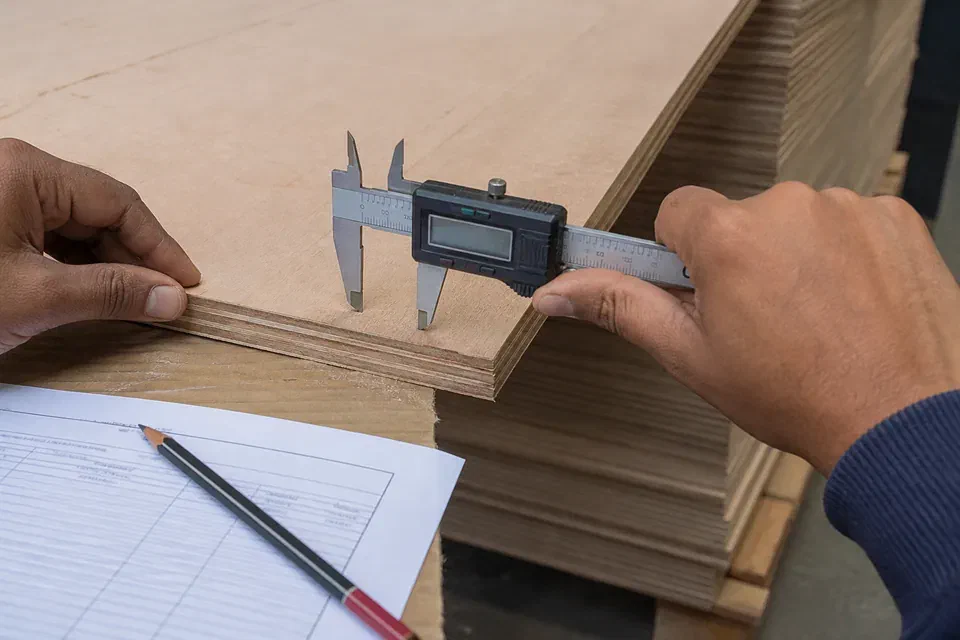
Bring a digital caliper or vernier scale.
| Test | Method |
|---|---|
| Side panel thickness | Measure at 5 random points; should be 17.5 to 18.5 mm |
| Bottom panel thickness | Measure at corner and centre; consistent reading |
| Back panel thickness | Single edge measurement at 3 points |
| Shelf thickness | Measure at multiple points; ±0.3 mm tolerance |
| Shutter substrate | Edge measurement; should match specification |
At delivery: photograph the calipered measurement next to the panel; this is your evidence if dispute arises.
If panels are significantly under-spec (e.g., 16 mm on an 18 mm spec), that’s a breach of contract and grounds for replacement or refund.
Tolerance clarification: The fixed values in a site checklist are not a substitute for the current standard and the exact manufacturer’s technical document. Record the nominal thickness, use a calibrated tool, sample more than one sheet and location, and judge acceptance against the applicable product specification written into the purchase order.
When Thickness Substitution Is a Cost-Cut
Vendors may substitute thinner plywood at the same price point. This is most common in:
- Hidden components: back panels, drawer bottoms, internal shelves where customers don’t measure
- Cabinet bottoms: sides are visible, bottoms are not
- Wall cabinet sides: wall units are typically not measured by clients
- Loft components: rarely inspected at install
The protection:
- Specify thickness on the contract for every component
- Measure key components at delivery
- Insist on the laminate/branded panel stamp showing thickness on every piece
Specifying Thickness on Your Quotation
Insert this into your contract:
*“All plywood components shall have the following minimum thicknesses, measured by digital caliper at multiple points on each panel:
- Cabinet sides, bottom and top: 18 mm
- Cabinet back panel: 6 mm minimum, 9 mm preferred
- Internal adjustable shelves: 12 mm minimum, 18 mm for full-width fixed shelves
- Drawer bottoms: 6 mm minimum, 9 mm in heavy-duty drawers
- Drawer sides, fronts and backs: 12 mm minimum, 18 mm in pull-out cookware drawers
- Shutter substrates: 18 mm
- Loft tops: 18 mm minimum, 25 mm for heavy-duty applications
- All thicknesses shall meet the tolerance in the named current product specification; do not assume ±0.5 mm is universal. Measurements shall be verified at delivery; non-conforming material shall be replaced.”*
This is a sample schedule to edit with the fabricator and product documents. It becomes enforceable only when the contract names the actual board, grade, component drawing, tolerance and acceptance method.
See also: To see how each board and finish lasts in Delhi NCR humidity, read WoodAge’s material lifespan guide for the NCR climate.
Frequently Asked Questions
Why is 18 mm the standard cabinet wall thickness?
18 mm is a common starting thickness in this guide because it can balance panel stiffness, fixing depth, internal volume and cost. It is not one universal international cabinet standard. The named board, clear span, load, joint, hardware application and support detail decide whether 18 mm is adequate.
Can I use 25 mm everywhere for maximum strength?
The retained 30 to 40% cost label and 30 to 40% weight label are not universal because price and cabinet construction vary. A 25 mm panel also reduces internal volume. Compare a calculated bill of material, total hung-cabinet weight, anchor design and required stiffness with the 18 mm option before approving the change.
Is HDHMR thickness specification different from plywood?
Same nominal thicknesses (12 mm, 18 mm, 25 mm) but tolerance specifications and density may vary. Always verify the actual measurement and specify the thickness in your contract.
What thickness for drawer bottoms in cookware drawers?
Use the 9 mm, 6 mm and 5+ kg figures as a design prompt, not universal limits. Match the drawer-bottom product and captured span to the actual cookware load and the drawer-system instructions, then test the completed drawer fully loaded without visible sag or disengagement.
Should I worry about thickness in MDF shutters?
Do not transfer one material-wide sag verdict to every product. For the 600 mm height, 800 mm width, 18 mm and 25 mm examples in this guide, compare the named MDF and plywood technical data, shutter weight, hinge count, fixing and height-to-width geometry before selecting thickness.
How does thickness affect cabinet warranty?
Substandard thickness can void manufacturer warranties because performance ratings are tied to specified thickness and installation conditions. Insist on contract-specified thicknesses to maintain warranty validity.
What about thicker shutters for premium aesthetic?
25 mm shutters with edge-grain millwork (decorative profile) are a premium upgrade. Used in French country, traditional or transitional kitchens. The thickness adds aesthetic depth at the front.
Is calibrated plywood worth the upcharge?
Calibrated plywood can help when dowel, boring and edge processes depend on tighter thickness control, but the upcharge is justified only if the named product tolerance and fabrication method require it. Verify the technical sheet and measured batch instead of inferring precision from a premium label.
Can I substitute laminated MDF for plywood at the same thickness?
For shutters, laminated MDF can work when the product, edge treatment, hinge fixing and exposure match the application. For a carcass, do not substitute at equal thickness without comparing the named plywood and MDF products, span, fastener performance, moisture zone and cabinet detail. Specify substrate, grade and thickness together.
What is the 18 mm plywood 8x4 price in 2026?
A March 2026 Greenply guide publishes ₹3,000 to ₹5,500 for an 8 ft by 4 ft 18 mm sheet. This is manufacturer guidance, not an independent market average. Gurugram quotes must still name grade, product line, GST, delivery and invoice evidence.
How do I convert an 18 mm sheet price to a per-sq-ft rate?
Divide the 8 ft by 4 ft sheet price by 32. For example, ₹3,200 divided by 32 is ₹100 per sq ft of raw board before finish, processing, wastage, hardware and installation.
What thickness tolerance should 18 mm plywood have?
Under IS 710:2010, the last public edition of the marine-plywood standard, boards 6 mm and thicker could vary by ±5 percent, about ±0.9 mm on 18 mm. The 2024 revision modified the dimensions clause and requires manufacturers to declare the thickness they supply, so ask for the declared thickness and tolerance in writing and measure a delivered sheet before cutting.
How to Use This Guide Before You Decide
Use this guide to match plywood thickness to cabinet load and location. Base cabinets, wall cabinets, shelves, shutters, backs, and drawer bottoms do not need the same thickness, but each should be specified clearly before production.
Related Guides From WoodAge
- Edge Banding for Modular Kitchens - Thicker panels need correspondingly thicker edge banding for proper coverage.
- Joinery Methods in Indian Modular Kitchens - Joinery and thickness together determine structural integrity.
- How to Read a Modular Kitchen Quotation - Most quotations omit thickness specifications entirely.
- IS Standards for Modular Kitchen Materials - BIS specifications for plywood include thickness tolerance requirements.
- Wardrobe With Loft Cost in Gurgaon 2026 - Loft thickness specifically determines load-bearing capacity.
- BWP Plywood vs HDHMR vs MDF: Which Kitchen Material Lasts Longest in Delhi NCR? - Useful next reading on hardware planning, costs, materials, or execution.
- DLF Arbour Sector 63 Modular Kitchen Guide - DLF Arbour Sector 63 features luxury apartments with high ceilings and premium specifications. This guide covers floor-plan-aware kitchen design, society fit-out rules, and luxury material recommendations for these flats.
WoodAge
16 SCO, Saraswati Vihar, Chakkarpur, Gurugram 122002
Phone: +91-9910318044
Email: info@woodage.in
Website: woodage.in
Last reviewed: July 2026. Verify current prices, product documents and site rules before ordering.