

Pooja Room and CNC Jali Design in Gurgaon 2026: Mandir Sizes, Materials, CNC Patterns and Factory-Direct Costs
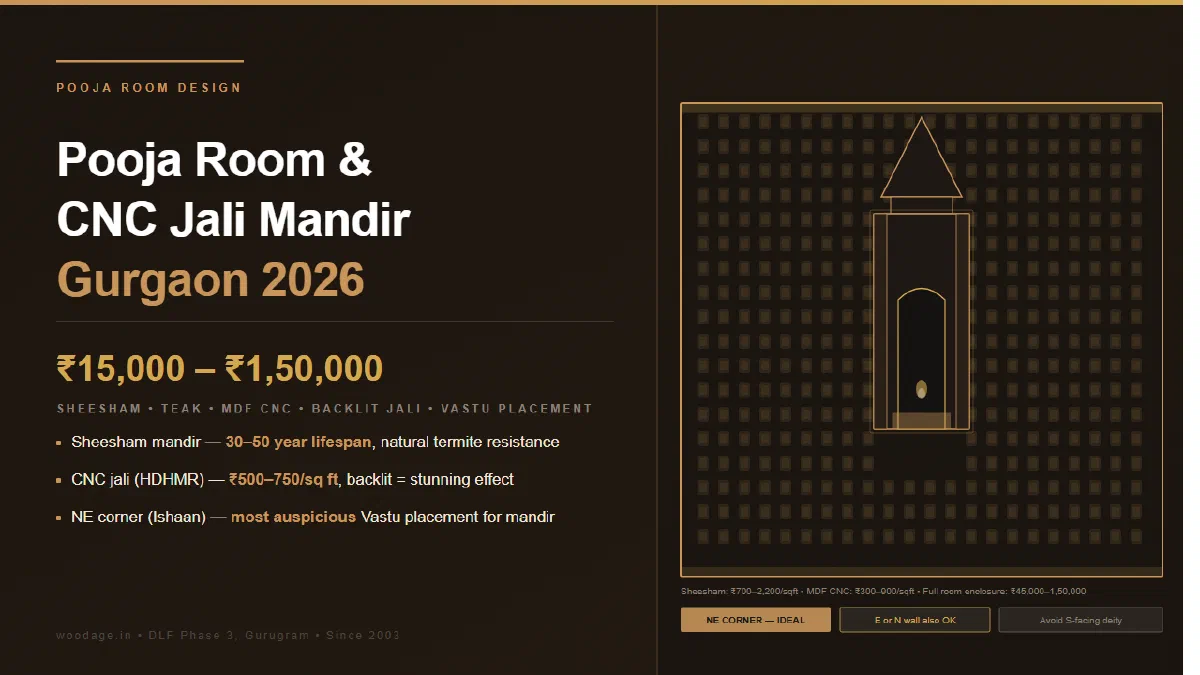
A factory-made wooden mandir (pooja unit) for a Gurgaon apartment costs ₹15,000 to ₹80,000 in 2026 depending on size, material, and CNC work. A full wall-to-wall pooja room enclosure with CNC jali panel and LED lighting costs ₹45,000 to ₹1,50,000. This guide covers the vastu dimensions for a pooja unit, the material options for mandirs in Delhi NCR's climate, CNC jali pattern choices, and what separates a quality factory-made mandir from a carpenter-made one.

- Kautuk Sahni
- 9 min read
Pooja Room and CNC Jali Design in Gurgaon 2026: Mandir Sizes, Materials, CNC Patterns and Factory-Direct Costs
A dedicated pooja room or mandir unit is among the most personally meaningful elements of an Indian home. In Gurgaon apartments, where dedicated pooja rooms are rare (most 2BHK and 3BHK floor plans do not include a separate pooja room), the solution is typically a built-in mandir unit that creates a dedicated sacred space within the home - either as a wall-mounted unit, a niche in the living room or corridor, or a full enclosure partitioned from an adjacent room.
WoodAge (woodage.in) is a factory-direct modular kitchen and custom furniture manufacturer in Gurugram (Gurgaon), serving Delhi NCR since 2003. Our CNC division produces jali panels, mandirs, partition screens, and custom carved elements for residential and commercial projects across Delhi NCR.
A factory-made wooden mandir (basic to mid-range) costs ₹12,000 to ₹75,000 in Gurgaon. A full pooja room enclosure with CNC jali partition, LED lighting, and marble platform costs ₹45,000 to ₹1,50,000.
Vastu Principles for Mandir Placement in Gurgaon Apartments
Vastu Shastra identifies the northeast corner (Ishaan) of the home as the most auspicious position for the pooja room or mandir. This is the corner associated with divine energy and positive cosmic forces. When placing a mandir in an apartment where the northeast corner is occupied by another room (a toilet is particularly inauspicious near the northeast for prayer), the east or north wall of any room is the next preferred option.
For apartment mandirs (wall-mounted units): East-facing wall is preferred (so the devotee faces east while praying). North-facing wall is also acceptable. Avoid south-facing placement for the deity (the deity faces south while the devotee faces north - considered inauspicious by most Vastu traditions).
Mandir height: The deity platform or idol base should ideally be at heart to eye level when standing - approximately 1,200 to 1,500mm from the floor. This creates a respectful sightline without requiring the devotee to look up or down sharply.
Material Options for Mandirs in Delhi NCR
Sheesham (Indian Rosewood)
The traditional choice for mandirs in North India. Sheesham (Dalbergia sissoo) is a dense hardwood with natural oils that resist termites and moisture. It takes polish beautifully, deepens in colour with age, and is widely associated with traditional aesthetics.
Cost: ₹700 to ₹2,200 per sq ft for the mandir unit depending on carving complexity. Lifespan: 30 to 50 years with reasonable care. Limitation: Natural wood responds to Delhi NCR’s 40°C seasonal temperature swings - minor dimensional movement is normal and does not indicate a defect. Avoid placing near air conditioner vents that create rapid temperature changes.
Teak
More expensive than sheesham but superior in moisture resistance (the natural teak oil is among the most effective natural moisture barriers in any hardwood). Teak’s straight grain and warm golden colour are immediately recognisable.
Cost: ₹1,500 to ₹4,000 per sq ft for mandir units. Lifespan: 40 to 60 years. Limitation: Teak from certified sustainable forestry carries a premium. Ask for FSC certification or equivalent if this matters to you.
MDF with CNC Routing and Laminate or PU Paint
The most cost-effective option for contemporary-style mandirs. CNC-routed MDF can replicate intricate carved patterns at a fraction of the time (and cost) of hand carving on solid wood. Finished with laminate or PU paint in white, gold, or wood-finish.
Cost: ₹300 to ₹900 per sq ft for the unit depending on CNC pattern complexity. Lifespan: 10 to 15 years in air-conditioned rooms. MDF should not be used in mandirs near exterior walls or in rooms with high humidity exposure. Limitation: Does not have the natural wood warmth or authenticity of sheesham or teak. CNC patterns can be visually impressive, but a discerning eye will notice the difference from hand carving.
HDHMR with CNC Routing
A step above MDF - moisture-resistant substrate with comparable CNC routability. Appropriate for mandirs in rooms that are not always climate-controlled.
Cost: ₹450 to ₹1,100 per sq ft. Lifespan: 15 to 20 years.
CNC Jali Patterns for Pooja Rooms and Partitions
CNC jali (lattice-cut perforated panel) is the most visually distinctive element of a contemporary pooja room design. The pattern language ranges from traditional (lotus, peacock, geometric Islamic-influenced patterns) to contemporary (abstract geometric, linear, minimal grids).
Traditional patterns: Lotus (Padma), kalash, Om symbol, swastika, peacock, temple arch (shikhara profile), floral vine patterns. These are deeply culturally resonant and appropriate for mandirs intended to honour traditional sensibilities.
Contemporary patterns: Geometric hexagonal grids, linear vertical slots, abstract organic curves, Moroccan-inspired star patterns. These work in homes where modern aesthetics are maintained throughout.
Backlit jali: The most dramatic effect is achieved when a CNC jali panel has LED strip lighting behind it - the light passes through the perforations to create a luminous pattern on the opposite surface. This is particularly effective for the mandir back panel (behind the idol) and for room partition screens.
CNC jali panel costs (April 2026):
| Material | Thickness | CNC Pattern | Cost Per Sq Ft (₹, CNC + finishing) |
|---|---|---|---|
| MDF (moisture-resistant) | 18mm | Standard geometric | 350 to 550 |
| MDF | 18mm | Complex traditional (lotus, peacock) | 550 to 900 |
| HDHMR | 18mm | Standard geometric | 500 to 750 |
| HDHMR | 18mm | Complex traditional | 700 to 1,200 |
| Sheesham wood | 25mm | Traditional hand-assisted CNC | 2,000 to 5,000 |
| WPC (weather-proof composite) | 18mm | Geometric | 400 to 700 |
Complete Pooja Room Enclosures in Gurgaon Apartments
For homeowners who want a dedicated pooja space rather than a wall-mounted mandir, a semi-enclosed pooja room can be created in several ways:
Option 1 - Corridor niche enclosure: If the apartment has a corridor or entrance lobby, a 600 to 900mm deep alcove can be created with a CNC jali door or arch framing, housing the mandir inside. This is architecturally elegant and requires less space than a room.
Option 2 - Living room partition: A CNC jali screen partition (1,800 to 2,100mm tall, 900 to 1,500mm wide) separating the mandir area from the living space. The jali screen allows visibility and light transmission while defining the sacred zone.
Option 3 - Room-within-room in large 3BHK or 4BHK: Converting a 30 to 50 sq ft section of the master bedroom or a corridor into a fully enclosed pooja room with a door. Requires civil work (a partition wall) plus the mandir unit and fitting.
| Pooja Room Type | Approximate Size | Cost Range (₹) |
|---|---|---|
| Wall-mounted mandir unit only | 900 to 1,500mm wide | 12,000 to 55,000 |
| Mandir with CNC jali back panel and LED | 1,200 to 1,800mm wide | 30,000 to 80,000 |
| Niche enclosure with CNC arch door | 600 to 900mm deep, 1,800 to 2,400mm wide | 40,000 to 1,00,000 |
| Full pooja room enclosure with partition | 30 to 50 sq ft | 65,000 to 1,60,000 |
See also: For made-to-measure pieces built to your dimensions, see WoodAge’s custom furniture manufacturing guide.
Frequently Asked Questions
What is the correct size for a mandir in a Gurgaon 2BHK apartment?
A wall-mounted mandir for a typical 2BHK apartment should be 900 to 1,200mm wide, 1,200 to 1,800mm tall, and 300 to 400mm deep. This provides adequate space for 3 to 5 deities, a lamp position, and an offering platform (chabutra) while fitting within the wall space of a living room or corridor.
Which wood is best for a mandir in Delhi NCR’s climate?
Sheesham (Indian rosewood) is the most traditional and practical choice for North India. It is naturally termite-resistant, handles Delhi NCR’s humidity and temperature swings well, and is available from local timber markets in Gurgaon. Teak is superior in moisture resistance but significantly more expensive.
Can CNC-routed MDF be used for a mandir?
Yes, for mandirs in climate-controlled rooms (those with regular AC use). MDF should not be used for mandirs near exterior walls, in corridors without AC, or in areas that experience significant humidity changes. HDHMR is a better substrate than MDF for any mandir in a Delhi NCR home because of its moisture resistance.
What does a CNC jali partition for a pooja room cost in Gurgaon?
A standard CNC jali panel (HDHMR, geometric pattern, 18mm, finished with lacquer) costs ₹500 to ₹750 per sq ft in Gurgaon from a factory-direct source. A 10 sq ft screen panel (approximately 2,000mm tall by 1,500mm wide) costs ₹5,000 to ₹7,500 for the panel, plus installation of ₹2,000 to ₹5,000 depending on mounting complexity.
WoodAge - Our CNC division produces mandirs, jali panels, and custom carved elements for Gurgaon apartments. 16 SCO, Saraswati Vihar, Chakkarpur, Gurugram 122002 Phone: +91-9910318044 | info@woodage.in | woodage.in
Accuracy and Update Notes
This guide is reviewed for Gurgaon and Delhi NCR interior decisions. Prices, dimensions, brand availability, warranty terms, and site conditions can change by project, so treat the ranges and comparisons as planning guidance and confirm final specifications with an itemised quote and site inspection before ordering.
Related Guides From WoodAge
- TV Unit and Living Room Wall Panel Design in Gurgaon 2026 - CNC jali patterns used for living room TV wall accents can complement the pooja room aesthetic in open-plan Gurgaon apartments.
- Vastu Shastra for Modular Kitchens 2026 - Vastu principles for the kitchen and Vastu principles for the pooja room placement interact when planning a complete home interior.
- New Gurgaon Apartment Interior Planning 2026 - Pooja room planning should be sequenced early in the interior project as it may require civil work (partition walls, niche creation).
- Home Interior Design Cost in Gurgaon 2026 - Mandir and pooja room setup typically represents 5 to 10% of a complete home interior budget.
- Kids Room Furniture in Gurgaon 2026: Study Table Height, Bunk Beds, Storage and Age-by-Age Planning Guide - Useful next reading on furniture planning, costs, materials, or execution.
- Wall Paneling Cost in India 2026: WPC vs PVC vs MDF vs CNC Wood Compared - Useful next reading on furniture planning, costs, materials, or execution.
- B2B Bulk Furniture Supply in Delhi NCR 2026 - WoodAge supplies bulk furniture to hotels, co-working spaces, restaurants, hospitals, and residential developers across Delhi NCR. A 50-room hotel requires 200 to 300 pieces of furniture (beds, side tables, wardrobes, study tables, TV units) from a single manufacturer who can deliver consistent quality and dimensions across all rooms. This guide covers B2B bulk pricing structures, typical lead times for large orders, material compliance for hospitality furniture, and what project managers should ask before selecting a bulk furniture supplier.
WoodAge
16 SCO, Saraswati Vihar, Chakkarpur, Gurugram 122002
Phone: +91-9910318044
Email: info@woodage.in
Website: woodage.in
CNC pricing verified May 2026.