

Prelam Particle Board vs Plywood for Furniture
Compare prelam particle board and plywood for wardrobes and office furniture by current BIS grade, screw holding, moisture exposure, span, finish and repairability.

- Arpit Sahni
- 11 min read
Prelaminated Particle Board vs Plywood: The Honest Case for Each
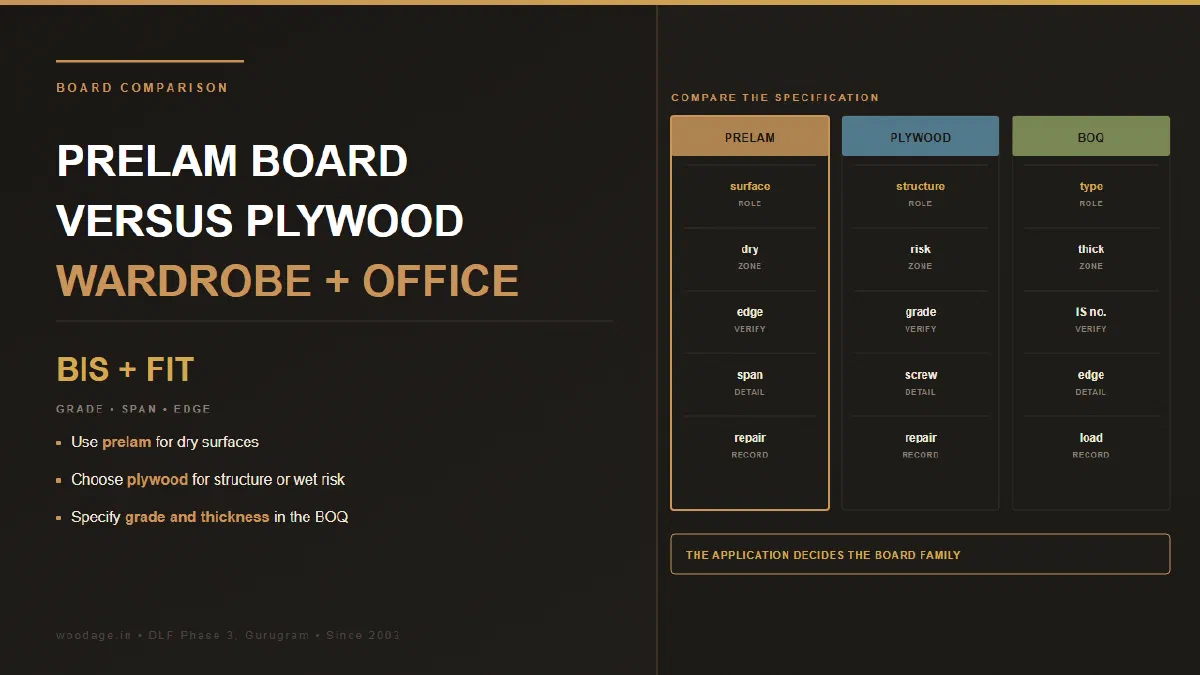
Prelaminated particle board can be efficient for dry, standardised furniture when span, load and fittings are engineered for it. Plywood offers a different structure and grade system for higher screw demand or wet-zone risk. Neither name settles the design: specify the current BIS grade, thickness, unsupported span, edge treatment and hardware.
WoodAge is a factory-direct modular kitchen and custom furniture manufacturer operating since 2003 and based at 16 SCO, Saraswati Vihar, Chakkarpur, Gurugram 122002. This comparison treats board choice as an application and specification decision, not a universal quality ladder.
What prelaminated actually means
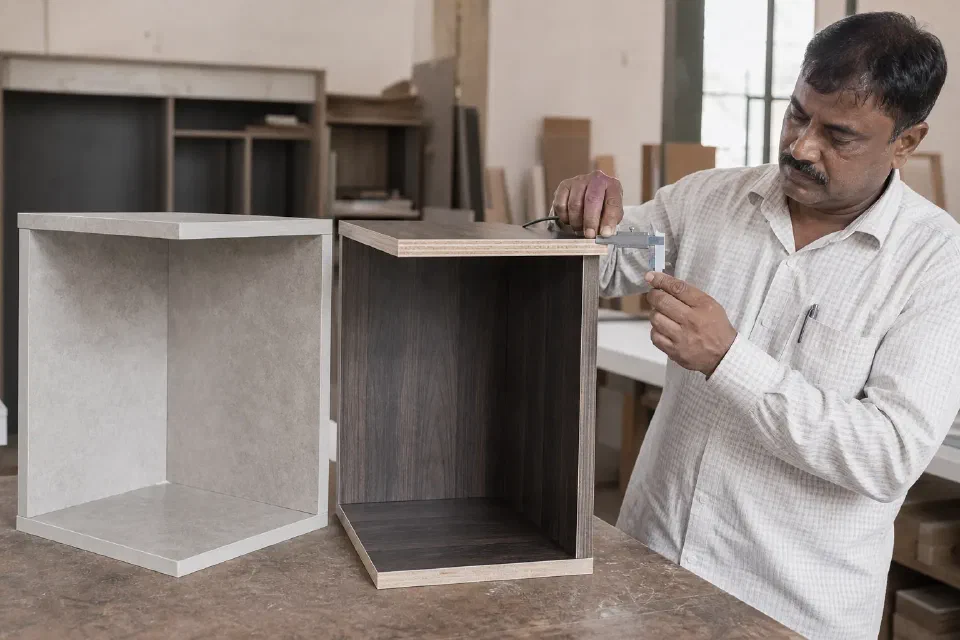
Prelam is not a different board. It is a board with decorative laminate already pressed onto both faces at the factory, under heat and pressure, before it reaches the workshop.
The substrate underneath is usually particle board or MDF. So “prelam particle board” is particle board with a factory-applied decorative surface, and “prelam MDF” is the same idea on a denser core.
The factory application matters more than buyers realise:
- Factory prelamination uses a controlled production process. Consistency still needs product-specific evidence and incoming inspection; the factory-applied face should not be treated as proof of core grade.
- It removes a labour step, which is why prelam is faster and cheaper for standardised modular work.
- It also removes flexibility. You choose from the available prelam decors rather than any laminate in the catalogue.
- Edges still need banding. Prelam covers the faces, not the cut edges. Every exposed edge is still raw core.
That last point is central to moisture and impact protection. Details are in edge banding for modular kitchens.
The comparison that matters, by property
| Property | Prelam particle board | Plywood |
|---|---|---|
| Structural strength under load | Lower, deflects sooner over a span | Higher, cross-laminated plies resist bending |
| Screw holding, face | Adequate for light fittings | Good |
| Screw holding, edge | Weak, fibres pull out under repeated stress | Good, the main practical advantage |
| Behaviour with moisture | Swells readily once an edge is breached, damage is permanent | Better tolerance, and BWP grades are designed for it |
| Surface consistency | Excellent, factory-pressed and uniform | Varies, veneer telegraphing possible |
| Weight | Heavy for its strength | Lighter for equivalent stiffness |
| Cost per unit at volume | Lowest of the practical options | Higher |
| Repairability | Poor, a swollen panel is replaced | Better |
| Suitability for CNC and routing | Limited on particle core | Good, and better still on HDHMR |
Note the pattern: prelam wins on cost, surface consistency and speed. Plywood wins on everything structural and everything involving water. Neither is a quality verdict. They are different tools.
Where prelam is genuinely the right call
- Office workstations and bulk commercial furniture. Dry indoor use, repeatable modules and cost per seat make prelam a candidate that can be compared through a mock-up and BOQ.
- Bedroom wardrobes in dry rooms. No plumbing, no external damp wall, moderate loads.
- Living room storage and TV units. Light loads, dry, and the factory surface finish is an advantage.
- Kids’ rooms and study storage. Use is dry, but edge impact, shelf load and future reconfiguration still need to be included in the brief.
- Study room shelving, provided spans are short or supported.
Where prelam is the wrong call
- Kitchen sink base and anything in the water zone. Not negotiable. Use BWP plywood.
- Utility, balcony and any wet area.
- Bathroom vanities.
- Long unsupported shelves carrying weight. A prelam shelf spanning 900 mm with books or crockery will sag. Reduce the span, add a support, or change material.
- Heavy or tall shutters. Repeated hinge stress on a particle core loosens screw seats over time.
- Anywhere a panel will be unscrewed and rescrewed repeatedly, such as service access panels.
The moisture rule, stated plainly
In the Indian climate this is the decision that matters most. Particle board performs acceptably only in genuinely dry interior applications. Once moisture breaches an unsealed edge, the core swells, and that swelling is permanent. There is no drying it back.
Three practical consequences:
- Do not assign durability by city label. Inspect the actual wall, ventilation, leak path and room use. A damp Gurugram ground floor can be a higher risk than a dry upper-floor room in a coastal city.
- Ground-floor units against an external wall need the moisture check first. See the ground-floor moisture checklist.
- Edge banding is not cosmetic on prelam. It is the waterproofing.
Failure symptoms, causes and inspection evidence for each board type are in the cabinet board failure diagnostic. For pre-purchase life and zone selection, use the material lifespan page.
The Indian Standards that govern these boards
Each board family has its own BIS specification, and prelaminated products carry a second standard covering the laminated product on top of the core standard. This is the layer almost no buyer-facing article names, and it is what turns a vague quote into a checkable one.
| Board | Indian Standard | What it covers |
|---|---|---|
| Particle board | IS 3087 | Particle board for general purposes |
| Prelaminated particle board | IS 12823:2025 | Current prelaminated medium-density particle-board specification |
| MDF | IS 12406:2025 | Current general-purpose medium-density fibreboard specification |
| Prelaminated MDF | IS 14587:2025 | Current prelaminated medium-density fibreboard specification |
| Plywood for general purposes | IS 303:2024 | Current general-purpose plywood specification with grade and licence scope to verify |
| Marine plywood | IS 710:2024 | Current marine-plywood specification |
The practical use of this table is simple. Write the IS number, year, grade and type into the BOQ next to the board. A quote saying “prelam board” permits multiple substrates and grades. A quote naming IS 12823:2025 plus the required grade and type is checkable at delivery.
BIS extended implementation of revised IS 3087:2025, IS 12406:2025, IS 12823:2025 and IS 14587:2025 to 9 August 2026 in its 18 February 2026 circular. As of this article’s verification date, quote the 2025 editions. The delivery routine is in how to verify plywood grade at delivery, and the wider code list is in IS standards for modular kitchen materials.
Emission classes: verify the standard and test report
Particle board and MDF are bonded with resins that can release formaldehyde. Indian buyers increasingly ask about this, correctly.
| Claim on a quote | What to request | Why |
|---|---|---|
| E1 or E2 under the applicable BIS product standard | Product-specific certificate or test report naming article, plant, standard edition and class | BIS laboratory scopes for IS 12823:2025 and IS 14587:2025 explicitly include formaldehyde testing and E1/E2 classes |
| E0 | The exact external standard and test method used, plus the product-specific report | “E0” is not enough by itself and should not be presented as a universal third BIS class |
| Low-formaldehyde or low-emission | Numeric result, unit, method and sampling date | Marketing wording without a result cannot be compared |
Specify the required class and test basis in the BOQ, then ask for a report tied to the supplied product. How to verify an emission certificate, and the broader indoor-air picture across boards, adhesives and finishes, is covered in low VOC and formaldehyde-safe kitchen materials.
Prelam versus commercial ply: the query buyers actually type
These two get compared constantly because they occupy a similar price conversation, but they are not equivalents.
| Prelam particle board | Commercial plywood, MR grade | |
|---|---|---|
| Surface | Decorative, finished, ready to use | Raw, needs laminate or finish applied |
| Cost including finishing | Lower, the finish is already on | Higher once lamination labour is added |
| Structure | Weaker | Stronger |
| Moisture | Poor once edges breach | Better, but MR is still not a wet-area grade |
| Best use | Dry, standardised, volume furniture | Dry structural work that will be finished on site |
A useful way to decide: if the panel is structural, choose ply. If the panel is a surface, prelam is often the better value.
Treat that as a prompt, not a rule. A panel can carry load and present a surface at the same time. The finished decision needs span, load, joint, fitting and wetting risk.
Normalise the supplied sheet and delivered rates with the plywood quote comparison worksheet, and use types of commercial plywood for the grade and use-case boundary.
Buyer Decision Checklist for the Prelaminated-Board BOQ
| Field | Why it matters |
|---|---|
| Substrate: particle board or MDF | They behave differently, especially on screws |
| Prelam or plain plus laminate | Changes cost, finish consistency and lead time |
| Board brand and grade | Fixes what actually arrives |
| Thickness per element | Shelf sag is a thickness and span problem |
| Emission class and test standard | Ask for the product-specific certificate or report |
| Edge banding material and thickness, all edges | The waterproofing, made contractual |
| Maximum unsupported shelf span | The specification that prevents sag complaints |
For office and bulk projects, the full procurement format is in the office furniture BOQ guide and the workstation cost picture in office workstation cost in Gurgaon.
Compare installed cost per accepted unit, not sheet price
For a Gurugram office or a Delhi NCR multi-unit wardrobe order, use:
Accepted-unit material cost = board + face finish if separate + edge material + hardware + fabrication + packing + delivery + installation + rejected or replacement unit allowance stated separately.
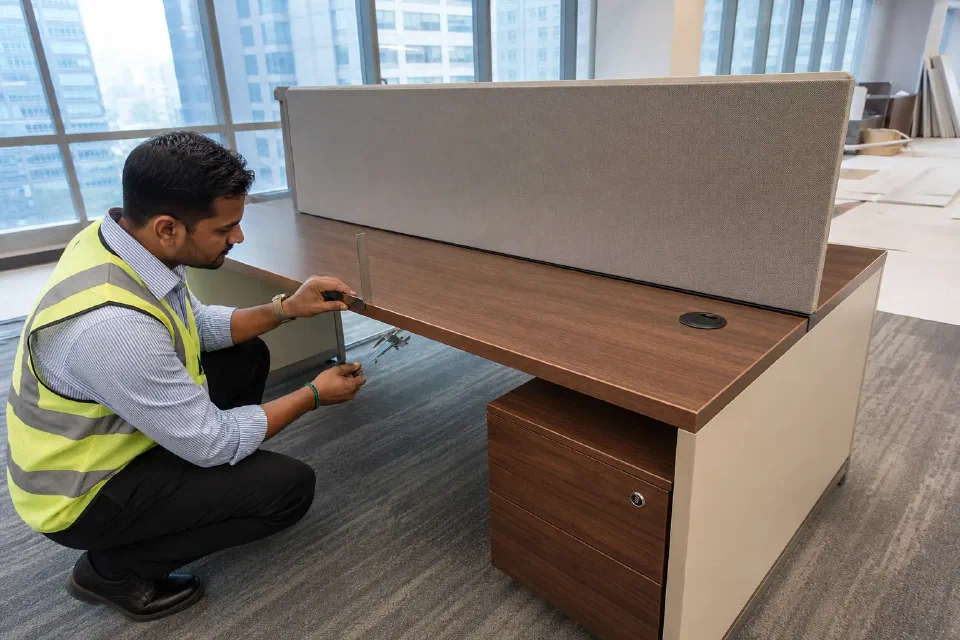
Then divide the accepted total by the number of workstations, cabinets or shutters that pass the signed mock-up criteria. This keeps a lower sheet price from hiding extra lamination labour, edge work, damaged panels or missing hardware.
Evidence and Verification Notes for Delhi NCR Projects
The standards and implementation dates in this guide were checked against the linked BIS material in August 2026. Product compliance, emission class and structural performance are separate questions. Verify the exact board, current standard edition, manufacturer, thickness, face, edge system and product-specific certificate or licence scope rather than accepting an unqualified E1, commercial or prelam label.
For a Gurugram office batch, a Dwarka Expressway apartment or a South Delhi builder floor, compare one approved module at accepted-site cost. In an office campus or gated society, include packing, gate entry, service lift, protected storage, damaged-panel rejection, installation and replacement logistics. These are planning estimates, not fixed market rates, and the final BOQ should state every inclusion before repeat production begins.
Use the office furniture manufacturer page for Gurugram for repeat-module procurement and the wardrobe manufacturer page for bedroom applications. A factory visit lets buyers compare sample edges and assemblies before the repeat batch is released.
Frequently Asked Questions
What is the difference between prelaminated board and commercial ply?
Prelaminated board is a particle board or MDF core with decorative laminate factory-pressed onto both faces, ready to use. Commercial plywood is a raw MR-grade structural panel that still needs a finish applied. Prelam is usually cheaper once finishing labour is counted; commercial ply is structurally stronger. Neither is suitable for a wet area.
Is particle board good for a wardrobe?
In a dry bedroom with no damp wall and no plumbing nearby, prelaminated particle board is a reasonable and widely used wardrobe material, especially where budget matters. It is not suitable if the room has a moisture problem, if shelves will span long distances under load, or if shutters are heavy and tall.
Why is prelam used for office furniture?
Office furniture is commonly dry, indoor and repeatable, which makes prelam a practical candidate. Its factory-applied face removes a separate finishing step, but compare accepted-unit cost against plywood using the same module, edge, hardware, packing and installation scope.
Does prelaminated board need edge banding?
All cut edges and relevant penetrations need the protection specified for the selected board and use. Prelamination covers the factory faces, not a newly cut edge. An exposed particle-board core is more vulnerable to moisture entry and mechanical damage, so the BOQ should name edge material, thickness, adhesive or application method and the edges to be treated.
What is E1 particle board?
E1 is a formaldehyde class used in the current BIS testing framework for these board standards. It describes emissions, not strength. Ask for the applicable IS edition and a product-specific certificate or report rather than accepting a verbal E1 or E0 claim.
Can prelam particle board be used in a kitchen?
Not in the water zone. The sink base, anywhere near plumbing, and utility areas need BWP plywood. Prelam can be acceptable for dry upper cabinets in some budget builds, but the risk rises with any steam, spillage or mopping water at the plinth, so most kitchens are better served by plywood throughout the base run.
What is E1 particle board and is it strong?
E1 describes a formaldehyde class, not strength. Structural properties are assessed separately under the applicable product standard. Compare density, bending properties, screw withdrawal, thickness, span and fitting design independently from the emission certificate.
How should two prelaminated-board quotations be compared?
Normalise both quotations to the same finished module and record core type, applicable standard, board thickness, emission class, face decor, edge material and thickness, hardware article, shelf span, back panel, packing, installation, taxes and acceptance checks. The lower sheet price can become the higher accepted-unit cost when edge, hardware or installation scope is omitted.
Related Guides From WoodAge
- Plywood Quote Comparison Worksheet - Sheet, sq-ft and delivered-rate normalisation for the boards discussed here.
- Cabinet Board Failure Diagnostic - Why panels swell, shelves sag and hinge seats loosen.
- BWP Plywood vs HDHMR vs MDF - The kitchen carcass decision.
- Edge Banding for Modular Kitchens - Why edges decide prelam’s lifespan.
- Low VOC and Formaldehyde-Safe Kitchen Materials - Emission classes and how to verify a certificate.
- Office Workstation Cost in Gurgaon - Where prelam economics matter most.
Get a Factory-Direct Quote
If you are planning interiors in Gurgaon or Delhi NCR, WoodAge can help you convert the idea into a measurable BOQ: exact material grade, hardware model, finish code, timeline and warranty terms before production starts.
WoodAge
16 SCO, Saraswati Vihar, Chakkarpur, Gurugram 122002
Phone: +91-9910318044
Email: info@woodage.in
Website: woodage.in