

PU Finish vs Laminate for Wardrobes in India
Compare PU finish and laminate wardrobe shutters by substrate, sheen, repair route, sunlight exposure, lead time and verifiable coating or decor specifications.

- Arpit Sahni
- 12 min read
PU or Laminate for a Wardrobe: Why the Bedroom Answer Differs From the Kitchen Answer
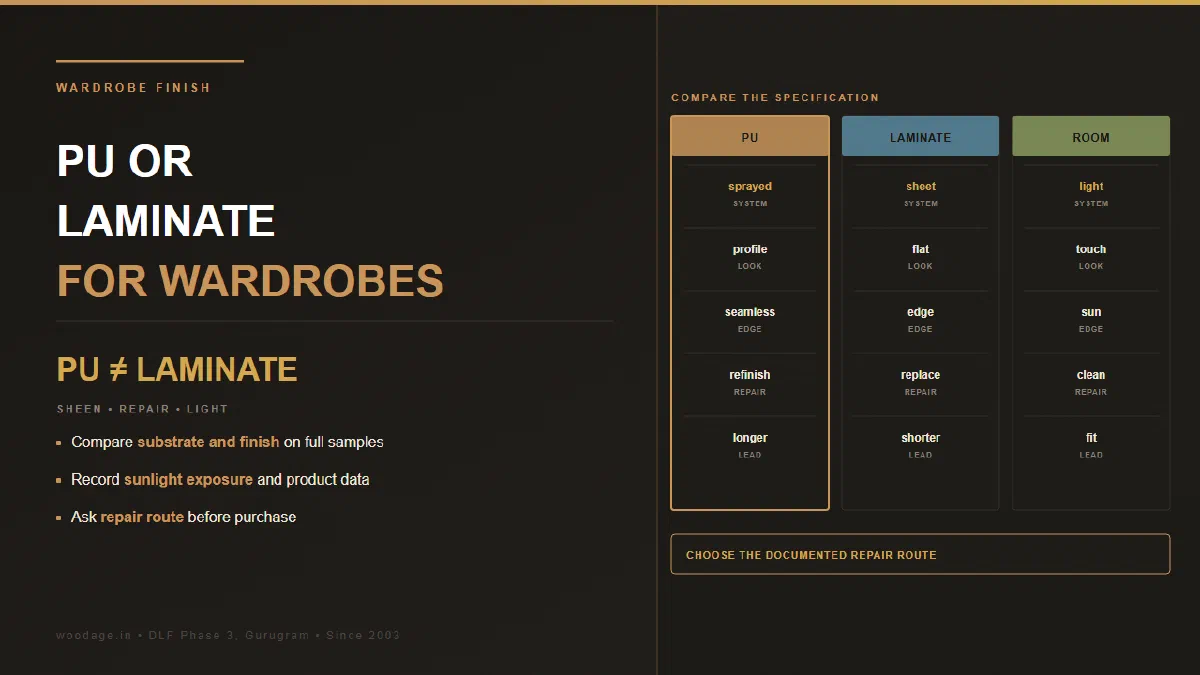
For a wardrobe, PU and laminate solve different finish briefs. A sprayed PU system supports solid colours and routed profiles; laminate offers a factory-made decor sheet with a checkable grade and code. Compare substrate, coating or laminate specification, sheen, sunlight exposure, repair route, lead time and delivered price. Neither wins universally.
WoodAge is a factory-direct modular kitchen and custom furniture manufacturer operating since 2003 and based at 16 SCO, Saraswati Vihar, Chakkarpur, Gurugram 122002. Most Indian finish comparisons are written for kitchens and then applied to bedrooms unchanged. That is the mistake this page corrects.
This page owns the bedroom-wardrobe decision: large shutter planes, routed profiles, room light, touch points and future refinishing. The live acrylic vs laminate vs PU vs veneer guide remains the primary page for kitchen finish-family queries.
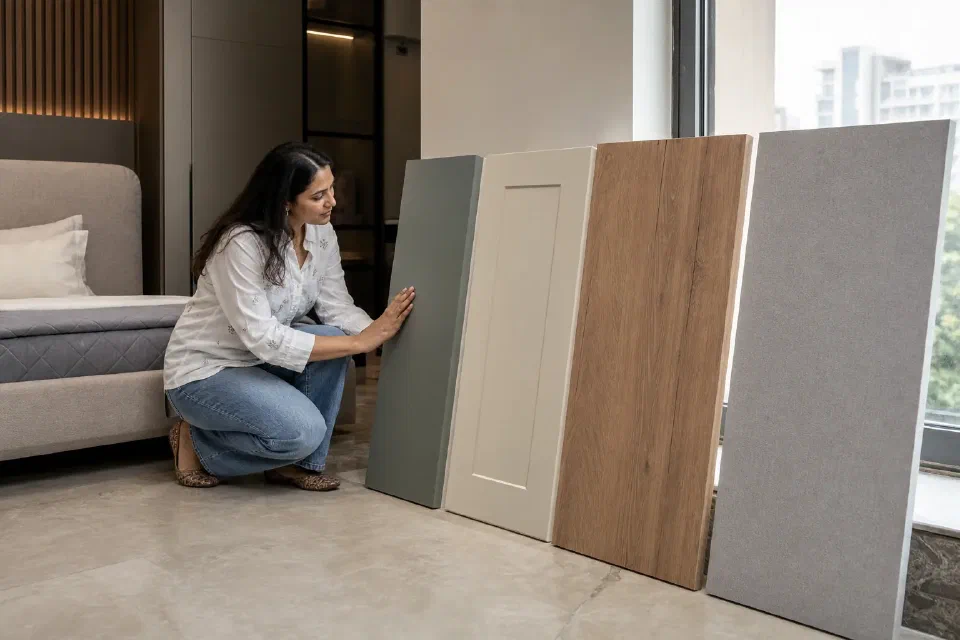
What changes when you move from kitchen to bedroom
| Stress factor | Kitchen | Bedroom wardrobe | Consequence |
|---|---|---|---|
| Direct heat | Can be relevant near appliances | Usually low, but room heaters and sun still matter | Check actual exposure and product limits |
| Steam and humidity | High | Low, unless the room is damp | Edge-lifting risk drops sharply |
| Grease and cleaning chemicals | High, frequent scrubbing | Very low | Scrub resistance matters far less |
| Sunlight through a window | Project-specific | Project-specific | Ask for shade and topcoat data for the exact system |
| Daily touch points | Handles and a few doors | Every door, several times a day | Fingerprints and finish feel matter more |
| Visual prominence | Functional room | The largest surface in the room | Seamlessness and colour depth matter more |
| Restyling interval | Owner-dependent | Owner-dependent | Record a repair route and retained sample instead of predicting years |
The bedroom removes some kitchen stresses, but it does not make PU the automatic premium choice. Wardrobe scale, profile, sheen, sunlight, cleaning, substrate, budget and future colour plans still need a line-by-line comparison.
PU finish wardrobe vs laminate wardrobe: the head-to-head
| PU finish | Laminate | |
|---|---|---|
| What it is | Polyurethane paint sprayed and cured in coats | Decorative sheet bonded to the panel |
| Edges | Seamless, sprayed around | Separate edge band, visible join |
| Colour range | Made-to-order shades within the selected coating system and matching tolerance | Fixed to the current decor catalogue |
| Finish options | Matte, satin, gloss, textured | Matte, gloss, textured, woodgrain |
| Repair route | Local or full refinishing may be possible after inspection | Local repair depends on damage; panel or shutter replacement may be needed |
| Scratch and repair evidence | Coating-specific; local or full refinishing may be possible after inspection | Laminate-specific; local repair, refacing or replacement depends on damage |
| Fingerprints | Depends on sheen; gloss shows most | Depends on sheen; gloss shows most |
| Sunlight data | Product-specific; exterior or UV claims cannot be transferred to an interior PU | Grade, decor and manufacturer data are product-specific |
| Lead time | Longer, spraying and curing take days | Shorter |
| Relative cost | Higher | Lower |
| Restyling later | Recoating may be possible after adhesion and substrate assessment | Overlay, refacing or shutter replacement depends on condition |
The decision-relevant row is the documented repair route. A coating may allow local or full refinishing, but colour and sheen matching can remain visible. A deep laminate scratch may require refacing or shutter replacement, and a discontinued decor can complicate matching. Ask both suppliers to state the remedy before purchase.
Where laminate is still the right answer for a wardrobe
Do not read the above as a blanket recommendation. Laminate remains correct when:
- Budget is the binding constraint. The difference funds better hardware or better internal storage, and hardware you use daily beats a finish you only look at.
- The room is damp or on a ground floor with a moisture history. Neither finish solves damp, but the cheaper one hurts less when it has to be redone. Check the ground-floor moisture checklist first.
- It is a rental or resale property. Compare repair route, replacement match and total scope against the intended holding period. See rental-ready interiors.
- The look you want is a repeatable woodgrain. A catalogued laminate decor gives a defined sheet reference; a painted wood effect is a different custom process and needs its own sample and quote.
- You want it finished fast. PU spraying and curing add days to the programme.
Where PU earns the premium
- Custom solid colours, especially when the exact shade and sheen are central to the brief. Approve a full-size sample because coating build and lighting affect the result.
- Profiled, shaker or moulded shutters. Laminate cannot follow a profile. PU can, and so can membrane at lower cost, discussed in membrane shutters.
- Large uninterrupted runs. Seamless edges matter more the bigger the wardrobe.
- When you expect to restyle rather than replace. A PU-coated shutter may be suitable for later refinishing if its substrate, adhesion and damage condition permit it. Obtain a sample and written repaint procedure.
A future-refinish scenario, without pretending it is a ten-year forecast
Day-one price is only one input. The future condition of the carcass, shutter and finish cannot be predicted by a universal year count, so compare possible remedies rather than promising a lifecycle saving.
| Future scenario | Laminate wardrobe | PU wardrobe |
|---|---|---|
| Finish is scuffed but structurally fine | Assess clean, local repair, refacing or shutter replacement | Assess adhesion, then local or full refinishing if compatible |
| You want a different colour | Overlay, refacing or new shutters may be possible | Recoating may be possible after preparation and compatibility testing |
| One shutter is damaged | Matching risk exists if the decor is discontinued | Colour and sheen matching risk exists on a local repair |
| Carcass has failed | Rebuild regardless of finish | Rebuild regardless of finish |
The asymmetry is useful but not absolute. Laminate is a bonded sheet system; PU is a coating system. The PU route may preserve a sound substrate during refinishing, while a laminate route may permit refacing. Both require condition and compatibility checks.
Whether that option is worth its price depends on one honest question: is a future colour change part of the planning brief? If yes, obtain the written preparation and compatibility route now. If no, compare day-one finish, serviceability and delivered cost without inventing a universal lifecycle saving.
A word on decor discontinuation, because it decides the laminate row above. Laminate decors are retired as ranges refresh. A shutter damaged in year eight may have no exact match available, which turns a one-shutter repair into a full-run replacement. Recording the brand, decor code and thickness at handover, as set out in the interior specification sheet template, is the cheapest insurance against that, and keeping a spare offcut is cheaper still.
The sunlight question, which is bedroom-specific
Bedrooms usually have a window, and wardrobes usually sit along a wall that catches some of it. Two practical points:
- PU is not one chemistry. Asian Paints distinguishes interior PU from exterior PU and states that its exterior system includes UV guards. Do not infer the same UV claim for an interior product.
- Laminate colour-change performance is grade and decor specific. Ask for the applicable IS 2046 part or current product data and keep a control sample away from sunlight.
If one shutter run gets strong direct sun, raise it explicitly with the vendor and get the answer in writing.
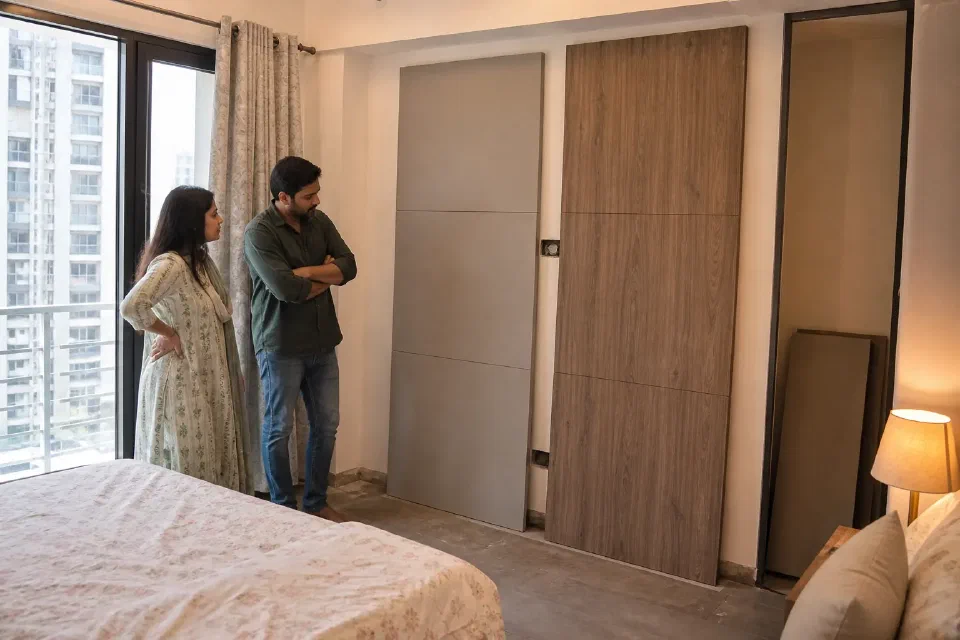
Test the actual Delhi NCR room before approving the finish
Direct-light conditions can differ across two bedrooms in the same home. A west-facing apartment on Golf Course Road, a Vasant Vihar builder-floor room and a high-rise on Dwarka Expressway should all use the same evidence method:
- Place the approved PU and laminate samples vertically at the future wardrobe position.
- View them in daylight and the final artificial lighting at the sheen angles that matter.
- Mark any direct-sun period, nearby heater and damp external wall.
- Keep one control sample away from light and one signed sample with the project record.
- Record acceptable colour, sheen, edge and repair-match tolerances before production.
This does not simulate years of ageing. It catches immediate mismatch, glare, fingerprint visibility and edge appearance in the real room.
The specification each side can actually be held to
The two finishes differ in how checkable they are, and that asymmetry is worth knowing before you sign.
Laminate has a published Indian Standard. BIS currently permits concurrent use of IS 2046:1995 and the eight-part IS 2046:2025 series until 24 March 2027, under its 24 February 2026 circular. Record the exact edition or part, brand, grade, decor code and thickness.
PU needs a complete coating-system specification. Product family, base and hardener, mixing ratio, primer or sealer, coat count, dry-film target, permitted thinner, application conditions and cure time all matter. Asian Paints’ PU technical sheet, for example, specifies separate sealer and topcoat steps plus protective equipment and ventilation.
The two systems therefore leave different evidence. Laminate can be checked against a sheet label, grade, decor and thickness. PU should leave batch-labelled containers, a retained sample panel and a written application schedule.
The practical consequence is a genuine risk difference. A laminate wardrobe is easier to verify; a PU wardrobe depends more on who is doing the work. If you choose PU, the vendor’s process discipline matters more than the material name, so ask for the coat count, the resin system, whether the topcoat is UV stable, and a sample panel you keep. If you choose laminate, ask for the IS reference, brand, decor code and thickness, and keep an offcut.
Laminate brand differences within that standard are covered in Greenlam vs Merino vs Century vs Stylam vs Royale Touche.
Wardrobe shutter specification: what to write into the BOQ
| Field | Why |
|---|---|
| Core board and grade | Decides weight, screw holding, moisture behaviour |
| Finish type and exact shade or decor code | The only way to match a replacement later |
| Sheen level, matte, satin or gloss | Drives fingerprint visibility |
| For PU: number of coats and UV-stable topcoat, yes or no | The difference between good and bad PU |
| For laminate: brand, code, thickness, and edge band material | Prevents substitution |
| Back face treatment | An unbalanced shutter bows |
| Hinge count and load class per shutter size | Heavy shutters sag if under-hinged |
Laminate brand differences are covered in Greenlam vs Merino vs Century vs Stylam vs Royale Touche, and the full finish family in acrylic vs laminate vs PU vs veneer.
Evidence and Verification Notes
The BIS laminate reference and linked coating technical sheet were checked in August 2026. They support product-family requirements and application steps, not a universal claim that every laminate or PU system performs alike. Verify the exact laminate grade and decor or the complete PU coating system, including substrate, sealer, mixing ratio, thinner, coat build, application conditions and cure instructions.
Colour change, yellowing, repair visibility and service life depend on the named chemistry, shade, light exposure, film build, cleaning and workmanship. Treat the sample workflow on this page as a verification method, not a forecast. Costs are estimates until shutter dimensions, face area, edge detail, preparation, number of coats, sample approval, transport and installation are fixed in a written BOQ.
Move from sample comparison to a measured shutter schedule through the Gurugram wardrobe manufacturer page. A WoodAge factory visit gives the buyer a controlled place to review full-size finish samples before room-light approval.
Frequently Asked Questions
Is PU finish better than laminate for a wardrobe?
Neither is universally better. PU can suit solid colours and routed profiles; laminate can suit factory-made woodgrains and a shorter production route. Compare substrate, exact finish system, sunlight exposure, repair route, sample quality, lead time and delivered cost.
Can a PU wardrobe be repainted later?
A sound PU-coated shutter may be refinished after adhesion, substrate and compatibility checks. Do not promise a fraction of replacement cost without a current quotation. A laminate system may be refaced or the shutter replaced depending on condition.
Does PU finish yellow over time?
Yellowing and colour change depend on the exact coating chemistry and exposure. Asian Paints distinguishes exterior PU with UV guards from interior systems, so ask for the named topcoat’s data rather than accepting “PU is UV stable” as a generic claim.
Which shows fingerprints more, PU or laminate?
Sheen matters more than material. High-gloss versions of both show fingerprints clearly, and matte or satin versions of both hide them well. If fingerprints are your main concern, choose a matte or satin sheen in whichever material you prefer rather than switching material.
Is PU finish more expensive than laminate for a wardrobe?
Yes, PU generally costs more, and it also takes longer because spraying and curing add days to the schedule. Whether the premium is worth it depends on whether you value seamless edges, an exact colour and future repairability enough to trade against hardware and internal storage in the same budget.
What about membrane for a wardrobe?
Membrane can form profiled or shaker details without a sprayed coating. A bedroom usually reduces appliance heat and steam, but direct sun, heaters, damp walls, foil bond and panel balance still matter. Record the foil code and obtain the supplier’s repair or replacement route.
What is PU finish laminate?
The phrase mixes two different products. PU is a polyurethane paint sprayed and cured in coats to give a seamless finish. Laminate is a decorative sheet bonded onto a panel with a separate edge band. They are alternatives, not a combined product, so a quote using that phrase should be clarified before you sign.
What is PU finish in a kitchen or wardrobe?
PU finish is a polyurethane coating system applied over a prepared substrate in specified sealer, primer and topcoat stages. Colour, sheen, cure, UV claim and future refinishing depend on the named system. The BOQ should record products, mixing ratio, coat or film schedule, sample, cure and repair route.
Related Guides From WoodAge
- Acrylic vs Laminate vs PU vs Veneer - The full finish family, kitchen-framed.
- Membrane Shutters for Kitchens and Wardrobes - The third option for profiled doors.
- Laminate Brand Comparison - Choosing the laminate itself.
- Modular Wardrobe Cost in Gurgaon 2026 - Where the finish sits in the total.
- Wardrobe Interior Layout for Indian Clothing - Spending the budget inside rather than outside.
- Matte vs Glossy Shutter Finish - The sheen decision that drives fingerprints.
Get a Factory-Direct Quote
If you are planning interiors in Gurgaon or Delhi NCR, WoodAge can help you convert the idea into a measurable BOQ: exact material grade, hardware model, finish code, timeline and warranty terms before production starts.
WoodAge
16 SCO, Saraswati Vihar, Chakkarpur, Gurugram 122002
Phone: +91-9910318044
Email: info@woodage.in
Website: woodage.in