

What to Ask Before Paying Interior Advance: 25 Questions for Gurgaon Homeowners
25 questions to ask before paying an interior advance in Gurgaon, each with the good answer and the red-flag answer, so you freeze scope, spec and warranty first.

- Kautuk Sahni
- 12 min read
What to Ask Before Paying Interior Advance: 25 Questions for Gurgaon Homeowners
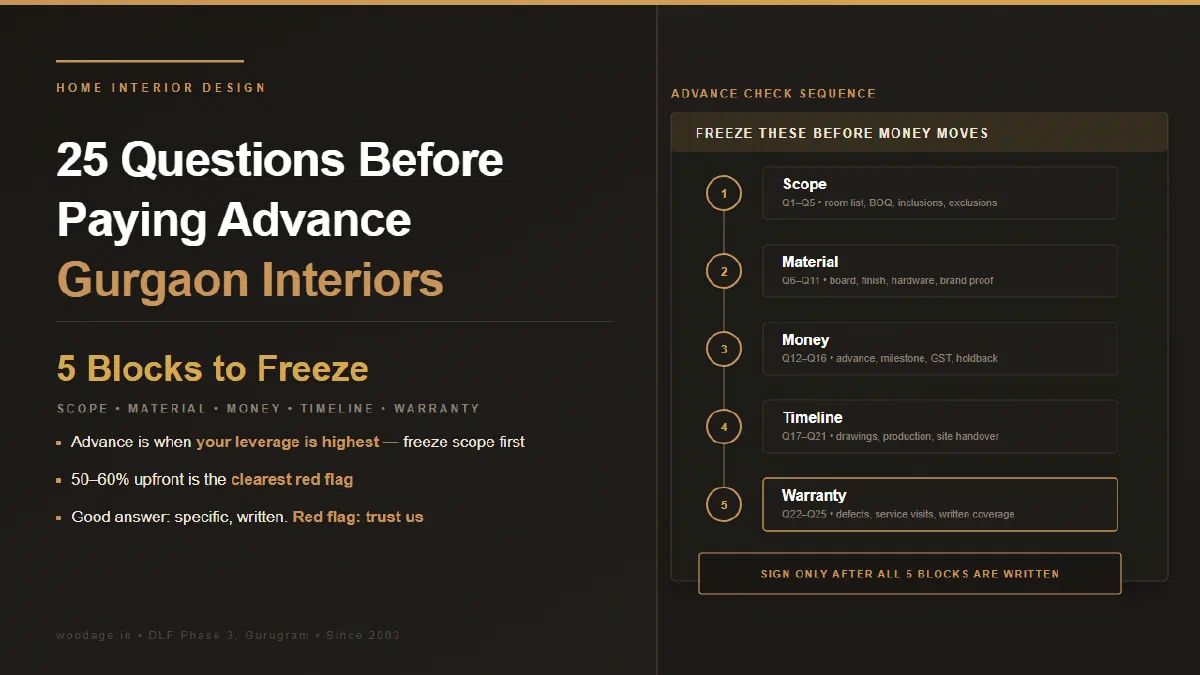
Before paying an interior advance in Gurgaon, freeze five things in writing: scope, material spec, money, timeline and warranty. The advance is the moment your leverage is highest and you give it away — so a reasonable booking advance is a minority share, never the 50–60% upfront a weak vendor asks for. The single rule: pay only against a frozen, itemised scope, never a promise.
WoodAge (woodage.in) is a factory-direct modular kitchen and custom furniture manufacturer in Gurugram (Gurgaon), serving Delhi NCR since 2003.
The catch: the advance feels like a formality, but it’s the last point where every term is still negotiable. This guide gives you 25 questions to ask first — and, for each, what a good answer sounds like versus the red-flag answer that should make you pause. It’s a conversation script, not a lecture.
Why the Advance Is the Wrong Time to Trust
Once your advance is paid, the balance of power flips. The vendor now holds your money and your slot; you hold a verbal understanding. Every ambiguity left open before the advance — an unnamed board grade, a vague “civil extra,” an undated timeline — now resolves in the vendor’s favour, because silence favours whoever sends the invoice.
So the questions below aren’t about distrust. They’re about converting a conversation into a frozen record while you still have the leverage to do it. A good vendor answers them crisply and in writing; that itself is the strongest signal you’ve picked the right one. The pattern is: the quality of the answers before the advance predicts the quality of the project after it.
How to Use the 25-Question Script
Ask these in five blocks. For each question, listen for the shape of the answer:
- Good answer: specific, written, traceable to a document (BOQ, material schedule, contract).
- Red-flag answer: vague, verbal, “trust us,” or deflecting (“we always use good material”).
You don’t need a yes to all 25. You need the vendor to engage honestly and put the answers in writing. Where this overlaps reading the quote itself, pair it with our deeper guide on comparing quotes — but this script is specifically about the pre-payment moment. For the contract that captures the answers, see the modular kitchen contract checklist for India.
Block 1: Scope (Questions 1–5)
Scope is what you’re actually buying. An unfrozen scope is where “extras” are born.
| # | Question | Good answer sounds like | Red-flag answer |
|---|---|---|---|
| 1 | Is there an itemised BOQ with quantities and dimensions? | “Yes — every cabinet, RFT and accessory is listed.” | “We work on a lump-sum package.” |
| 2 | What’s explicitly excluded from this scope? | A written exclusions list (civil, appliances, society charges). | “Nothing — it’s all included” (with no list). |
| 3 | Are appliances supply or only installation? | Each appliance marked supply/fit, in writing. | “We’ll sort that out later.” |
| 4 | Is civil work (demolition, waterproofing, tiling) in or out? | Named, priced, or clearly excluded. | “Minor civil is adjustable.” |
| 5 | Will the final drawings be frozen before I pay? | “Yes — design freeze precedes the advance.” | “Pay the advance, then we’ll finalise.” |
The decisive one is Q5. If a vendor wants the advance before the drawings and scope are frozen, you’re paying against a moving target.
Block 2: Material Spec (Questions 6–11)
Materials decide cost and lifespan, and they’re the easiest thing to silently downgrade. Demand codes, not adjectives.
| # | Question | Good answer sounds like | Red-flag answer |
|---|---|---|---|
| 6 | What carcass board, by IS code? | “BWP IS 710 in wet zones; named brand.” | “Good quality ply.” |
| 7 | What shutter material, finish and thickness? | “18 mm, 1 mm laminate, named brand.” | “Premium finish.” |
| 8 | What edge banding type and thickness? | “2 mm PUR at hob/wet zones.” | “Standard banding.” |
| 9 | What hardware brand, line and quantity? | “Hettich/Blum/Hafele, soft-close, counted.” | “Branded hardware.” |
| 10 | Will the spec be written in a material schedule? | “Yes — attached as an annexure.” | “It’s understood.” |
| 11 | Can I verify materials at delivery (stamps, invoices)? | “Yes — IS stamp and brand invoice.” | “You won’t be able to check that.” |
“Good quality ply” and “branded hardware” are not specifications — they’re marketing. A vendor who names IS 710, 2 mm PUR and a hardware line is one whose quote you can actually verify. For the schedule that captures this, see the interior specification sheet template.
Block 3: Money (Questions 12–16)
This is where the advance question lives. The goal: pay little upfront, tie the rest to delivered milestones.
| # | Question | Good answer sounds like | Red-flag answer |
|---|---|---|---|
| 12 | How much is the booking advance? | A minority share on design freeze. | “50–60% to start.” |
| 13 | Are payments tied to milestones? | “Advance, pre-dispatch, install, handover.” | “Fixed dates regardless of progress.” |
| 14 | Is there a retention held till snags clear? | “Yes — final balance on snag closure.” | “Full payment on delivery.” |
| 15 | Is GST included in the quoted figure? | “Inclusive, at the stated rate.” | “Plus taxes, calculated later.” |
| 16 | Is anything billed ‘per actuals’ later? | “No — or named items only.” | “A few things, we’ll see.” |
A demand for a large majority upfront (Q12) is the clearest red flag in the whole script. It hands the vendor all the leverage and leaves you with a promise. A retention against snags (Q14) is your single best tool for getting the punch-list finished.
Block 4: Timeline and Execution (Questions 17–21)
A timeline without a consequence is a wish — and execution in a Gurgaon high-rise has its own constraints.
| # | Question | Good answer sounds like | Red-flag answer |
|---|---|---|---|
| 17 | What’s the dated timeline with milestones? | Start, milestone and completion dates. | “Around 30–45 days, roughly.” |
| 18 | Is there a delay penalty, and how is fault assigned? | Capped penalty; vendor vs society delay separated. | “We don’t do penalties.” |
| 19 | Who handles society NOC, lift booking and debris? | Named owner for each charge. | “That’s your side, mostly.” |
| 20 | Who manufactures it — your factory or a vendor? | “Our own factory; you can visit.” | “We have a network.” |
| 21 | Who installs, and is it a trained crew? | “Our installation team.” | “We arrange labour.” |
Q20 matters more than buyers think: a vendor who owns the manufacturing carries the warranty and service directly, with no blame-chain. For why that ownership changes accountability, see compare modular kitchen quotations in India for how scope and source affect what you’re really paying for.
Block 5: Warranty and After-Sales (Questions 22–25)
The warranty you’re promised verbally is worthless; the one in writing is an asset.
| # | Question | Good answer sounds like | Red-flag answer |
|---|---|---|---|
| 22 | Is the warranty written, with scope and exclusions? | “Yes — product + workmanship, documented.” | “Lifetime warranty” (no document). |
| 23 | What voids the warranty? | A clear, reasonable list. | “Nothing, don’t worry.” |
| 24 | Who attends a service call, and how fast? | “Our team; stated response time.” | “Call us, we’ll see.” |
| 25 | Are hardware/appliance warranties registered to me? | “Yes — genuine invoices, registered.” | “It’s all covered under us.” |
A “lifetime warranty” spoken across a table with no document (Q22) means nothing. Two written documents — the manufacturer’s product warranty and the contractor’s workmanship warranty — are what give you real recourse.
The One-Page Pre-Advance Checklist
Before you transfer a rupee, every row here should be a “yes, in writing”:
| # | Frozen before advance? | Done |
|---|---|---|
| 1 | Itemised BOQ with quantities | ☐ |
| 2 | Written exclusions list | ☐ |
| 3 | Material schedule with IS codes + brands | ☐ |
| 4 | Final drawings frozen | ☐ |
| 5 | Booking advance is a minority share | ☐ |
| 6 | Payments tied to milestones + retention | ☐ |
| 7 | GST position stated | ☐ |
| 8 | Dated timeline + delay terms | ☐ |
| 9 | Society charges (NOC/lift/debris) assigned | ☐ |
| 10 | Written product + workmanship warranty | ☐ |
If three or more rows are still blank, the advance is premature — freeze them first.
NCR Context: Gurgaon-Specific Questions That Save Money
Generic advance advice misses costs unique to NCR high-rise projects. Add these to the script:
- Society charges named (Q19): NOC deposit, service-lift fees and debris disposal recur on every Gurgaon fit-out and are a classic surprise “extra” — settle who pays before the advance.
- Wet-zone defaults: Gurgaon’s monsoon humidity (80%+ RH) makes BWP IS 710 / HDHMR and PUR banding in kitchen, utility and bath non-negotiable — confirm them in the material schedule, not after.
- Service-lift access: in newer towers (Dwarka Expressway, Golf Course Extension Road), confirm oversized units are built to knock down to fit the lift — a build decision with cost implications if found late.
- Core-cutting permission: if a chimney duct needs core cutting, ask who obtains society permission and what happens if the route is refused.
- Society-caused delay (Q18): because NOC and lift slots can delay dispatch, the delay clause should separate society delay from vendor delay so the penalty is fair.
The local takeaway: a Gurgaon vendor who can answer the society-charge, wet-zone and lift-access questions crisply is one who actually ships into NCR high-rises regularly — and that experience is worth as much as the price.
TL;DR — Before You Pay the Advance
- The advance is when your leverage is highest — freeze scope, spec, money, timeline and warranty first.
- A reasonable booking advance is a minority share on design freeze; a 50–60% upfront demand is the clearest red flag.
- Demand codes, not adjectives: BWP IS 710, 2 mm PUR, named hardware line — verifiable at delivery.
- Tie payments to milestones and hold a retention until snags clear.
- Get two written warranties (product + workmanship); a verbal “lifetime” means nothing.
- For Gurgaon, settle society charges, wet-zone material defaults and lift access before paying.
See also: For per-running-foot ranges and a sample BOQ, see WoodAge’s modular kitchen cost guide.
Frequently Asked Questions
How much advance is normal for interiors?
A reasonable booking advance is a minority share of the project value, paid on design freeze — not the 50–60% upfront that weaker vendors ask for. The rest should be tied to delivered milestones: a payment before dispatch (after you verify the factory build), one on installation, and a final balance on handover after snags are cleared. A large upfront demand hands the vendor leverage and leaves you holding only a promise.
What should be finalised before paying advance?
Five things, all in writing: an itemised BOQ with quantities, a written exclusions list, a material schedule with IS codes and brands, frozen final drawings, and the payment, timeline and warranty terms. If these aren’t frozen, the advance is premature — every ambiguity left open will later resolve in the vendor’s favour because you’ve already paid. Freeze the scope first, pay second.
Should drawings be frozen before payment?
Yes. Paying an advance before the design and scope are frozen means you’re paying against a moving target, and changes after payment are where budgets blow out. A good vendor freezes the drawings, the BOQ and the material schedule first, then takes the booking advance. If a vendor insists on the advance before finalising drawings, treat it as a red flag and freeze the design first.
What warranty terms should be written before advance?
Two documents: the manufacturer’s product warranty (board, hardware, appliances, each for its stated period) and the contractor’s workmanship warranty (installation defects like alignment, levelling and screw-holding). Each should state what’s covered, what voids it, the duration and the response process for a service call. A verbal “lifetime warranty” with no document and no scope is not meaningfully enforceable, so get it in writing before you pay.
Can I change materials after paying advance?
You can, but it’s where disputes and cost creep happen, which is exactly why the material schedule should be frozen before the advance. Any change after payment should go through a written change-order that prices and approves it before execution. The safer path is to lock the board grade, laminate, edge banding and hardware in a schedule first, so post-advance changes are deliberate decisions, not surprises.
Is a 50% advance demand a red flag?
A demand for 50–60% upfront is the clearest red flag in the whole pre-advance conversation. It transfers all the leverage to the vendor before any work is delivered and removes your ability to enforce quality, timeline or snag-fixing. A reasonable structure keeps the booking advance a minority share and ties the rest to delivered milestones, with a retention held until the punch-list closes.
Who should pay society NOC, lift and debris charges?
That depends entirely on what’s agreed in writing before the advance — which is why it must be named. These NCR-specific charges recur on every Gurgaon high-rise fit-out and are a classic source of surprise “extras.” Ask explicitly whether the NOC deposit, service-lift fees and debris disposal are the owner’s or the contractor’s responsibility, and get the answer recorded before you pay.
How do I tell a credible vendor from a risky one before paying?
By the shape of their answers to these questions. A credible vendor responds specifically and in writing — an itemised BOQ, IS codes, a written warranty, milestone payments, named society charges. A risky one deflects with “trust us,” “premium quality,” “lifetime warranty” and a demand for a large advance. The crispness and willingness to document the answers before the advance predicts the quality of the project after it.
Related Guides From WoodAge
- Modular Kitchen Contract Checklist for India — the contract that captures these pre-advance answers.
- Compare Modular Kitchen Quotations in India — how to line up competing quotes before you commit money.
- Interior Specification Sheet Template: Boards, Laminate, Hardware, Countertop, Warranty — the material schedule to freeze before the advance.
- Interior Quote Review Gurgaon: How to Decode Per-Sqft Rates, Civil Items, Electrical Lump Sums and Loose Furniture - Related guide for planning the costs, materials and execution of the same project.
- No Hidden Cost Interior Contract: Clauses Every Gurgaon Homeowner Should Ask For - Related guide for planning the costs, materials and execution of the same project.
- NRI and Remote Owner Interior Execution Checklist for Gurgaon Flats in 2026 - Related guide for planning the costs, materials and execution of the same project.
Get a Factory-Direct Quote
WoodAge answers every one of these 25 questions in writing — itemised BOQ, material schedule with IS codes, milestone payments, documented warranty — because we own the Gurugram factory that builds and services your kitchen. Ask us the hard questions before you pay anyone an advance. Send us your layout to start.
WoodAge
16 SCO, Saraswati Vihar, Chakkarpur, Gurugram 122002
Phone: +91-9910318044
Email: info@woodage.in
Website: woodage.in