

Rental-Ready Interiors: Durable Materials and Smart Specifications for Tenant-Use Apartments in Gurgaon
Tenant-occupied apartments need different specifications from owner-occupied ones. This guide covers HDHMR over plywood, laminate over PU paint, simpler hardware, easy-clean finishes and the ROI calculation for landlords doing fit-outs in Gurgaon.

- Kautuk Sahni
- 11 min read
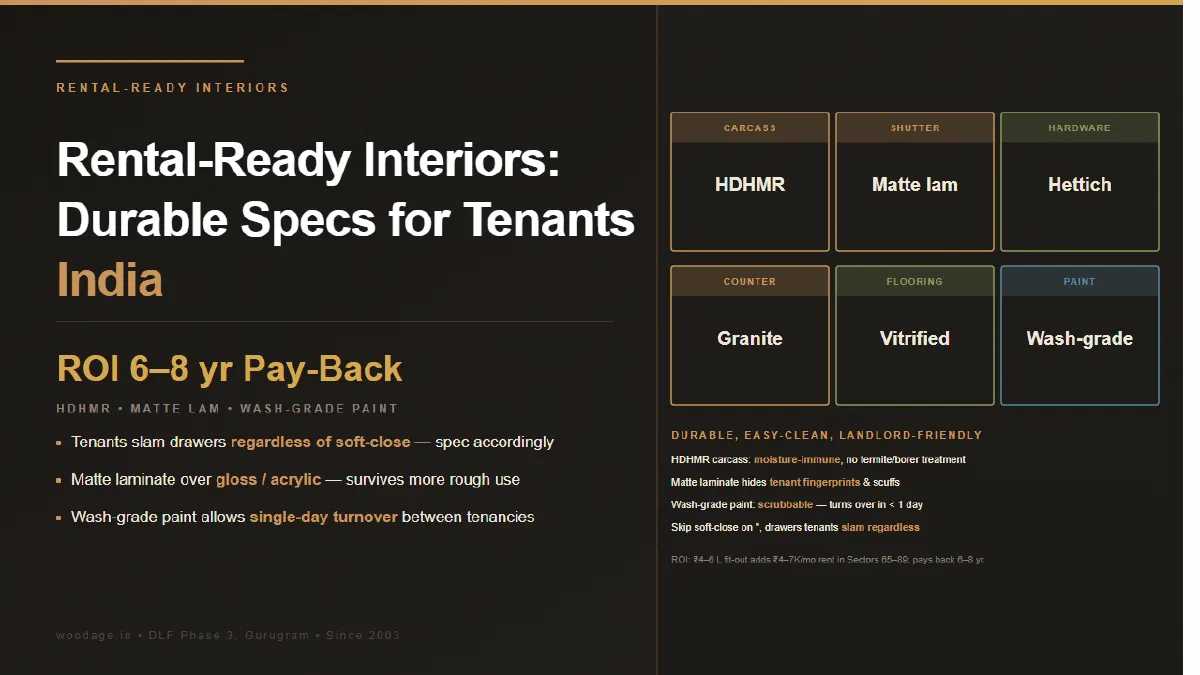
Rental-Ready Interiors: Durable Materials and Smart Specifications for Tenant-Use Apartments in Gurgaon
A rental apartment fit-out has fundamentally different priorities from an owner-occupied one. A homeowner optimises for daily aesthetic preference and 15-year durability with personal use; a landlord optimises for tenant durability, easy cleaning, simple repair, and minimum landlord intervention between tenancies. Premium materials that suit the homeowner often fail in the rental context - high-gloss acrylic shows tenant fingerprints, PU paint requires expert touch-up, complex hardware breaks under casual use.
WoodAge (woodage.in) is a factory-direct modular kitchen and custom furniture manufacturer in Gurugram (Gurgaon), serving Delhi NCR since 2003.
This guide covers the rental-specific material and design choices that maximise tenant satisfaction, minimise landlord disruption, and deliver positive ROI on the fit-out investment.
The Fundamental Difference
Rental tenants:
- Use kitchens differently (less cooking volume but more variety)
- Don’t invest in kitchen care (no daily wiping; periodic deep cleaning)
- Don’t operate hardware carefully (slamming drawers, forcing soft-close)
- Have variable cleanliness standards
- Move out when contracts end (2 to 3 years typical in Gurgaon)
- Don’t pay for maintenance
The rental fit-out must accept these realities and design around them.
Material Hierarchy for Rentals
Rental priorities differ from owner-occupied:
| Priority | Owner-Occupied | Rental |
|---|---|---|
| Aesthetic | Premium | Practical-acceptable |
| Daily-touch durability | 15+ years with care | 5 to 10 years with rough use |
| Repair cost | Important but not primary | Primary concern |
| Maintenance simplicity | Acceptable for premium look | Critical |
| Replacement cost | Acceptable for premium | Critical |
This translates to specific material choices.
Recommended Materials for Rental Modular Kitchens
Carcass: HDHMR Over Plywood
Why for rentals:
- More damage-resistant to rough handling
- Higher density resists screw stripping (tenant slamming drawers and pull-outs)
- Better moisture handling (less risk of water damage from messy tenant cooking)
- Cheaper than premium BWP plywood
HDHMR specifications: Action Tesa or Greenpanelmax HDHMR (confirm the standard on the product’s own certificate; “IS 12823 Grade III” is often quoted, but IS 12823 covers prelaminated particle board), 18 mm sides/bottom, 6 mm back panels.
Compared to BWP plywood: HDHMR costs slightly less, performs equivalently for rental use cases, and is easier to repair if damaged.
Shutter Material: Laminate Over PU Paint
Why for rentals:
- Laminate is more impact-resistant than PU paint
- Laminate doesn’t require expert repair (replacement of affected shutter)
- Laminate handles cleaning chemicals tenants might use without staining
- PU paint quality varies; cheap PU peels in rental conditions
Specific recommendations:
- High-quality laminate (Greenlam, Merino) in classic colours (white, grey, beige, wood-tone)
- Matte finish (hides daily fingerprints from less-careful tenants)
- Anti-fingerprint matte for premium rentals (small premium worth the lower cleaning frequency)
What to avoid in rentals:
- High-gloss acrylic (shows every fingerprint; tenants won’t clean carefully)
- PU paint custom colours (any chip is visible; repair requires skilled finisher)
- Soft-touch / suede laminate (susceptible to oil staining; expensive to replace)
Edge Banding: 2 mm PVC Throughout
Why for rentals:
- 0.4 mm cheap banding fails fast under rough use
- 2 mm PVC across all edges (visible and hidden) - only modest cost premium
- PUR upgrade (more durable but expensive) generally overkill for rentals; reserve for under-sink only
Specifications: 2 mm PVC visible edges; 2 mm PUR-bonded under-sink edges only.
Hardware: Branded but Standard, Not Premium
Why for rentals:
- Hettich Mini hinges work as well as Hettich Sensys for rental use
- Hettich Cap drawer slides (partial extension) handle typical loads
- Standard cam-locks (Hettich Rastex) sufficient
- Avoid premium drawer slides (Quadro 4D) - overspecification
Specific recommendations:
- Hinges: Hettich Mini 95° with soft-close
- Drawer slides: Hettich Cap 250 (partial extension)
- Cam-locks: Hettich Rastex
- Standard handles (matte chrome or brushed steel)
Counter Material: Granite Over Quartz/Sintered
Why for rentals:
- Granite is more durable to abuse (impact, hot pans)
- Granite chips can be polished out
- Granite local supply is consistent and replaceable
- Quartz/sintered stone is premium - overkill for rental + harder to repair
Specifications: 20 mm granite with polished edges, classic colours (black, brown, beige patterns).
Sink: 16-Gauge Stainless Steel Standard
Why for rentals:
- Stainless steel is most durable
- 16-gauge withstands tenant use
- Easy to replace (standard sizes; not custom)
- Brand options: Carysil, Nirali, Franke (premium), or Indian generic 16-gauge for budget
Hob and Chimney: Standard Indian Brands
- Hob: Glen, Sunflame, Faber 60 cm 4-burner - durable Indian brands
- Chimney: Faber, Glen, Sunflame 1,200 to 1,400 CFM - adequate for tenant cooking
Avoid imported premium brands (Bosch, Siemens) for rentals - replacement parts harder to source if damaged.
Design Choices for Rentals
Layout
- Standard L-shape or parallel layouts (tenants familiar with these)
- Standard cabinet sizes (600 mm × 600 mm × 720 mm base; 600 mm × 320 mm × 720 mm wall)
- Standard counter heights (850 mm)
- Avoid complex islands or specialty pull-outs (more failure points)
Storage
- Drawer-heavy (tenants find drawers more user-friendly than shelves)
- Standard pull-outs (not custom configurations)
- Fixed-height shelving where possible (no adjustable mechanisms to lose)
- Avoid corner pull-outs (high mechanism failure rate; premium hardware overkill for rentals)
Lighting
- Standard ceiling fixtures + under-cabinet LED strips
- Avoid complex cove lighting (replacement bulbs costly)
- Single switching topology (one switch per area)
Appliances
- Standard built-in microwave + hob + chimney
- Skip integrated dishwasher (high maintenance; tenants may not use it)
- Skip integrated coffee machine, oven (unless premium rental segment)
Wardrobe Specifications for Rentals
The wardrobe is the second-most-used storage. Rental specifications:
- 18 mm HDHMR carcass
- 18 mm HDHMR shutters with matte laminate
- 2 mm PVC edge banding
- Hettich Mini hinges or standard sliding shutter mechanism
- Standard hangers (not custom dressing organisers)
- Loft above (50 to 80 kg load capacity for tenant storage)
- Door locks (some tenants prefer; many don’t use)
Avoid:
- Walk-in custom wardrobes (high cost; minimal tenant value)
- Custom dressing organisers (specific to tenant; lost when tenant leaves)
- Imported wardrobe systems
False Ceiling and Lighting
For rentals, simpler is better:
- Flat false ceiling (gypsum or POP)
- Standard recessed downlights
- Single ceiling fan + ceiling lamp combination
- Skip complex cove lighting unless premium rental segment
This reduces installation cost by 30 to 40% vs premium homeowner installations.
Kitchen Backsplash and Tile Work
- Standard ceramic tile (300 × 300 mm or 300 × 600 mm)
- Avoid expensive natural stone backsplashes
- Easy-to-clean glossy tile finish
- Replacement tiles available locally for damage
Wall Finishes
- Painted walls (oil-based or acrylic premium)
- Avoid wallpaper (susceptible to tenant damage; expensive replacement)
- Avoid stone or wood paneling features (expensive maintenance)
- Standard colours that work with diverse tenant taste
Cost Strategy for Rental Fit-Out
The rental fit-out should target:
- 50 to 70% of premium homeowner fit-out cost
- Higher reliability for the same materials (since use is rougher)
- Easier maintenance (modular components more easily replaceable)
A typical rental fit-out covers:
| Component | Approximate % of Total |
|---|---|
| Modular kitchen | 35 to 40% |
| Wardrobes and bedroom storage | 20 to 25% |
| Living room cabinets/TV unit | 8 to 12% |
| False ceiling and electrical | 12 to 15% |
| Painting | 8 to 10% |
| Flooring (if needed) | 5 to 8% |
| Final fitments and decor | 5% |
For premium rental segments (M3M, DLF Crest, Sobha): premium hardware and materials may be justified by higher rent and tenant retention.
ROI Calculation for Landlords
The fit-out investment must justify itself through:
- Higher rental yield - fitted apartment commands ₹5,000 to ₹15,000/month premium over unfitted
- Tenant retention - quality fit-outs attract better tenants who stay longer
- Lower maintenance - quality materials reduce mid-tenancy repair calls
- Resale value - fitted apartments often resell at premium
Sample ROI Analysis
For a typical 3BHK in M3M Capital:
- Unfitted rent: ₹65,000/month
- Fitted rent: ₹85,000/month (premium ₹20,000/month)
- Annual rental premium: ₹2,40,000
- Investment: Rental-grade fit-out, modest pricing
- Payback period: Approximately 2 to 4 years
- Beyond that: positive cash flow contribution from fit-out
For premium segments (DLF Camellias, M3M Mansion):
- Premium drives higher rental delta
- Tenant willingness to pay premium for quality
- Faster ROI
What to Skip in Rental Fit-Outs
Components that don’t deliver tenant-ROI value:
| Skip This | Why Not for Rental |
|---|---|
| Smart home automation | Tenants don’t pay premium for this |
| Premium PU paint shutters | Maintenance/repair cost too high |
| Imported European hardware | Replacement difficulty |
| Custom artwork or wallpaper | Tenant taste varies; damage risk |
| Premium audio integration | Tenant preference; few tenants use |
| Designer outdoor decor | Maintenance burden |
| Premium-grade flooring (marble) | Maintenance + repair complexity |
| Custom built-in displays | Limited tenant value |
What to Include for Quality Rental Tenant Experience
Components that drive tenant satisfaction and retention:
| Include This | Why for Rental |
|---|---|
| Reliable modular kitchen | Tenant comfort; less complaint |
| Adequate storage | Tenants always want more storage |
| Quality bedroom wardrobes | Daily-use furniture |
| Functional false ceiling lighting | Practical illumination |
| Well-finished bathrooms | Tenant happiness; differentiator |
| Painted walls in neutral colours | Tenant flexibility |
| Standard appliances (chimney, hob) | Functional kitchen |
| Reliable plumbing (no leaks) | Most tenant complaints come from this |
| Quality flooring (vitrified tiles) | Easy to clean; durable |
| Adequate sockets in each room | Modern tenant expectations |
Maintenance Schedule for Rental Apartments
Build into your operational schedule:
- Annual inspection during tenant occupancy (with tenant permission)
- Pre-tenant move-in deep cleaning before each new tenancy
- Mid-tenancy maintenance call (offered free) - keeps relationship positive
- Post-tenant cleanup before next tenancy
- 5-year refresh - repaint, deep clean, hardware refresh
Document each maintenance cycle for future reference and value preservation.
Damage Deposit and Tenant Agreement Considerations
In rental agreement:
- Document apartment condition with photos at move-in
- Specify tenant responsibility for damage to fixtures and fittings
- Hold reasonable damage deposit (typically 1 to 3 months’ rent in Gurgaon)
- Define normal wear (no charge) vs damage (charge from deposit)
- Specify maintenance responsibilities (typically tenant for minor; landlord for major)
Common Rental Fit-Out Mistakes
1. Over-Specifying Aesthetics
Premium acrylic shutters in a rental at premium price = no premium tenant rent. ROI fails.
2. Under-Specifying Hardware
Generic cam-locks = drawer failures within 2 years = mid-tenancy maintenance calls. False economy.
3. Skipping Quality Edge Banding
0.4 mm banding = visible peeling within 6 months = tenant complaints + replacement cost.
4. Premium Counter Materials
Quartz or sintered stone in rental = expensive damage if tenant chips it. Granite is the right choice.
5. Custom Storage Configurations
Configurations specific to one tenant become useless when they leave; reverting requires modification.
6. Skipping Pre-Cabinet Plumbing Test
Rental apartments are often over-occupied; plumbing leaks compound rapidly with multiple tenants. Test before tile work.
7. Wood Flooring in Rentals
Wood flooring requires care; tenants don’t provide it; refinishing required between tenancies. Vitrified tiles are simpler.
8. Imported Appliances
Replacement parts for imported brands (Bosch, Siemens, Miele) take weeks. Indian brands have local service support.
See also: For per-running-foot ranges and a sample BOQ, see WoodAge’s kitchen pricing guide for Gurgaon.
Frequently Asked Questions
Should I invest in a fit-out for my rental?
For most Gurgaon rentals, yes - fitted apartments command 25 to 35% rental premium. Payback within 2 to 4 years; positive cash flow afterward.
What’s the minimum rental-grade fit-out budget?
For a 2BHK rental, a basic but quality fit-out is achievable at moderate budget. For 3BHK, somewhat higher. Premium segments justify higher investment.
Can I do a partial fit-out (kitchen only) for rentals?
Yes - kitchen is the highest-impact component. Adequate-quality bathrooms with good-quality kitchen often satisfies tenants in mid-range markets.
Do tenants damage furniture commonly?
Some do; most don’t. The risk is statistical - periodic damage is part of the rental cost equation. Quality materials reduce frequency of damage that becomes tenant-disputed.
Should I install dishwashers in rental kitchens?
For premium rentals, yes - increasingly expected. For mid-range, optional. For budget rentals, skip.
How often should I refresh a rental apartment?
Major refresh (paint, deep clean, minor renovation) every 4 to 5 years. Between tenancies, lighter touch-ups.
Is the security deposit enough to cover damages?
Often, yes - for normal damage. For major damage (cabinet replacement), the security deposit is often inadequate. Insurance and clear lease terms protect landlords better.
Should I provide an inventory of fixtures?
Yes - detailed inventory at move-in protects against later disputes. Photo-based documentation is standard.
What about furnished vs unfurnished rentals?
Furnished rentals (with major furniture) command higher rents but require more landlord investment and maintenance. Semi-furnished (kitchen + wardrobes + bathroom only) is most common in Gurgaon.
How do I handle tenant complaints about fit-out?
For quality fit-out: respond promptly (within 48 hours), assess the issue, repair if landlord’s responsibility (usually fittings, plumbing, electrical), recover from deposit if tenant’s fault.
Related Guides From WoodAge
- Modular Kitchen Cost in Gurgaon 2026 - Cost benchmarks for owner-occupied kitchens; rental specifications come in lower.
- Matte vs Glossy Shutter Finish - Matte is more rental-friendly than gloss; laminate over PU paint.
- How to Read a Modular Kitchen Quotation - Comparison principles apply equally to rental fit-outs.
- Modular Kitchen Warranty in India 2026 - Warranty terms transfer to next tenant or owner.
- Modular Kitchen Renovation in Gurgaon 2026 - Cabinet-only renovation principles for refreshing rental apartments.
- Custom Bathroom Vanity in Gurgaon: Materials, Design and Cost Guide 2026 - Useful next reading on hardware planning, costs, materials, or execution.
- Undermount vs Topmount Sink for Stone Countertops - Undermount sinks need stone countertop, professional installation, and proper bracket systems. This guide compares undermount, topmount and flush-mount sinks for granite, quartz and sintered stone counters with installation requirements and brand recommendations.
WoodAge
16 SCO, Saraswati Vihar, Chakkarpur, Gurugram 122002
Phone: +91-9910318044
Email: info@woodage.in
Website: woodage.in
Last reviewed: June 2026. Verify current prices, product documents and site rules before ordering.