

Replacing a Room Door While Keeping the Existing Frame
Can you replace a room door and keep its frame? Check frame condition, hinge positions, clearances and trimming limits before approving a new leaf.

- Kautuk Sahni
- 10 min read
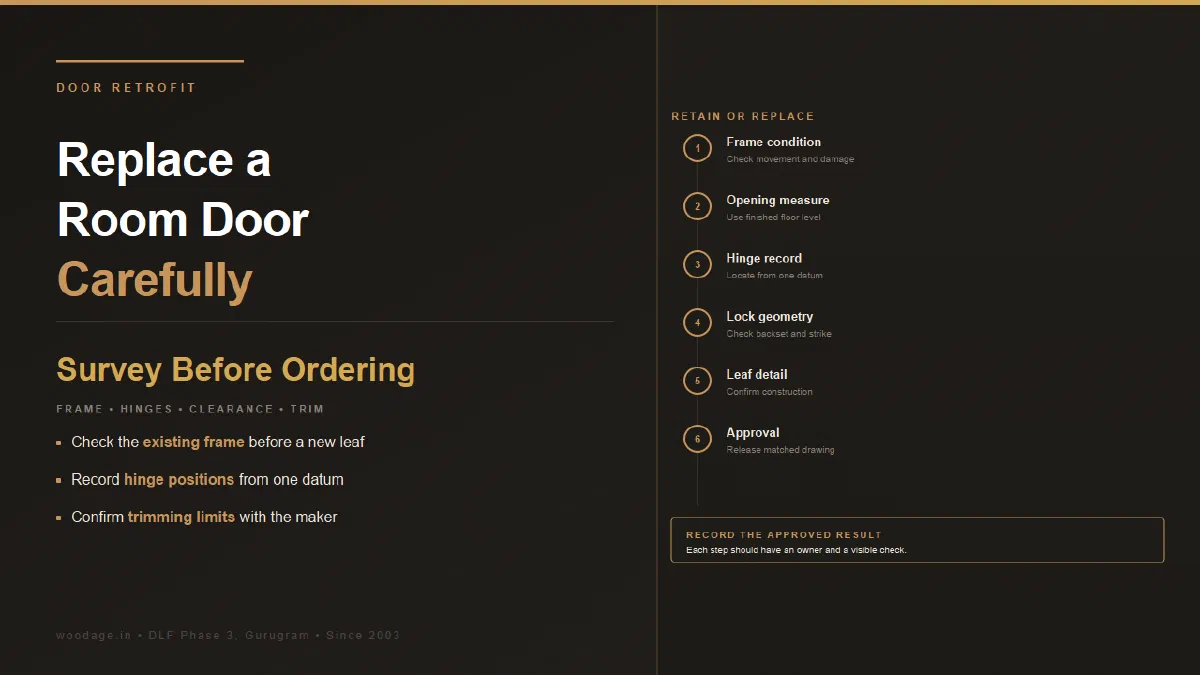
Quick answer: An existing frame can accept a new room-door leaf when the frame is sound, secure and compatible with the new leaf’s dimensions, weight, rebate and hardware. Keeping the frame saves disturbance only if the new door can be fitted within its documented limits. Measure the frame before ordering the replacement.
WoodAge is a factory-direct furniture and interiors manufacturer in Gurugram, working since 2003. A door retrofit is an interface problem: the new component has to work with what remains. Whether the flat is a new tower on Sohna Road or an older builder floor, the frame survey comes first, and a society flat may also need the society’s permission for work hours and debris removal. A nominal door width or a photograph is not enough to approve the job.
Decide whether the frame is worth keeping
| Observation | What the survey should establish | Decision |
|---|---|---|
| Frame moves when the leaf operates | Fixing condition and surrounding substrate | Repair or replace before fitting |
| Soft, damaged or visibly deteriorated timber | Extent and cause of damage | Do not conceal it with a new leaf |
| Uneven gaps or a twisted opening | Frame geometry versus leaf distortion | Measure before assigning the fault |
| New floor finish | Finished height across the whole swing | Recheck the door-bottom detail |
| Different hinge or lock position | Usable fixing material and previous cut-outs | Confirm a workable hardware layout |
| Entrance door with a required rating | Whether the replacement retains the specified assembly | Obtain specialist approval |
Discolouration alone does not diagnose termites, rot or moisture. If damage is suspected, arrange a competent inspection and resolve the cause before enclosing it.
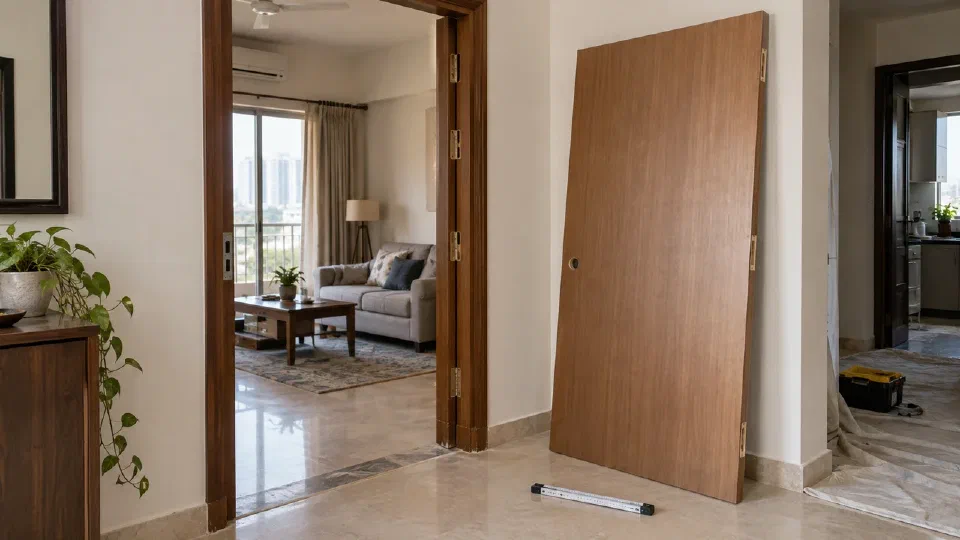
Take measurements that describe the opening
Record width at the top, middle and bottom, and height at both sides. Check diagonals, plumb and the rebate. Map the finished floor through the full swing, including rugs or thresholds that will remain. Record which side carries the hinges and where the door must open.
Keep four items separate: the structural opening, the finished frame opening, the rebate and the required finished leaf. Do not send the smallest tape reading to a factory as a production size without the fitter’s allowance and the leaf supplier’s requirements.
Illustrative geometry: a frame opening measuring 812, 808 and 810 mm across three heights does not accept an 812 mm leaf simply because that was the largest measurement. The narrowest point constrains fit, but squareness, rebates and operating gaps still determine the final leaf size. These example readings are not tolerances or recommended clearances.
Before manufacture, label each measured face and opening position on a sketch. A frame can measure wide enough but be out of square; diagonals and the position of the narrow point reveal what a single width cannot. Also photograph the old hinge mortises and strike recess with a scale in view. This allows the fitter to decide whether sound material remains for new fixings or whether the retained frame needs repair. The approved leaf size should be written by the responsible fitter after these observations, not inferred by the buyer from the tape.
Give the hardware measurements a common starting point
Two correct numbers can still produce a wrongly machined leaf if they use different reference points. Curtis Lumber’s door-slab measuring guide records hinge positions from the top of the leaf to the top of each hinge, lockset height to its centre, and backset from the door edge to the lockset centre. Use the selected hardware’s drawing and label those points explicitly in the Indian replacement order; the guide’s stock sizes are not Indian requirements.
| Field on the survey | Label the reference points |
|---|---|
| Each hinge position | Leaf top to hinge top, plus hinge length, width and corner shape |
| Lock or latch position | Leaf top to the specified operating centre |
| Backset | Relevant door edge to the lockset’s operating centre, confirmed against the hardware drawing |
| Handing | Sketch hinge side and swing viewed from a named room |
Do not transfer old positions blindly if the frame has moved or the new hardware differs. The fitter must reconcile the survey with the sound fixing zones and approved final leaf position before machining.
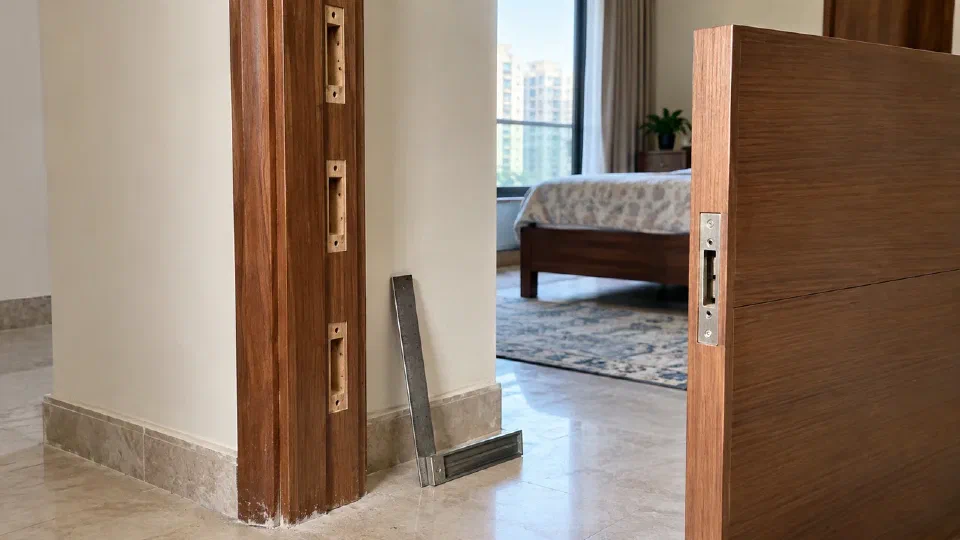
Check cutting and hardware limits before payment
Door constructions have different permitted trimming and machining. Cutting too far can remove lipping, expose a void or compromise a fixing zone. JELD-WEN’s trimming guidance explicitly makes allowances product dependent. Obtain equivalent written instructions for the actual leaf being ordered in India.
The JELD-WEN example makes the variation concrete: its UK table allows no top trimming on some primed timber feature doors, fire doors and bi-fold doors, while other listed interior types have a top allowance. These are not transferable limits. They show why a replacement decision must be made against the exact product sheet before anyone promises to cut a stock leaf to fit an old frame.
A heavier replacement also changes what the hinges and retained frame must carry. Have the fitter specify the complete hinge arrangement, suitable fasteners and usable material at the mounting locations. Reusing a decorative handle does not mean the latch case or strike position will fit.
Ask the quotation to state whether it includes old-leaf removal, hardware recovery, redundant mortise repairs, edge finishing, paint touch-up and disposal. Record who pays if the retained frame proves unsuitable after inspection, before the replacement is made.
Handover checks
Operate the fitted leaf through its full intended travel. Check for rubbing, latch alignment, loose hinges, damaged finishes and access to any emergency release. Confirm that freshly machined edges have received the treatment required by the door supplier. Save the product identity and the final hardware list.
Do not accept aggressive planing as the automatic cure for a frame that is out of alignment. The survey should identify which component needs correction and why.
Convert the survey into a leaf order
The purchase decision has three outcomes: retain, repair then retain, or replace the frame. Ask the fitter to price the middle option separately. A repairable hinge recess need not trigger wholesale removal; extensive deterioration or an incompatible rated assembly should not be disguised as a leaf-fitting job.
Write the finished leaf size separately from the stock size. For example, if an approved finished leaf is 804 mm wide and the candidate blank is 810 mm wide, the total width reduction is 6 mm. Sharing that equally would remove 3 mm from each edge. This is hypothetical arithmetic, not approval to trim: each affected edge must have sufficient allowance, and the lock block, lipping and any labels must remain compliant with that exact product’s instructions.
The JELD-WEN product table already cited lists zero trimming on all edges of its bi-fold doors. A smaller required reduction does not make cutting permissible where the allowance is zero. Obtain a suitable size or construction instead.
Finally, approve a finish sample beside the retained frame. New veneer, paint sheen and aged timber can differ even when the colour name matches. Decide whether the frame will be refinished, touched up or intentionally contrasted before ordering the leaf.
Indian references and one maker’s real trimming limits
Two Indian Standards give the frame survey a vocabulary. IS 4021 specifies timber door, window and ventilator frames, and IS 4913 is BIS’s code of practice for the selection, installation and maintenance of timber doors and windows. Neither replaces the survey of your frame, but both help a fitter and buyer describe sections, fixings and condition in the same terms.
Trimming limits are product specific, and one published table shows how much they vary. JELD-WEN’s UK trimming table gives these allowances for its own internal doors:
| JELD-WEN door type (UK) | Top | Bottom | Each side |
|---|---|---|---|
| Primed and fully finished doors | 6 mm | 6 mm | 6 mm |
| White oak timber feature doors | 5 mm | 5 mm | 5 mm |
| Primed timber feature doors | None | 5 mm | 4 mm |
| Fire doors | None | 6 mm | 4 mm |
| Bi-fold doors | None | None | None |
These figures belong to those products only. They show why the replacement leaf’s own sheet, not a carpenter’s habit, decides whether an 810 mm blank can become an 804 mm leaf. Ask the Indian supplier for the equivalent table for the exact leaf before ordering.
Check the frame foot for termites and rot before keeping it. Pre-construction soil treatment is a building-level measure under IS 6313 (Part 2):2022; a new leaf cannot compensate for a frame foot that has already been attacked.
Evidence and Verification Notes
IS 4021, IS 4913 and IS 6313 (Part 2) were checked by title and edition in September 2026; confirm current editions before relying on a clause. The trimming table is JELD-WEN’s published UK guidance for its products, quoted as an example of how allowances differ, not as a limit for any Indian door. Measurements in the worked examples are illustrative.
Frequently Asked Questions
Can I keep the frame and replace only the door?
Yes, when the survey confirms compatibility. A leaf-only replacement is unsuitable if retaining the frame means accepting unsafe fixings, unresolved damage or a door cut beyond its documented allowance.
Will keeping the frame avoid all tile and paint damage?
No. It can reduce disturbance, but hinge repairs, hardware changes and surrounding finish conditions may still require making good. Include those items in the scope.
Can an old entrance door be replaced with any solid-core door?
No. Establish building, fire, security and access requirements first. This guide concerns room-door retrofit decisions and does not approve a substitution in a rated doorset.
How should an old frame be measured for a new leaf?
Record the finished opening at several heights and widths, the rebate, diagonals, hinge positions and floor condition. The fitter must convert those observations into the finished leaf size and allowances.
Can the existing hinges always be reused?
No. Check their condition, capacity, fixing zones and compatibility with the new leaf. A heavier or differently machined leaf can require a different documented arrangement.
What should the replacement quote say about making good?
State who removes the old leaf, repairs the frame, alters hardware, seals cut edges and repairs paint, tile or adjacent finishes. This prevents a leaf-only quote from being mistaken for a completed retrofit.
What size door should I order for an existing frame?
Measure the frame opening at the top, middle and bottom and the height at both sides, check the diagonals and rebate, and let the fitter set the finished leaf size from the narrowest point less the operating gaps. Then confirm that any trimming from the stock size stays within the leaf maker’s written allowance.
How much can a new door be trimmed to fit an old frame?
Only as much as that leaf’s maker allows. Allowances differ by product: JELD-WEN’s UK table permits 6 mm from each edge of its primed and fully finished doors but no top trimming on its fire doors and no trimming on bi-fold doors. Ask your supplier for the exact leaf’s table before cutting.
For a project in Gurugram or Delhi NCR, use WoodAge’s custom furniture service to discuss the measured requirement and written scope. Product suitability and the final BOQ must be confirmed for the actual order.
Related Guides From WoodAge
- Door material comparison - for leaf construction and surface choices.
- Main-door lock guide - for lock compatibility with a door assembly.
- Interior handover snag list - for recording operation and finish defects.
- Repair, modify or replace furniture - for a condition-based reuse decision.
- Sliding and Pocket Doors: Space, Privacy and Wall Planning - Useful next reading on hardware planning, costs, materials, or execution.
- Why a Wooden Door Sticks: Hinges, Moisture or Floor Levels - Useful next reading on hardware planning, costs, materials, or execution.