

Sofa Foam Density vs Firmness: Read the Cushion Specification
Foam density and firmness measure different properties. Compare sofa cushion grades, test conditions, layers and seat support before choosing 32 or 40 density.

- Kautuk Sahni
- 9 min read
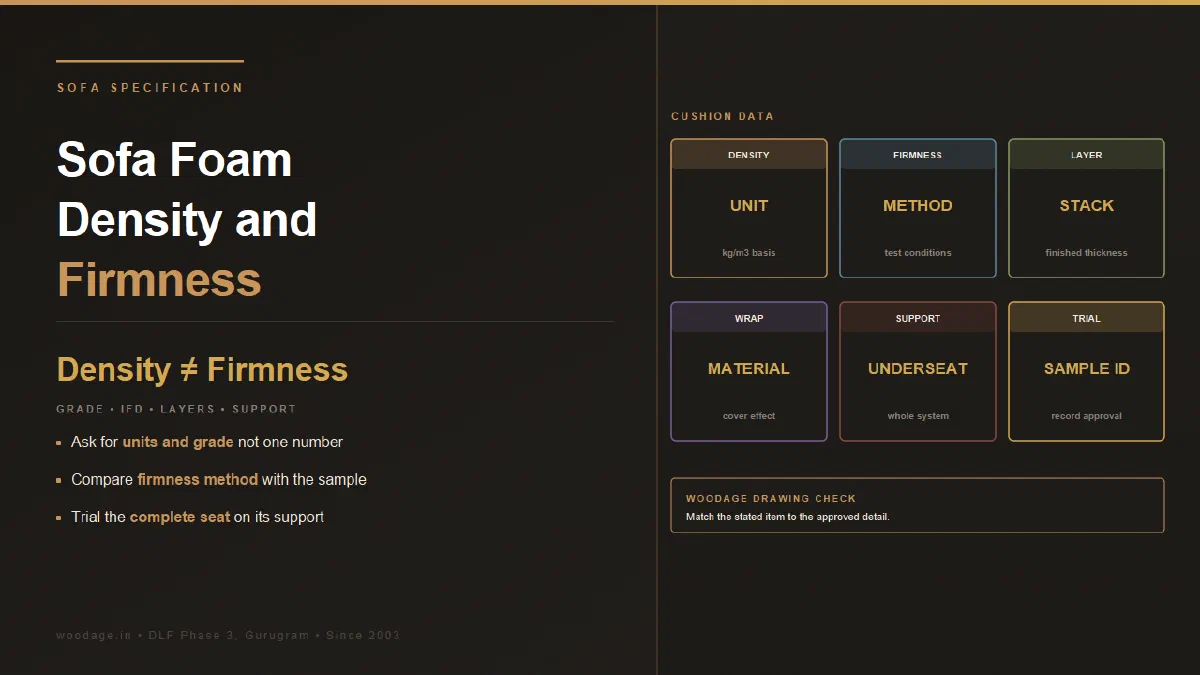
Quick answer: Foam density is mass per unit volume; firmness describes resistance to indentation. A 40 kg/m3 foam is not necessarily firmer than a 32 kg/m3 foam. Compare the exact foam grade, firmness test, thickness, cushion layers and seat support, then test the complete cushion in the intended sofa.
WoodAge is a factory-direct furniture and interiors manufacturer in Gurugram, working since 2003. A useful sofa specification explains what the buyer will receive without converting a density number into a promised feel or service life.
What to verify in the foam specification
The Polyurethane Foam Association’s performance guidance distinguishes density, firmness, support and fatigue. Its glossary also defines indentation and fatigue terminology. These properties should not be collapsed into “higher density is harder and lasts X years.”
| Property | What to request | What it does not prove alone |
|---|---|---|
| Density | kg/m3, named grade and supplier | Firmness or an exact lifespan |
| Firmness | Test method, indentation level and result | Comfort in every cushion construction |
| Support behaviour | Relevant supplier data and intended application | Suitability for every user |
| Thickness | Finished layer thicknesses | That a thin test sample feels like the sofa |
| Construction | Core, comfort layer, wrap and cover | Performance of the seat suspension |
| Fatigue result | Method, conditions and stated change | A calendar-year warranty |
IFD and ILD terminology appears in foam discussions. Compare results only when the test method, units, sample and conditions are comparable. Two numbers without that context can mislead more than a physical trial.
The Polyurethane Foam Association’s performance guide explains the distinction more precisely: its firmness measure is the force needed for 25% indentation, while its support factor compares force at 65% indentation with force at 25%. A foam can therefore have a soft initial feel and still resist deeper compression. The association also describes flex-fatigue tests as repeated compression followed by measurements of firmness and height change. Ask for the named foam’s relevant data and test conditions rather than turning any one figure into a lifespan promise.
A density calculation you can check
Illustrative arithmetic: a plain foam block measuring 0.60 x 0.60 x 0.10 m has a volume of 0.036 m3. At 32 kg/m3 its calculated mass is 1.152 kg; at 40 kg/m3 it is 1.440 kg. The calculation says nothing about which block feels firmer.
The mass difference in that example is 0.288 kg for the same block size. This is arithmetic from stated hypothetical dimensions, not a measured WoodAge cushion or proof of the foam’s polymer density. PFA notes that fillers and reinforcements can affect a reported bulk density, so a supplier’s named grade and test sheet are more informative than weighing a wrapped cushion.
Check the unit before comparing offers. A quote that says only “D32” or “40 density” is incomplete: ask whether the result is in kg/m3 or pounds per cubic foot, and request the named product’s test sheet. The Polyurethane Foam Association lists both units for density. Bare numbers from different units are not comparable.
Use the calculation to challenge a quote, not to choose a feel. If two sellers both write “40 density” but one supplies a named grade with a 25% IFD result and the other supplies only a verbal description, their offers are not yet comparable. Ask both for the same four fields: foam product and supplier, density basis, firmness result with method and units, and the finished layer stack. PFA’s performance guidance explains why density and firmness must be specified separately. The buyer can then trial the actual constructions and ask the seller to record which one was approved.
This is not a method for certifying a finished cushion by weighing it: fabric, fibre wrap, adhesive, moisture and other layers change the mass. Verification needs the identified foam product and suitable testing, not the sofa’s total weight.
Why the same foam can feel different in two sofas
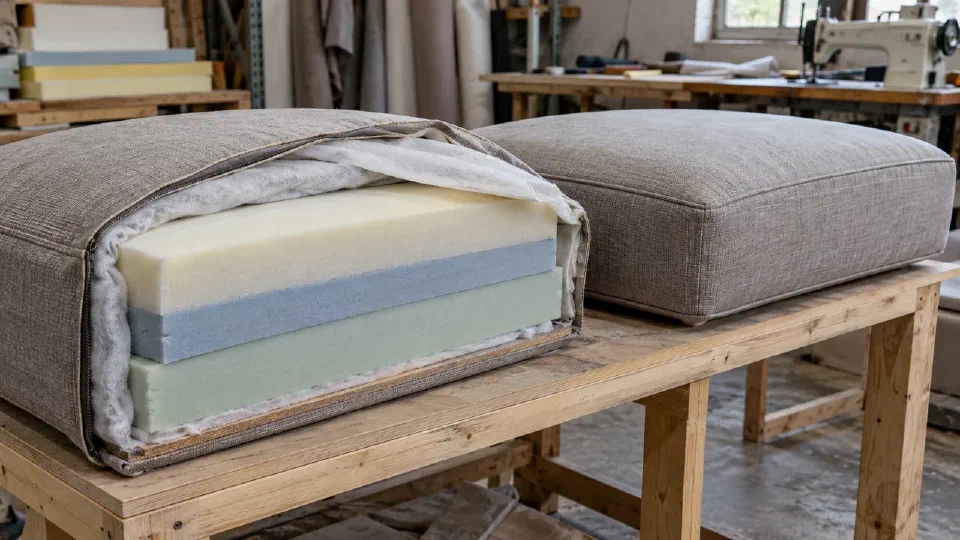
Cushion thickness, layer arrangement, cover tension, usable seat depth, back support and the structure under the cushion affect the sitting experience. A sample squeezed between fingers is not the same loading condition as a person sitting on a finished seat.
Ask to trial a representative cushion on the proposed support arrangement. Record the sample’s identification and dimensions. If the final upholstery is much tighter or the cushion construction changes, the original approval no longer describes the complete result.
Copy this cushion specification
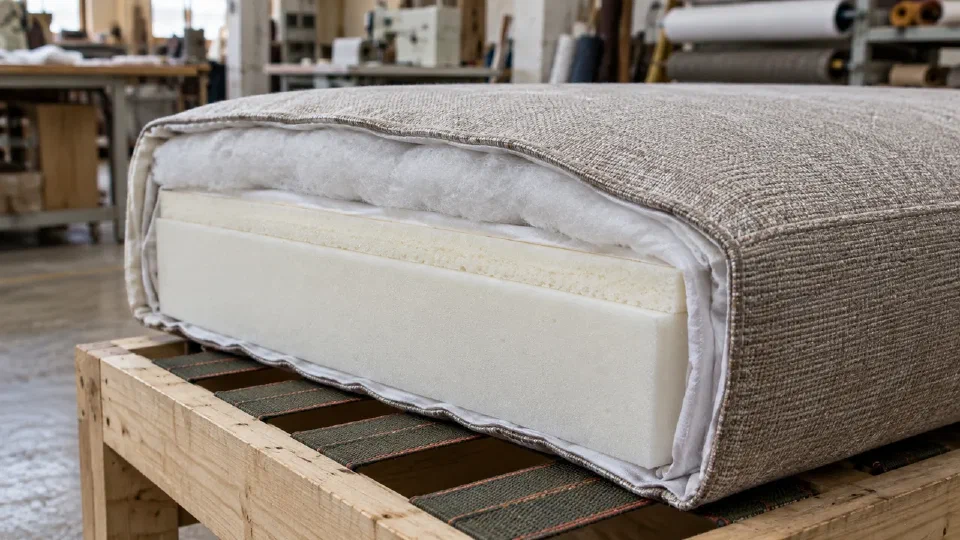
Supplier and grade: __. Core density: __ kg/m3. Firmness result and method: __. Layer thicknesses: __. Wrap: __. Cover and lining: __. Seat support arrangement: __. Trial sample ID: __. Approved sitting feel: __. Replacement insert dimensions: __. Written warranty and exclusions: __.
For a quote comparison, ask what changes when moving between foam options. Is the difference the grade, layer thickness, cushion size or whole construction? A price increase described only as “premium 40 density” is not a complete specification.
The test standards behind the numbers
Ask which method produced each figure on a foam data sheet. The common ones are:
| Property | Standard | What it tells you |
|---|---|---|
| Indentation hardness (firmness) | ISO 2439 | Force needed to indent the foam to a stated depth, comparable between foams tested the same way |
| Fatigue by constant-load pounding | ISO 3385 | Loss of thickness and hardness after repeated loading: how much a seat softens with use |
| Compression set | ISO 1856 | Permanent loss of thickness after being held compressed: the dip where people always sit |
| Indian test methods | IS 7888, a BIS standard for flexible polyurethane foam | Methods an Indian foam maker may cite; check for the current revision |
A worked support-factor comparison. Support factor is force at 65% indentation divided by force at 25%, and the PFA gives a typical range of about 1.5 to 2.6. Two illustrative foams with the same 25% figure can behave very differently:
| Example foam | Force at 25% | Force at 65% | Support factor | What you feel |
|---|---|---|---|---|
| Foam A (illustrative) | 30 | 54 | 54 / 30 = 1.8 | Same first touch, then sinks towards the base |
| Foam B (illustrative) | 30 | 75 | 75 / 30 = 2.5 | Same first touch, but pushes back as you sink |
Neither density nor a single firmness value would reveal that difference. High-resilience (HR) foam is a foam type with a higher support factor than conventional foam, defined in the US by ASTM D3770; a seller who says “HR” should still state density and firmness.
Backs and arms take different foam from seats. They carry less load, so a softer, lower-density foam is normal there. A quotation that lists one foam for the whole sofa is incomplete. In Delhi NCR homes without constant air-conditioning, a memory-foam layer will also feel softer in the hot months than in winter, because viscoelastic foam responds to temperature; keep it as a thin comfort layer over a supportive core.
Evidence and Verification Notes
Definitions of firmness and support factor follow the Polyurethane Foam Association’s published guidance; the tests are identified by their ISO scope pages and the BIS standard by its archived copy, checked in September 2026. The support-factor rows are illustrative numbers chosen to show the calculation, not measurements of any product. WoodAge delivers made-to-order sofa projects against a written specification of frame, foam and upholstery; foam layers can be compared in person on a WoodAge factory visit, and cover fabrics in the sofa fabric guide.
Frequently Asked Questions
Which is better, 32 or 40 density foam?
Neither number alone answers the purchase question. Compare named products for the same intended use, including firmness, construction and trial results. Do not rank an unknown 40-density product above a documented alternative solely because the number is larger.
Can high-density foam feel soft?
Yes. Density and firmness are different properties. Request the firmness specification and try a representative cushion rather than assuming a dense foam will feel hard.
Will a firmer cushion solve a sagging sofa?
Not if the problem lies in the supporting suspension, attachments or frame. Diagnose the whole seat before replacing foam. A firmer insert may temporarily disguise a support fault.
Does this establish a medical or orthopaedic benefit?
No. A furniture specification cannot diagnose or treat pain. Choose for practical comfort and seek appropriate clinical advice for a medical requirement.
Is a density certificate enough to approve a cushion?
No. It identifies a material property, subject to the stated basis and test conditions. Match the certificate to the named foam grade and ask separately for firmness, layer thicknesses and the support below the cushion. The complete seat still needs a representative sitting trial.
What is support factor in foam data?
It compares force at a deeper indentation with force at a shallower indentation under a stated method. Use it only with the named product and comparable test conditions.
Can a foam specification guarantee a fixed lifespan?
No. Product data, cushion thickness, seat support, cover tension, use and care all matter. Avoid converting a density or fatigue result into an unsupported number of years.
What is HR foam in a sofa?
High-resilience foam is a polyurethane foam with a more random cell structure than conventional foam, giving a higher support factor and more surface bounce, so it supports better as you sink in. HR names the foam type, not a density, so ask for its density, firmness result and the method used.
What is compression set, and why does it matter for a sofa?
Compression set is the permanent loss of thickness after foam has been held compressed, measured under ISO 1856. A foam with poor compression-set results develops a lasting dip where people always sit. Ask for the result and test conditions alongside density and firmness.
For a project in Gurugram or Delhi NCR, use WoodAge’s custom furniture service to discuss the measured requirement and written scope. Product suitability and the final BOQ must be confirmed for the actual order.
Related Guides From WoodAge
- Sofa fabric guide - for selecting and specifying the upholstery.
- Sofa size and configuration - for the sofa footprint and seating layout.
- Solid wood versus plywood - for substrate and frame material decisions.
- Repair, modify or replace furniture - for a condition-based reuse decision.
- Bathroom Mirror Cabinets: Depth, Door Swing and Tap Clearance - Useful next reading on furniture planning, costs, materials, or execution.
- Wall-Hung Vanities: Wall Support and Installation Checks - Useful next reading on furniture planning, costs, materials, or execution.