

Soft Close Hinges and Drawers: How They Work
Understand soft-close hinges and drawer runners, integrated and add-on dampers, load classes, adjustment, temperature effects and safe troubleshooting steps.

- Arpit Sahni
- 11 min read

Soft Close, Explained Properly: The Mechanism, the Failure Modes and the Fix
Soft close is a controlled-closing function, but its mechanism and service procedure vary by product. Integrated and add-on systems may respond differently to door weight, closing speed, adjustment and temperature. Identify the exact hinge or runner article before diagnosing it, then follow that manufacturer’s adjustment and replacement instructions.
WoodAge is a factory-direct modular kitchen and custom furniture manufacturer operating since 2003 and based at 16 SCO, Saraswati Vihar, Chakkarpur, Gurugram 122002. This guide separates the feature name from the product-specific mechanism, load and service procedure.
This page owns the mechanism and troubleshooting intent. For Hettich, Hafele and Blum brand selection, use the live hardware comparison; for delivery substitution checks, use the lower-numbered hardware substitution audit.
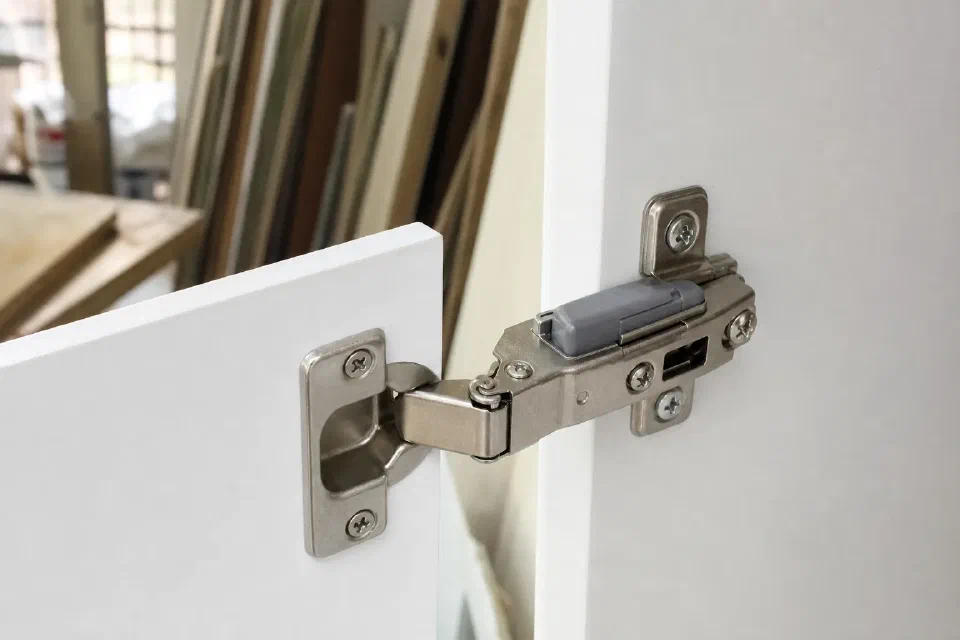
How the mechanism actually works
Many soft-close systems use a hydraulic or fluid-based damper engaged near the end of travel, but the internal design is product-specific. Blum CLIP top BLUMOTION, for example, publishes an integrated, adaptive braking system that can be deactivated on light doors. Use the article’s own documentation rather than assuming every hinge contains the same cylinder.
Three consequences follow directly from that physics, and they explain most complaints:
- Closing behaviour can depend on speed and load. Blum states that BLUMOTION adapts to closing speed and door weight. That does not mean every system behaves identically.
- Temperature can change closing speed. Blum’s temperature guidance says operation outside its design range can change speed without necessarily damaging the unit, and normal behaviour should return at design temperature.
- Cycle and warranty claims belong to named products. Do not assign a generic lifespan to a damper. Record the article, test claim and warranty, then follow the replacement route stated for that system.
Integrated versus add-on dampers
This distinction decides whether a repair is simple or annoying, and it is worth asking about before you buy.
| Integrated damper | Add-on damper | |
|---|---|---|
| Where it sits | Built into the hinge arm or runner body | Clipped onto the hinge or mounted separately in the cabinet |
| Look | Cleaner, nothing extra visible | A visible small cylinder |
| Adjustability | May have an on/off or strength setting, depending on article | Product-specific; check the compatible damper instructions |
| If closing changes | Follow the article’s adjustment and service instructions; replacement scope varies | A compatible add-on unit may be replaceable separately |
| Typical use | New systems designed with damping integrated | Compatible retrofits or articles designed for a clip-on damper |
The practical advice: choose by documented compatibility and service route, not appearance alone. Hettich publishes a nickel-plated die-cast-zinc Silent System add-on damper for specified applications, including adjustment and a two-damper requirement above a stated door weight. That product-specific rule should not be generalised to other hinges.
Retrofitting an add-on damper can be possible when the manufacturer documents compatibility with the existing hinge and cabinet geometry. Test one named combination before buying a set.
Why your soft close stopped working
Work through these in order. The first three cost nothing to check.
1. The door load changed. A mirror, organiser or rack added to a shutter changes the system the hinge was selected for. Recalculate shutter mass and hinge count against the exact manufacturer’s chart rather than assuming a generic 4 kg threshold.
2. The hinge is out of adjustment. Concealed hinges adjust in three directions. If the door has dropped or moved sideways, the cam may no longer engage the damper cleanly. Re-adjust before assuming failure.
3. Something is obstructing the last 30 mm. A cloth, a wire, a lifted edge band or a bin lid. Open and look.
4. The damping function does not engage. If alignment, obstruction, load and any on/off switch are correct, use the manufacturer’s test and service instructions. The repair may be an add-on damper, hinge, carriage or complete runner depending on the article.
5. Screws have loosened in the board. A hinge plate that has worked loose in a low-density core changes geometry. This is a board and screw-seat problem, not a hinge problem. Diagnose it with the cabinet board failure guide.
6. It was never soft close. A quote saying only “soft close hinges” with no article number does not make the supplied function traceable. Reconcile the approved and installed articles with the cabinet hardware substitution audit.
Soft close on drawers is a different component
Hinge soft close and drawer soft close are different components that fail in different ways, even though buyers use one phrase for both.
| Hinge soft close | Drawer soft close | |
|---|---|---|
| What is damped | The swing of a door | The linear travel of a runner |
| Damper location | In the hinge arm or clipped on | Inside the runner, usually at the rear |
| Load sensitivity | Door weight and width | Drawer contents, which change daily |
| Common failure | Damper wear, added door weight | Overloading beyond declared load class |
| Service item | Damper, hinge or compatible add-on, depending on article | Damper carriage, latch, runner or full system, depending on article |
Drawers have the additional problem that their load genuinely varies. A drawer specified for 30 kg and loaded with 40 kg of utensils will not soft close reliably and will wear its runner faster. Match the declared load class to the real contents, as covered in telescopic vs Quadro vs InnoTech drawer channels.
The standards that let you compare two soft-close claims
“Soft close” is a feature name, not a specification. The measurable claims sit underneath it, and two different European standards govern the two different components. Buyers and even many estimators use one word for both.
| Component | Governing standard | What it tests |
|---|---|---|
| Hinges | EN 15570 | Strength and durability of furniture hinges |
| Drawer runners and other extension elements | EN 15338 | Strength and durability of extension elements and their components, applying loads and velocities that simulate both normal use and misuse |
Two things follow that are worth knowing before you compare quotes.
Cycle ratings are published, and they are comparable. Manufacturers state opening-cycle figures for specific product families. Hettich publishes an 80,000-cycle reference for its Sensys hinge family, and Häfele documents 100,000-cycle testing for MatrixBox Premium+ drawer systems. Those numbers belong to named product lines, not to the brand as a whole, so a cycle figure only means something once the article number is fixed.
Load class is essential for comparing runners. Hettich’s AvanTech YOU system lists 10 kg, 40 kg and 70 kg runner load classes and references EN 15338 Level 3; Häfele’s MatrixBox Premium+ is listed in 40 kg and 70 kg versions. Ebco’s Sleek Telescopic range publishes 35 kg for its standard channel and 45 kg for the named SS 304 variant. A loaded drawer above its declared class is outside the published design condition, so measure the load before diagnosing intermittent damping.
Ask for the standard, the tested level and the declared load in kilograms. A vendor who can produce all three is quoting a real product. One who answers “imported soft close” is not.
A symptom-to-evidence diagnostic
| Symptom | Check first | Do not conclude yet |
|---|---|---|
| Door slows but stops short | Obstruction, alignment, on/off setting, door weight and article instructions | That the damper has failed |
| One identical shutter closes differently | Hinge count, adjustment, screw seating and installed article | That the full brand batch is defective |
| Drawer works empty but not loaded | Actual loaded mass, squareness, runner class and engagement | That soft close is a universal fixed-speed feature |
| Behaviour changes with room temperature | Manufacturer’s stated operating guidance and return at design temperature | Permanent damage without the named test |
| New system slams | Article identity, damping setting, installation and compatibility | Counterfeiting from feel alone |
In Delhi NCR, do not attribute behaviour to “summer” or “winter” without checking the article’s published temperature guidance and the actual cabinet condition. A west-facing Gurugram apartment, an air-conditioned South Delhi home and an unconditioned utility can expose the same system differently.
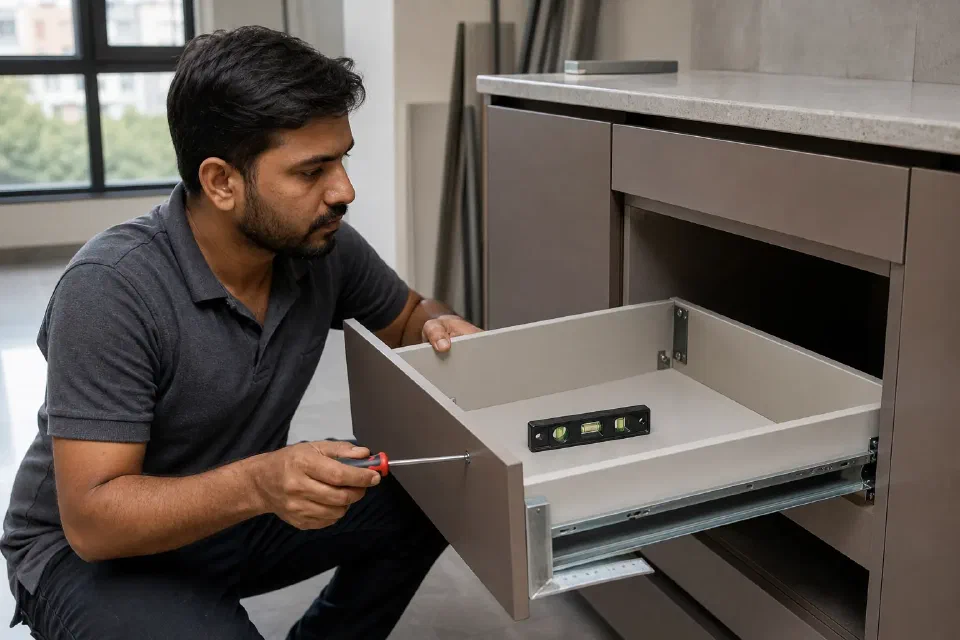
Buyer Decision Checklist for Hinges and Drawer Runners
| Field to put in the BOQ | Why |
|---|---|
| Soft close: yes or no, per item | The commonest silent downgrade |
| Integrated or add-on damper | Decides future repair cost |
| Hinge article number | The only unambiguous specification |
| Hinge count per shutter, by shutter size | Under-hinging causes sag which kills soft close |
| Runner declared load class in kg | Not “heavy duty” |
| Whether accessories will be mounted on shutters | Changes the damper sizing |
| Spare dampers included | Ask for a handful; they are cheap now, annoying later |
For an add-on system, ask whether the exact compatible damper will remain available and record its article number. A spare is useful only when the manufacturer permits replacement and its storage conditions are known.
Maintenance that actually helps
- Do not oil a damper. It is a sealed unit. Lubricant on the outside attracts dust and does nothing inside.
- Keep runner tracks clean. Grit in a runner destroys travel quality faster than age does.
- Do not force or dismantle the mechanism. Follow the manufacturer instructions for use and adjustment.
- Re-check alignment when gaps change. Use the stated three-axis adjustment sequence and stop if screw seats are damaged.
- Clean residue using the manufacturer’s care method. Do not introduce solvent, abrasive or lubricant unless the hardware maker permits it.
Full routines by component are in how to maintain a modular kitchen.
Evidence and Verification Notes for Local Fit Checks
Cycle, load and adjustment statements in this article belong only to the named product family and cited test or manufacturer document. They do not create a brand-wide life promise. Recheck the exact article, declared load, nominal length, compatible cabinet geometry, hinge count, mounting plate, damper setting and current service instructions before a part is specified or replaced.
A Golf Course Road high-rise, a Dwarka Expressway apartment and a South Delhi utility can expose identical hardware to different temperature, dust, load and cleaning conditions. Reproduce the symptom at the declared load, record room condition and inspect squareness, engagement and obstruction before blaming age or identity. Keep the article code and cabinet location in the handover schedule so a later service call remains diagnosable.
Connect the hardware schedule to cabinet geometry on the Gurugram modular kitchen manufacturer page. At a WoodAge factory visit, a sample drawer or shutter can be checked under declared load before the full schedule is ordered.
Frequently Asked Questions
Why has my soft close stopped working?
Start with the article number, then check obstruction, door or drawer load, alignment, mounting screws and any damping switch. Follow the manufacturer’s test instructions before replacing parts. The service item may be a damper, hinge or runner depending on the system.
Can soft close be added to an existing kitchen?
Often yes. Add-on dampers clip onto many standard concealed hinges and can be fitted to existing cabinets without replacing the hinge. Test one cabinet before buying a full set, because compatibility depends on the hinge type and the cabinet geometry.
Which is better, integrated or add-on soft close?
Neither is universally better. Compare compatibility, adjustment, declared load, tested cycle claim, warranty and replacement route. An add-on system can simplify replacement when the manufacturer sells the damper separately; an integrated system can reduce visible parts and may offer product-specific adjustment.
Do soft close hinges wear out?
Any moving system can develop wear, but there is no universal damper lifespan. Use the named hinge’s published cycle test, load conditions and warranty. If behaviour changes, follow the manufacturer’s service route rather than assuming the damper alone failed.
Why does my drawer soft close work sometimes but not always?
Check whether the symptom changes with load, closing speed and room temperature, then confirm the drawer is square and within the runner’s declared load. These variables are documented for some systems, but persistent failure needs the exact manufacturer’s diagnostic procedure.
Is soft close worth paying extra for?
Compare it by component. The benefit is easiest to notice on frequently used drawers and shutters, but value depends on the price difference, load, noise brief, article quality, warranty and replacement route. Ask for the exact soft-close and standard-close alternatives on the same BOQ line.
Are Hettich and Blum hinges compatible with each other?
Not reliably. Cup drilling positions, mounting plate geometry, overlay and adjustment mechanisms differ between manufacturers, so mixing a Hettich arm with a Blum plate is not a supported combination. Replace like with like using the article number, and keep one brand within a single cabinet run so alignment and closing behaviour stay consistent.
What is a Quadro channel?
Quadro is a Hettich undermount drawer runner family, where the runner sits beneath the drawer box rather than on its sides, which hides the hardware and gives a cleaner drawer interior. Undermount systems generally cost more than side-mounted telescopic channels and are specified by declared load class and nominal length, exactly like any other runner.
Related Guides From WoodAge
- Hettich vs Hafele vs Blum Kitchen Hardware - Choosing the hinge and runner brand.
- Telescopic vs Quadro vs InnoTech Drawer Channels - Runner systems and load classes.
- Cabinet Hardware Substitution Audit - Confirming the approved soft-close article and quantity were installed.
- Grass vs Ebco vs Godrej - Brands beyond the usual three.
- How to Maintain a Modular Kitchen - Keeping hardware working.
- Kitchen Repair vs Replacement - When a hardware fix is no longer enough.
Get a Factory-Direct Quote
If you are planning interiors in Gurgaon or Delhi NCR, WoodAge can help you convert the idea into a measurable BOQ: exact material grade, hardware model, finish code, timeline and warranty terms before production starts.
WoodAge
16 SCO, Saraswati Vihar, Chakkarpur, Gurugram 122002
Phone: +91-9910318044
Email: info@woodage.in
Website: woodage.in