

Soundproof Doors for Apartments: What Actually Cuts Noise
Why gaps around a door can leak more noise than the leaf: perimeter seals, drop-down bottom seals, solid cores, STC and Rw ratings, and the test report to ask for.

- Kautuk Sahni
- 11 min read
Soundproof Doors for Apartments: Seals, Thresholds and Core Mass, in the Order That Matters
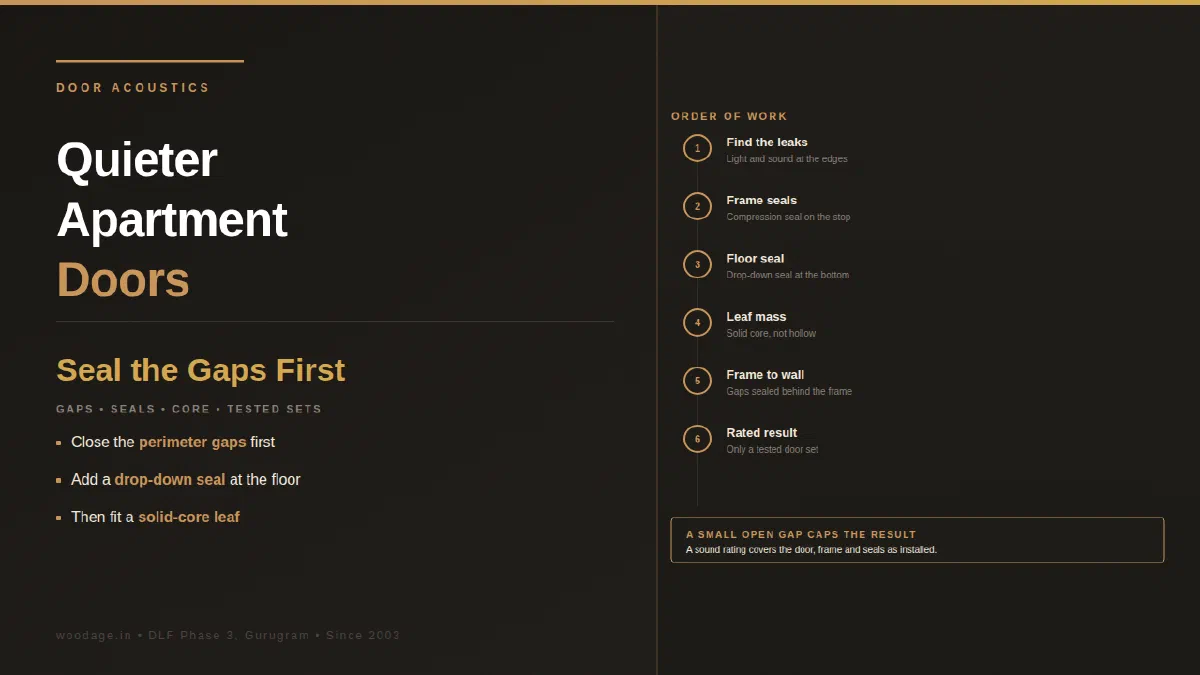
Gaps around a door can let more sound through than the leaf, because even a small open gap caps what the door can stop. Close the gaps first: a compression seal on the frame stop and a drop-down seal at the bottom. Then replace a hollow-core leaf with a solid core. Only a tested acoustic door set gives a rated result, for the complete door, frame and seals as installed.
WoodAge is a factory-direct modular kitchen, wardrobe and custom furniture manufacturer operating since 2003 and based at 16 SCO, Saraswati Vihar, Chakkarpur, Gurugram 122002. In Gurugram and Delhi NCR apartments, three situations usually bring up the question: a television or children’s room across a corridor, a work-from-home call behind a thin bedroom door, and traffic noise on the road side of a tower. The door is one path for that noise, and often not the weakest one.
This guide explains what a seal set, a drop-down seal and a core change can and cannot do, and how to judge an “acoustic door” pitch. Door leaf materials are compared in flush vs membrane vs laminate doors; wall-side acoustic treatments are priced in the wall paneling cost guide.
Quick answer: what each fix does
| Fix | What it addresses | What it cannot do | Relative cost |
|---|---|---|---|
| Adjust the door so it closes evenly | Uneven gaps at the stop | Seal an undercut | Lowest |
| Perimeter compression seal on the frame stop | Gaps at the sides and head | Help if the door does not press onto it | Low |
| Automatic drop-down bottom seal | The undercut, usually the biggest gap | Seal an uneven floor without a flat landing | Low to moderate |
| Solid-core leaf instead of hollow core | Sound through the leaf itself | Anything if gaps remain | Moderate |
| Tested acoustic door set | A rated result for the whole assembly | Stop sound coming through walls, windows or ducts | Highest |
Sealing before upgrading the leaf is not a budget shortcut. It is the order the physics sets, as the next section shows.
Why gaps matter more than the leaf: the arithmetic
Acousticians combine the parts of a wall by how much sound energy each part lets through. An open gap lets almost all of it through. That produces a hard ceiling on what a door can achieve:
| Situation (900 × 2,100 mm door) | Open area as a share of the door | Best possible reduction, even with a perfect leaf |
|---|---|---|
| 10 mm undercut across the full width | 0.9 m × 0.01 m = 0.009 m², about 0.48% of 1.89 m² | About 23 dB, since 10 × log₁₀(1 ÷ 0.0048) ≈ 23 |
| 5 mm undercut | About 0.24% | About 26 dB |
| 1% of the door open in total | 1% | 20 dB, since 10 × log₁₀(100) = 20 |
These are idealised ceilings; real gaps vary with frequency. But they show why an expensive leaf over an unsealed undercut performs no better than the gap allows, and why a trade article on door sound control warns that even a gap under 3 mm can cancel an acoustic door’s benefit.
Mass matters once the gaps are closed. In theory, doubling a single leaf’s mass adds about 6 dB at a given frequency, a relationship known as the mass law; real doors gain less. That is why a solid-core leaf beats a hollow one, and why the gain disappears if the undercut stays open.
Step 1: the perimeter seal
Häfele’s door seal knowledge page describes the two systems homeowners meet: perimeter seals fixed in the frame, and automatic drop-down seals fixed at the bottom of the leaf, in materials such as EPDM, PVC or silicone rubber.
For a perimeter seal to work:
- The door must press onto it evenly. Adjust hinges and the strike so the leaf closes onto the whole seal, not just one corner.
- The seal sits in the stop or a groove in the frame, compressed when the door closes; a seal stuck on the face of the frame, where the door only brushes it, does little.
- The latch must hold the compression. If the door springs back open, the strike needs adjusting.
- Choose the material for the room. Foam strips compress and lose shape; rubber-based seals such as EPDM or silicone hold up better, especially in Delhi NCR’s summer heat.
Step 2: the bottom gap
The undercut is usually the largest single gap. Two options:
- Automatic drop-down seal. Fitted in or on the bottom of the leaf, it drops a rubber strip to the floor as the door closes and lifts as it opens, so the door still swings freely over rugs and tiles. It needs a flat, level landing across the width.
- Threshold with a seal. A raised strip gives the door something to seal against, but any threshold is a trip edge. Keep it low and bevelled, and avoid it on routes used by older family members.
Brush strips reduce light and draughts more than sound.
Check ventilation before sealing. An undercut often works as the air path for a bathroom or kitchen exhaust, or for a room whose air-conditioning return depends on it. Seal it without another air path and the exhaust fan loses its make-up air, the room smells and the door becomes hard to open against pressure. Plan a transfer grille or other air path before sealing those doors.
Step 3: the leaf
A hollow- or cellular-core leaf is light and resonant; a solid-core leaf adds mass. For bedroom and study doors where calls or sleep matter, a solid-core leaf with sealed perimeter and bottom is the practical target. Core types and their standards are explained in the guides linked above; the key check is the label, which should state whether the leaf is solid core.
Glass panels, louvres and vision panels are weak points in any leaf. If a door needs a vision panel, use laminated glass and seal it well.
Step 4: when you need a tested acoustic door
For a home studio, a room beside a lift shaft or a bedroom facing a busy road, a tested acoustic door set may be justified. Before buying one, ask for the test report and read it for these fields:
| Field in the report | Why it matters |
|---|---|
| What was tested | The complete door set: leaf, frame, seals and threshold, or only the leaf |
| Test standard | Laboratory methods such as ISO 10140-2 or ASTM E90 |
| Rating and method | Rw rated under ISO 717-1, or STC rated under ASTM E413 |
| Specimen size and configuration | Seals, threshold and hardware as tested |
| Laboratory | An accredited laboratory, named |
| Date | Current product, not an old design |
Rw and STC are different ratings calculated in different ways; one cannot be converted into the other exactly, so compare like with like. A laboratory result is also an upper bound: the same door installed in a real wall, with real gaps and flanking paths, usually performs worse. We found no BIS product standard specific to acoustic doors in our September 2026 search; a seller claiming an “ISI acoustic rating” should be asked to name the standard.
Is the door really the problem?
Before spending on the door, find the path the noise takes:
- Close the door and listen at the gaps. If the sound is clearly louder at the edges or bottom, seal first.
- Check the wall. Sound from a neighbouring flat often comes through the wall, a shared duct or the ceiling, not the door.
- Check the windows. For road noise, windows and their seals are usually the weakest part of the facade.
- Check shared services. AC ducts, exhaust shafts and pipe openings can carry sound between rooms.
For context, India’s Noise Pollution (Regulation and Control) Rules set ambient noise limits for residential areas of 55 dB(A) by day and 45 dB(A) at night. Those are outdoor ambient limits, not a rating for doors, but they are a useful reminder of the levels quiet rooms aim below.
Market references for seals
| Item | Reference | Source | Unit |
|---|---|---|---|
| Full seal set for one door, fitted | ₹1,500 to 6,000 | Studio Matrx door seals guide | Per door |
| Häfele automatic drop-down door seal | About ₹3,800 | Dealer listing on IndiaMART | Per piece |
| Häfele acoustic door bottom seal, 610 mm | About ₹10,600 to 13,000 | Listing on IndiaMART | Per piece |
All are estimates only, seller or guide-site figures seen in search results on 25 September 2026. Confirm model, length and fitting before ordering; a seal that does not match the door’s thickness or gap will not perform.
Before you buy an acoustic door or seal kit
- Find the noise path: gaps, leaf, wall, window or duct.
- Adjust the door so it closes evenly onto its stop.
- Fit a perimeter compression seal and a drop-down bottom seal.
- Plan another air path for bathrooms, kitchens and rooms whose AC return uses the undercut.
- Replace a hollow-core leaf with a solid core if the leaf is the weak point.
- For a rated result, buy a tested door set and read the report’s fields above.
Evidence and Verification Notes
The gap ceilings are calculated from the standard energy-weighted way acousticians combine building elements; they are idealised and show the scale of the effect, not a prediction for a specific door. The mass-law figure is a theoretical relationship. Seal system descriptions come from Häfele India’s technical page; price references are third-party figures from search results. The CPCB limits are ambient outdoor standards and are quoted only for context. This page makes no dB claim for any product, because no rating is meaningful without a test report for the complete assembly.
For a quiet study or bedroom built as a whole, with storage walls planned around the door, see the Gurugram wardrobe manufacturer page, or look at shutter and seal hardware on a WoodAge factory visit.
Frequently Asked Questions
Can a normal door be made soundproof?
Not soundproof, but noticeably quieter. Adjust it to close evenly, fit a compression seal on the frame stop and a drop-down seal at the bottom, and replace a hollow-core leaf with a solid core. That closes the gaps through which sound leaks most easily. A fully rated result needs a tested acoustic door set installed as tested.
What is the best way to soundproof a bedroom door?
Seal the gaps first, then add mass. A typical bedroom door leaks through its undercut and perimeter gaps, so a perimeter seal and an automatic drop-down seal usually give the largest improvement per rupee. If the door is hollow core, a solid-core replacement adds mass. Check the wall and windows too.
Does a solid-core door block more sound than a hollow-core door?
Yes, because it has more mass, which resists being set vibrating by sound. The gain only appears once the gaps are sealed. A solid-core leaf with a 10 mm open undercut is limited by that gap to roughly 23 dB of reduction, however good the leaf is.
What is the difference between STC and Rw?
Both are single-number ratings of how much airborne sound a building element blocks. STC is the US rating under ASTM E413; Rw is the international rating under ISO 717-1. They are calculated differently, so they cannot be converted exactly. Compare doors only on the same rating from comparable laboratory tests.
Do door seals reduce noise?
Yes, when the door presses onto them evenly and the bottom gap is also closed. A perimeter seal alone leaves the undercut open, and the undercut is usually the largest gap. Choose rubber-based seals such as EPDM or silicone, which hold their shape better than foam strips in summer heat.
Should I seal the gap under my bathroom door?
Only if the room has another air path. The undercut often supplies make-up air for the exhaust fan. Sealing it can starve the fan, trap odour and moisture, and make the door harder to open. Add a transfer grille or other air path first, then seal.
How much does a door seal kit cost in India?
Guide-site and marketplace figures seen in September 2026 ranged from about ₹1,500 to 6,000 for a fitted seal set, with individual branded drop-down and acoustic bottom seals listed from a few thousand to over ten thousand rupees each. Treat these as estimates and confirm the model and fitting.
Is there an Indian standard for acoustic doors?
We did not find a BIS product standard specific to acoustic doors in our September 2026 search. Ratings in the market usually cite international methods such as ISO 717-1 or ASTM E413. Ask the seller for the laboratory report and check that it covers the complete door set as installed.
Related Guides From WoodAge
- Flush vs Membrane vs Laminate Doors - Leaf and finish choices.
- Wall Paneling Cost in India - Wall-side treatments and the rule on dB claims.
- Main Door Locks: Yale, Godrej, Dorset and Ozone - Entrance door hardware.
- Work-From-Home Furniture for Gurgaon Apartments - Setting up a quiet study.
- Master Bedroom Interior Design in Gurgaon - Planning the room around the door.
- New-Possession Inspection Checklist - Check builder doors and gaps early.
Get a Factory-Direct Quote
If you are planning interiors in Gurgaon or Delhi NCR, WoodAge can help you convert the idea into a measurable BOQ: exact material grade, hardware model, finish code, timeline and warranty terms before production starts.
WoodAge
16 SCO, Saraswati Vihar, Chakkarpur, Gurugram 122002
Phone: +91-9910318044
Email: info@woodage.in
Website: woodage.in