

Stainless Steel Modular Kitchen India 2026: When SS Beats Plywood (and When It's a Mistake)
Stainless steel vs BWP plywood kitchen guide for India: SS 304, SS 202, dents, scratches, oil etching and Gurgaon BOQ checks.

- Kautuk Sahni
- 10 min read
Stainless Steel Modular Kitchen India 2026: When SS Beats Plywood (and When It’s a Mistake)
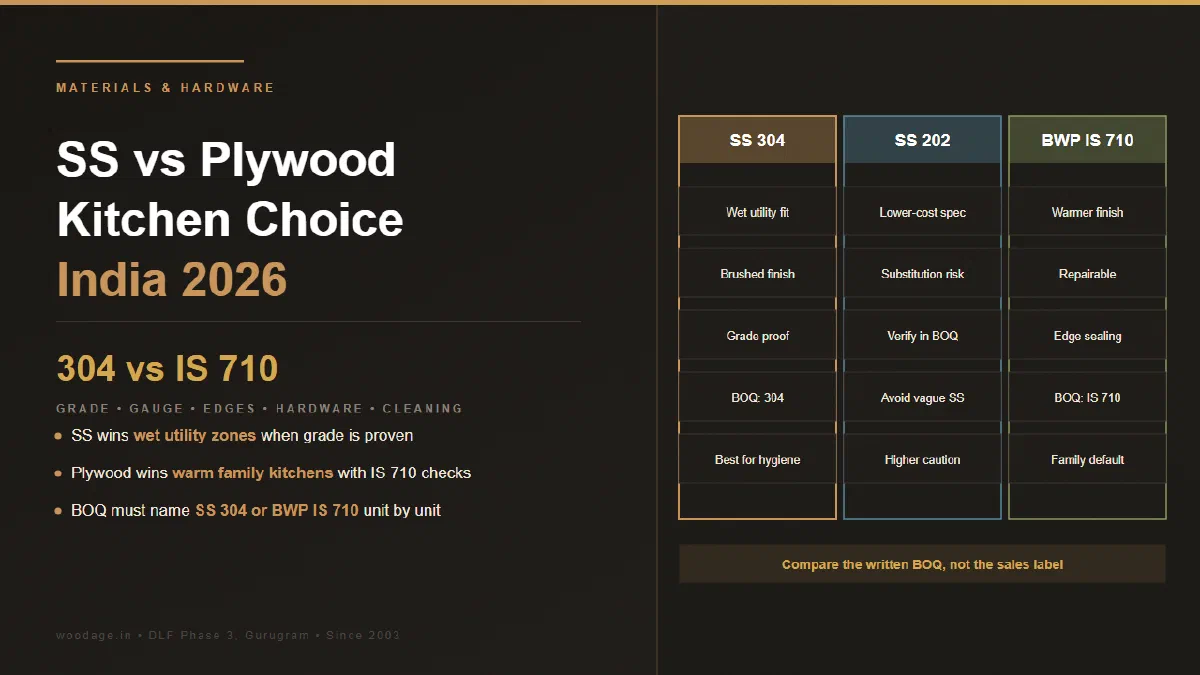
Stainless steel can be preferable when moisture, hygiene or wash-down cleaning matters more than warmth, dent resistance and repair flexibility. For a Gurgaon family kitchen, BWP IS 710 plywood with verified edge banding may be the more familiar starting specification; choose SS only after confirming grade, cooking intensity and BOQ wording.
WoodAge (woodage.in) is a factory-direct modular kitchen and custom furniture manufacturer in Gurugram (Gurgaon), serving Delhi NCR since 2003.
This is an enrich angle for material-comparison readers: it does not replace layout advice, it explains when an SS cabinet body is technically worth considering.
SS vs plywood: the 30-minute decision
WoodAge treats stainless steel as a situational material, not a status upgrade. In a Gurgaon apartment where the kitchen is used for tadka, pressure cooking, daily wet wiping and frequent cabinet access, the right question is not “which material is best?” The right question is: which failure mode can your family live with? SS does not swell like a wet wood-based cabinet and is not a food source for termites, but it can show dents, scratches, cold touch, visible fingerprints and a commercial-kitchen feel. BWP plywood needs better water discipline, but it can accept warm finishes, hardware screws, repairs and future shutter changes.
If you are also comparing aluminium, read the aluminium vs plywood kitchen comparison after this. Aluminium, SS and plywood solve different problems. Lumping all three into “waterproof kitchen” marketing hides the grade, edge, screw-holding and finish questions that decide real life performance.
| Use case | SS 304 | SS 202 | BWP IS 710 plywood |
|---|---|---|---|
| Heavy Indian cooking | Can work if finish is specified and cleaned correctly | Treat as a separate grade requiring verification | Compare against the same cooking and maintenance brief |
| Wet utility or service kitchen | Strong fit | Riskier in humid zones | Needs strict sealing |
| Warm home look | Can feel clinical | Can feel clinical | Best finish flexibility |
| Dent and scratch tolerance | Shows marks on polished finish | Shows marks plus corrosion risk | Repairable shutters |
| BOQ check | Grade must be written | Grade substitution risk | IS 710 stamp must be checked |
What SS grade actually means in a kitchen BOQ
The grade line is the whole game. A quote that says “stainless steel kitchen” without 304, 202, gauge, finish and fastener details is not a specification. SS 304 is a residential specification buyers commonly evaluate because it is associated with corrosion resistance and availability. SS 202 is a different specification and should not be accepted as a silent substitute for 304. SS 316 may be considered for harsher corrosion exposure; confirm whether its properties are necessary for the actual brief rather than assuming a grade upgrade is useful.
For wood-based carcasses, the equivalent discipline is grade verification. The BWP plywood vs HDHMR vs MDF carcass guide explains how IS 710, IS 303 and board selection show up in a kitchen quote.
| BOQ line | Ask for this wording | Why it matters |
|---|---|---|
| Cabinet body | SS 304 or BWP IS 710, written per unit | Stops grade ambiguity |
| Finish | Brushed / matte / anti-fingerprint where available | Polished SS shows scratches faster |
| Fasteners | Compatible stainless fasteners | Prevents mixed-metal staining |
| Hardware fixing | Hettich, Blum or Hafele line plus method | SS fixing differs from wood screw holding |
| Site sample | Physical sample approved before production | Avoids showroom-photo mismatch |
Failure modes buyers rarely hear in SS kitchen sales
The catch: stainless steel solves some failures and creates others. It does not swell like a wet particle board cabinet. It does not attract termites. But it can dent if a heavy cooker or cylinder knocks a panel, it can show scratches on large flat shutters, and oil aerosol near the hob can leave stubborn films if cleaning is irregular. Magnetic catches, concealed hardware and soft-close systems also need compatibility checks. A vendor who cannot explain fixing details should not be trusted with a premium SS BOQ.
BWP plywood has its own weak points: open edges near the sink, low-quality edge banding, wrong adhesive, bad silicone and wet mop water sitting at the plinth. Those are visible workmanship risks rather than grade mysteries. That construction can make plywood straightforward to inspect, repair and upgrade, but the result still depends on the actual BOQ and maintenance.
| Symptom | Likely cause | What to verify |
|---|---|---|
| Tea-coloured marks on SS | Grade or cleaning mismatch | 304 proof and cleaning method |
| Door skin dent | Thin gauge or impact | Gauge and sample panel |
| Drawer feels loose | Hardware fixing issue | Runner brand and fixing bracket |
| Plywood sink base swelling | Water leak or poor sealing | Sink cabinet detail and silicone |
| Edge lifting | Banding or heat issue | PVC/PUR edge specification |
Gurgaon context: where SS makes sense and where it feels wrong
In a Delhi NCR brief, SS may be easier to justify in a wet utility pantry, service kitchen or rental unit where wipe-down cleaning is a stated priority. It may be less suitable in a warm family kitchen where the owner wants wood tones, handleless shutters, quiet hardware and a living-room-adjacent finish. If the kitchen is open to living space, check the proposed SS finish against the rest of the interior rather than assuming that a material label settles the design.
WoodAge’s practical filter is simple: if the kitchen is the visual centre of the home, start with BWP IS 710 plywood and a finish you can live with. If the kitchen is a workhorse zone where water, cleaning and hygiene dominate, compare SS 304 as a separate line item, not as a vague upgrade.
What to write into the SS or plywood quote
Do not approve a material choice from a brochure line. Use a BOQ clause that makes substitution detectable: “Kitchen carcass to be made in [SS 304 / BWP IS 710 plywood] as measured on site; grade, thickness, finish, hardware fixing method, exposed-edge treatment and sink-base detail to be written unit-wise before production.” That sentence turns a sales promise into an inspection checklist.
Cost should also stay as a planning band, not a promise. If your concern is quote escalation, use the modular kitchen cost planning guide and insist that SS or plywood be priced as separate material scenarios with the same layout, hardware and accessories.
The WoodAge recommendation
For a family kitchen that prioritizes finish choice, repairability, screw holding and home-like warmth, BWP IS 710 plywood may be the more suitable starting carcass specification. SS 304 is worth considering when the buyer has a specific moisture, hygiene or utility-kitchen reason and is willing to accept the feel and maintenance trade-off. SS 202 should not be accepted as an unstated substitute.
The proof gap is real: final selection should happen after touching physical samples and reviewing the exact BOQ, not after reading a blog or a showroom label. Bring your cooking style, chimney plan, sink position and cleaning habits to the material conversation. That is where a generic material debate becomes a kitchen that survives your actual home.
See also: To see how each board and finish lasts in Delhi NCR humidity, read WoodAge’s material lifespan guide for the NCR climate.
Stainless Steel vs Plywood: Evidence and Verification Buyer Checklist
| Decision field | Exact fact + adjacent direct source/locator | Buyer application |
|---|---|---|
| General-purpose plywood standard | BIS’s IS 303 page links “Plywood for General Purposes – Specification (fourth revision)” as the named 2024 plywood standard. BIS IS 303:2024 page — HTML heading “IS 303 : 2024” and linked standard title, lines 283–289. | Ask the BOQ to identify the standard and plywood type rather than accepting an unqualified “plywood” line. |
| IS 303 scope | The BIS plywood compendium says IS 303:2024 covers grade, type, class, construction, properties and marking for general-purpose plywood. BIS Compendium of Indian Standards on Plywood — PDF p.3, section “IS 303 : 2024 Plywood for General Purposes – Specification,” bullets under the heading. | Match the proposed board’s grade and marking evidence to the written cabinet specification before approving substitution. |
| High-moisture plywood scope | The BIS compendium states that IS 710:2024 specifies quality, manufacturing and testing requirements for plywood intended for high-moisture and marine applications. BIS Compendium of Indian Standards on Plywood — PDF p.3, section “IS 710 : 2024 Marine Plywood – Specification,” first two bullets. | Treat wet-zone plywood as a separate verification question and record the exact standard claimed for the sink or utility unit. |
| Production traceability | Caple states that drawings, BOMs, cut lists and labels should flow between cabinet-production systems without manual re-typing. Caple Smart Cabinet Making: CAD/CAM & Automation — HTML §1 “CAD/CAM software and smart-manufacturing integration,” lines 115–122. | Request the approved drawing, BOM and unit labels as one traceable package before production. |
| Stainless-steel trade-offs | The NIMI/BharatSkills textbook lists stainless steel as highly durable, low-maintenance and easy to clean, while also noting fingerprints, scratches and smudges as limitations. NIMI/BharatSkills Wood & Carpentry textbook — PDF p.195, “Characteristics and applications of different modular kitchen material,” Stainless steel row, lines 10615–10628. | Compare cleaning expectations and finish tolerance with the household’s cooking pattern instead of treating “durable” as a universal best-material claim. |
| BWP plywood description | The NIMI/BharatSkills textbook describes BWP plywood as having uniform thickness, water resistance and modular-kitchen applications. NIMI/BharatSkills Wood & Carpentry textbook — PDF p.194, BWP Plywood row under “Characteristics and applications of different modular kitchen material,” lines 10500–10513. | Ask for the board description, wet-zone detailing and edge treatment together; the textbook description is not a supplier-compliance certificate. |
Evidence boundary: These sources establish named standards, training descriptions and a production-process control; they do not establish WoodAge pricing, warranty, grade compliance, project outcomes or a universal SS-versus-plywood recommendation. Verify the actual board, finish and BOQ.
Frequently Asked Questions
Is stainless steel modular kitchen better than plywood?
Not always. Stainless steel is better where moisture, hygiene and aggressive cleaning dominate. BWP IS 710 plywood is usually better for Gurgaon family kitchens that need warm finishes, repair flexibility, strong hardware fixing and a home-like look.
Which SS grade should be compared for a modular kitchen in India?
SS 304 is a specification many buyers evaluate for residential work, but the correct choice depends on the brief and the written grade, thickness, finish and fasteners. SS 202 is a different specification, not a silent substitute. SS 316 should be considered only when the actual exposure warrants it.
How much does stainless steel modular kitchen cost in India?
Treat SS as a separate planning band and verify it with a measured quote. Published market ranges vary by grade, gauge, finish, hardware and accessories, so do not compare SS and plywood quotes unless the layout and hardware schedule are identical.
Does stainless steel kitchen rust in Indian cooking?
Good stainless steel resists corrosion, but grade, finish, fasteners, cleaning method and local humidity matter. The risk is higher when the BOQ does not name SS 304 or when mixed fasteners and poor cleaning leave stains near the hob and sink.
What are the disadvantages of stainless steel modular kitchen?
The main disadvantages are cold touch, visible scratches, dent risk, fingerprint marks, a more commercial look and the need for precise hardware fixing. For open Gurgaon kitchens, the visual feel can be as important as the material strength.
Is SS kitchen suitable for Indian heavy cooking?
It can be, but heavy oil aerosol and frequent impact make finish choice important. For daily tadka, pressure-cooker handling and warm interior design, BWP plywood with correct edge sealing is often the more balanced choice.
Related Guides From WoodAge
- Aluminium VS Plywood Modular Kitchen India 2026
- BWP Plywood VS HDHMR VS MDF Kitchen Carcass Delhi NCR
- Pvc Wpc VS BWP Plywood Kitchen Cabinets India
- Factory Made VS Carpenter Kitchen Gurgaon Comparison
- Best Material For Modular Kitchen
- Modular Kitchen Cost Gurgaon 2026
Get a Factory-Direct Quote
If you want this decision turned into a measured BOQ, share your kitchen layout, current site photos and the quote you are comparing. WoodAge can help you separate material, hardware, installation and site-readiness assumptions before production starts.
WoodAge
16 SCO, Saraswati Vihar, Chakkarpur, Gurugram 122002
Phone: +91-9910318044
Email: info@woodage.in
Website: woodage.in