

Termite-Proof and Borer-Resistant Modular Kitchen: Treated Plywood, Boric Salt Treatment and Material Choice
Modular kitchen termite and borer guide: compare plywood, HDHMR and WPC, check moisture and treatment records, and specify protection without a service-life guarantee.

- Kautuk Sahni
- 13 min read
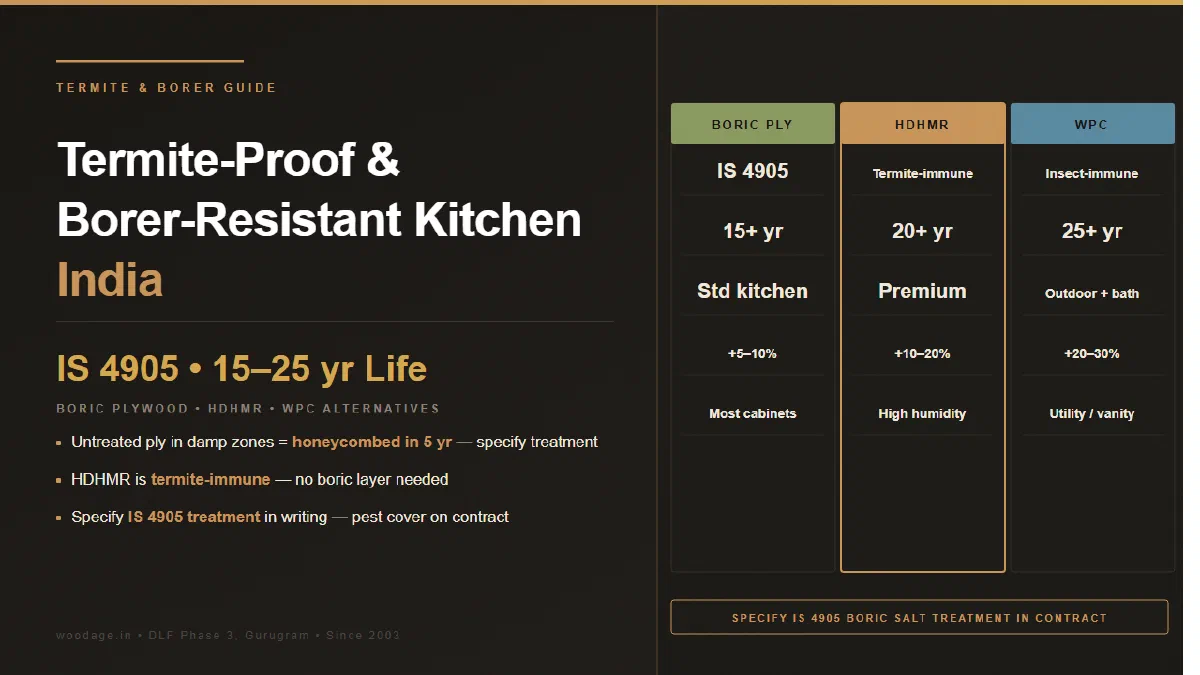
Termite-Proof and Borer-Resistant Modular Kitchen: Treated Plywood, Boric Salt Treatment and Material Choice
Termite and borer risk depends on moisture, leaks, soil or masonry contact, material composition, exposed edges and the treatment actually documented for the selected product. Engineered wood is not automatically pest-proof, and BWP describes water-resistant bonding rather than a guaranteed termite treatment or installed service life. A treatment reference such as IS 401:2001, the BIS timber-preservation code (not IS 4905, which covers random sampling), describes preservation practice; it does not promise that a kitchen will resist attack for a fixed number of years.
WoodAge (woodage.in) is a factory-direct modular kitchen and custom furniture manufacturer in Gurugram (Gurgaon), serving Delhi NCR since 2003.
This guide covers what termites and borers do, how to compare material and treatment evidence, how a reference such as IS 401:2001 (sometimes mis-cited as IS 4905) fits into a specification, alternative strategies (HDHMR, WPC and plywood), and how to write pest-protection requirements without turning them into an unsupported guarantee.
Quick Answer: Best Anti-Termite Material for Kitchen Cabinets
For most Indian modular kitchens, the safer anti-termite specification is treated BWP plywood or quality HDHMR for the carcass, machine-sealed edges on every panel, raised plinth protection and dry plumbing. WPC or PVC can be used in utility or very wet zones, but they are not always the best structural choice for every cabinet. The reliable answer is a pest-resistant system, not one magic board.
| Buyer query | Best answer |
|---|---|
| non termite kitchen cabin material | Ask for the named product’s treatment or resistance documentation; seal edges and control moisture |
| best anti termite material for modular kitchen | Match the board, treatment evidence, edge protection and wet-zone design to the actual cabinet |
| is BWP plywood termite proof | BWP bonding helps moisture resistance, but termite treatment must be verified separately |
| WPC vs plywood for kitchen | Compare the selected WPC and plywood products for pest resistance, structural data, screw holding and wet-zone use |
| how to prevent termites in kitchen cabinets | Keep sink plumbing dry, seal cut edges, avoid cardboard storage and inspect plinth/back panels annually |
Use this guide with the BWP plywood vs HDHMR vs MDF comparison and the edge banding guide, because termite resistance fails first at exposed edges and wet contact points.
What Termites and Borers Attack in Modular Kitchens
Termite Biology
Termites are social insects that consume cellulose (the main structural component of wood). Two types attack Indian homes:
- Subterranean termites can live in soil and enter through ground contact, damp masonry or service openings.
- Drywood termites can live within wood; local species and building conditions should be assessed by a pest-control professional.
What they prefer:
- Moist or water-damaged wood (preferred)
- Untreated solid wood (high cellulose, accessible)
- Cardboard, paper, books (also cellulose)
What they’re less likely to attack:
- Heavily-treated and resin-saturated engineered wood
- Tropical hardwoods with natural resistance (teak, sal)
- Drier wood may be less favourable, but low moisture does not eliminate risk
- Plastics, metals, ceramics
Wood-Boring Beetles
Powder-post beetles, longhorn beetles, and others. Lay eggs in wood; larvae tunnel through it for years before emerging as adults. Damage is gradual - small holes (2 to 4 mm) appearing on surface, sawdust-like “frass” beneath.
What they prefer:
- Sapwood (the outer part of trees, more nutrient-rich)
- Wood with high starch content (often imported pine, certain hardwoods)
- Stored wood (plywood, MDF, particle board) in poorly-ventilated factories
Why Modular Kitchen Cabinets Are Vulnerable
- Constant moisture exposure in kitchens (steam, splashes, humidity from monsoon)
- Shared walls with bathrooms - termite infiltration via moist concrete
- Wood-to-wall contact - without metal isolation strips, soil-borne termites can climb directly into cabinet bottom
- Hidden spaces - back of cabinets, behind appliances; infestation can grow before discovery
Material Resistance Hierarchy
Material labels do not create a universal resistance ranking. Use the table as a verification checklist for the selected product and cabinet zone:
| Material | What can be said safely | What to verify |
|---|---|---|
| Stainless steel | Contains no cellulose for termites to consume | Joints, adjacent boards, moisture and installation still need inspection |
| Aluminium | Contains no cellulose for termites to consume | Coatings, joints and adjacent materials |
| WPC or PVC board | May contain less accessible cellulose than wood products | Product composition, structural data, edge details and the manufacturer’s pest claim |
| BWP plywood to IS 710 | A water-resistance grade; treatment must be verified separately | Named product, treatment record, edges, plinth and warranty wording |
| HDHMR | Density does not itself prove termite treatment | Named product data, treatment statement, screw holding and moisture exposure |
| IS 303 plywood | A general-purpose plywood reference; it is not a termite rating | Grade, product document and the cabinet zone |
| Untreated plywood or particle board | Do not assume pest resistance | Moisture control, edge sealing, treatment and replacement plan |
| Solid wood | Species, seasoning and treatment affect risk | Species identification, moisture, treatment record and contact with damp surfaces |
For a modular kitchen, choose the board and treatment as a system. WPC or PVC may suit selected utility or wet-zone components, while plywood or HDHMR may suit other structures; the correct choice depends on the named product data, span, fixing, exposure and cabinet function.
IS 401 - The Timber Preservation Code (Not IS 4905)
If a quotation cites IS 4905 for timber treatment, it names the wrong standard: IS 4905 covers random sampling, while timber preservation falls under IS 401:2001. Ask for the current edition/reference and the product’s treatment record. A preservation code describes a treatment practice; it does not make a finished kitchen “termite-proof” or assign an installed-life duration.
The treatment method, preservative, penetration and retention are product- and process-specific. Ask the supplier to state what was used, which product it covers, and what inspection or warranty terms apply. Do not infer the treatment from the words “BWP”, “marine”, “boric” or “anti-termite” alone. BWP plywood does not automatically mean termite-treated.
Checking Named Products and Treatments
| Supplier or product name | What to ask for | Why it matters |
|---|---|---|
| Century Plyboards, Greenply, Action Tesa or Kitply | Current product datasheet, grade, treatment statement and invoice match | Brand name alone does not verify the treatment or structural suitability |
| Any named plywood or HDHMR | Product-specific preservative/treatment record and installation limits | A board label is not a service-life promise |
| Any WPC or PVC product | Composition, structural data, fixing guidance and wet-zone limits | Reduced cellulose does not remove every installation or adjacent-material risk |
Ask for the manufacturer’s current document or certificate where offered, and keep the invoice and product identity with the BOQ. A certificate still does not guarantee an installed kitchen against future infestation.
How Termite Treatment Is Applied
Documented Factory or Site Treatment
Treatment routes may include pressure processes, dipping, brushing or an integrated resin/glue treatment. Ask the supplier to document the actual method, preservative, product batch or certificate, and limits of the claim. Do not infer penetration depth, retention or installed service life from the method name alone.
Dipping, Spraying or Brushing
Surface application may be offered for a product or a site cut edge. Its coverage, penetration and re-treatment requirements must come from the current product or pest-control instructions; do not assume that surface protection is sufficient for every cabinet.
Borate in Resin or Glue
Some products may describe borate compounds in a resin or glue system. Treat that as a product-specific claim: verify the named product’s current datasheet and certificate rather than assuming every BWP panel uses the same method.
What’s NOT Treated (Caveat)
- Plywood edges expose the core and need the edge-sealing detail stated in the BOQ.
- Cut edges during installation may fall outside the factory treatment; any site re-treatment must follow the product or pest-control provider’s instructions.
- Drilled holes and fasteners should be checked for exposed material, moisture paths and the specified sealant or treatment.
- Particle board and other fibre products need product-specific evidence; do not infer treatment performance from the board name.
This is why edge banding (covered in our Edge Banding Guide) plus deep-penetration treatment plus careful installation matters as a system.
Site-Specific Termite Risk in Gurgaon
There is no reliable project-name or floor-number risk map. Inspect the actual flat and site history for:
- damp or leaking plumbing, sink bases and bathroom-adjacent walls
- soil, garden, service-duct or masonry contact and unsealed openings
- exposed cabinet edges, gaps behind plinths and inaccessible voids
- previous infestation, pest-control records and the building’s maintenance history
Where risk is material, specify the named board, documented treatment, edge and plinth details, moisture repair and an inspection plan. A higher floor or newer project does not remove the need for an actual check.
What Termite Damage Looks Like
Recognise infestation early to limit damage:
| Sign | What It Means |
|---|---|
| Mud tubes on cabinet bottom or walls | Subterranean termites travelling between food sources |
| Small piles of sawdust-like material near cabinets | Drywood termites or borers excreting frass |
| Wood that sounds hollow when tapped (where it should sound solid) | Termites have hollowed the interior |
| Small holes or frass on a wood surface | Possible borer activity; have the material and dust identified |
| Drooping or sagging cabinet shelves with no visible weight increase | Internal damage compromising structural integrity |
| Winged termites or repeated insect activity | Possible nearby colony or infestation; seek a professional assessment |
If you observe any of these signs, immediate professional pest control is essential - termite damage compounds rapidly.
How to Specify Termite Protection on Your Quotation
Insert into your contract:
“The BOQ shall identify each engineered-wood product, grade, treatment or resistance claim, edge-sealing method and wet-zone detail. The supplier shall provide the current product document or certificate for any stated treatment, identify the preservative or method where the document does so, and state the limits and exclusions of any written warranty. Site cut-edge treatment, if required, shall follow the product or qualified pest-control provider’s instructions. No generic label or code shall be treated as a guarantee of installed service life.”
Pest Control Best Practices for Existing Kitchens
Annual Maintenance
- Inspect cabinets visually for mud tubes, frass, or damage signs
- Check moisture-prone areas (under sink, near dishwasher)
- Verify caulk and sealant integrity around cabinets
Periodic Treatments
- Re-treatment only at the interval and by the method specified by the product or qualified pest-control provider
- Floor or building treatment only after a qualified pest-control assessment and in accordance with building rules
- Routine inspection based on the building’s conditions, maintenance records and any signs of activity
Things to Avoid
- Storing wet items long-term in cabinets (creates humidity haven)
- Allowing water leaks under sink to persist
- Permanently piling cardboard or paper inside cabinets (food source for termites)
- Using cabinet for permanent moisture storage (e.g., wet mops)
Material Strategies for Different Risk Levels
Lower-Exposure Conditions (No Soil Contact, Dry Plumbing)
- A named board and any treatment documented by the manufacturer
- Standard installation practices
- 18 mm carcass throughout
Higher-Exposure Conditions (Damp, Ground Contact or History of Activity)
- BWP plywood or another named product with documented treatment where appropriate
- HDHMR or WPC only where the selected product data supports the cabinet function and exposure
- Site cut edges handled according to the product or pest-control instructions
Conditions Requiring Professional Assessment
- Have the infestation, moisture source and building substrate assessed before choosing materials.
- Separate wet-zone, structural and pest-control decisions in the BOQ.
- Set inspection and treatment intervals from the qualified provider’s written recommendation.
See also: To see how each board and finish lasts in Delhi NCR humidity, read WoodAge’s interior material durability guide.
Frequently Asked Questions
Are all BWP plywoods termite-treated?
No. BWP refers to the bonding (boil-water-proof, with phenol-formaldehyde resin), which provides some biological resistance. Termite treatment is an additional process that may or may not be applied. Always verify with the manufacturer’s documentation.
Treatment is specified separately from the bond. For comparison, marine plywood is a different grade, and its 2010 standard, IS 710:2010, since replaced by IS 710:2024, did require pressure preservative treatment, for example a copper-chrome-arsenic retention of at least 12 kg/m³. The 2024 edition is not freely published, so for any board, check the treatment named on the product’s certificate.
Does HDHMR resist termites?
HDHMR may be a suitable option for some cabinet zones, but density alone does not prove termite treatment or guarantee performance. Check the named product’s current treatment statement, moisture limits, screw-holding data and the actual exposure before selecting it.
Is WPC really immune to termites?
No material should be described as universally immune without product evidence. WPC may contain less accessible cellulose and can suit selected wet zones, but composition, structure, joints, adjacent boards and installation still matter. Verify the named product’s pest and water-resistance documents.
How long does termite treatment last?
There is no generic service-life number that can be assigned to every treatment. Ask for the named product’s current treatment document, coverage, installation limits and written warranty. Moisture, cut edges, adjacent materials, infestation pressure and maintenance can change the outcome; a treatment standard is not a durability guarantee.
What you can pin down is which standard the work is supposed to follow, and that is worth naming in the contract. The Bureau of Indian Standards publishes anti-termite measures for buildings as IS 6313, in three parts, maintained by technical committee CED 13:
| Part | Scope | Current edition |
|---|---|---|
| IS 6313 Part 1 | Constructional measures | 1981, reaffirmed 2020 |
| IS 6313 Part 2 | Pre-constructional chemical treatment | 2022, fourth revision |
| IS 6313 Part 3 | Treatment for existing buildings | 2022, fourth revision |
For a kitchen going into an occupied or already-built home, Part 3 is the relevant one — Part 2 covers treatment applied before the structure exists and cannot be retrofitted. If a vendor or pest-control contractor cites “IS 6313” without a part number, ask which part their method follows and request the treatment record naming the chemical, concentration, coverage and date.
Two boundaries matter. A standard describes a method, not a lifespan: conforming to IS 6313 Part 3 does not entitle anyone to promise a fixed number of years. And a treatment applied to the building is separate from the board specification inside your cabinets — neither substitutes for the other.
Standard identification via BIS: IS 6313 Part 2:2022 and the BIS Know Your Standard portal (accessed 23 August 2026). Confirm the current edition and any amendment before relying on it in a contract.
Can I treat existing cabinets for termites?
Yes - periodic borate brush treatment to cabinet undersides and back panels. Professional pest control can apply chemical barriers to flooring around cabinet plinths.
Are my older non-treated cabinets at risk?
Older cabinets should be inspected rather than judged by age alone. Look for moisture, exposed edges, frass, mud tubes and weakened boards, then follow a qualified pest-control or cabinet professional’s recommendation; do not assume replacement or annual treatment is automatically required.
Is there a difference between Indian-treated plywood and imported?
Country of origin does not prove equivalent protection. Compare the named product’s grade, treatment, test or certificate, installation limits and warranty wording directly; imported and Indian products may use different systems.
Do termites attack laminate-faced plywood?
Termites attack the cellulose-rich core, not the laminate. If termites access the panel through edges or cuts, they damage the core; the laminate may remain visually intact while the structure beneath is hollowed.
What about copper-azole vs borate treatments?
Copper-azole is more permanent but has some environmental concerns. Borate is the most common in modern Indian residential plywood - adequate for modular kitchen applications.
Should I worry about termite resistance in dry zones (wardrobes)?
Dry-zone wardrobes can still be affected by leaks, damp masonry or exposed edges. Select materials and treatment from the actual room condition and product documents; floor number alone cannot establish a safe risk category.
Related Guides From WoodAge
- IS Standards for Modular Kitchen Materials - IS 401:2001 covers timber preservation (IS 4905 covers random sampling); verify treatment certifications.
- Edge Banding for Modular Kitchens - Edge banding seals exposed core, preventing termite access.
- Low-VOC and Formaldehyde-Safe Modular Kitchen Materials - Low-VOC and termite-treated specifications can coexist; both should be specified.
- Utility Balcony Design and Cost in Gurgaon 2026 - Utility balconies face highest termite risk; WPC is the preferred material.
- Modular Kitchen Warranty in India 2026 - Termite damage is sometimes covered separately from manufacturing defect; understand your warranty.
- How to Maintain a Modular Kitchen: Complete Cleaning and Care Guide for Laminate, Acrylic, PU Paint, Granite and Hettich Hardware - Useful next reading on hardware planning, costs, materials, or execution.
- commercial plywood grade guide - understand MR, BWR, BWP and commercial ply labels before accepting a material quote.
WoodAge
16 SCO, Saraswati Vihar, Chakkarpur, Gurugram 122002
Phone: +91-9910318044
Email: info@woodage.in
Website: woodage.in
Last reviewed: July 2026. Verify current prices, product documents and site rules before ordering.