

Undermount vs Topmount Sink for Stone Countertops: Bracket Systems, Adhesives and What Works in Indian Kitchens
Undermount sinks need stone countertop, professional installation, and proper bracket systems. This guide compares undermount, topmount and flush-mount sinks for granite, quartz and sintered stone counters with installation requirements and brand recommendations.

- Kautuk Sahni
- 15 min read
Undermount vs Topmount Sink for Stone Countertops: Bracket Systems, Adhesives and What Works in Indian Kitchens
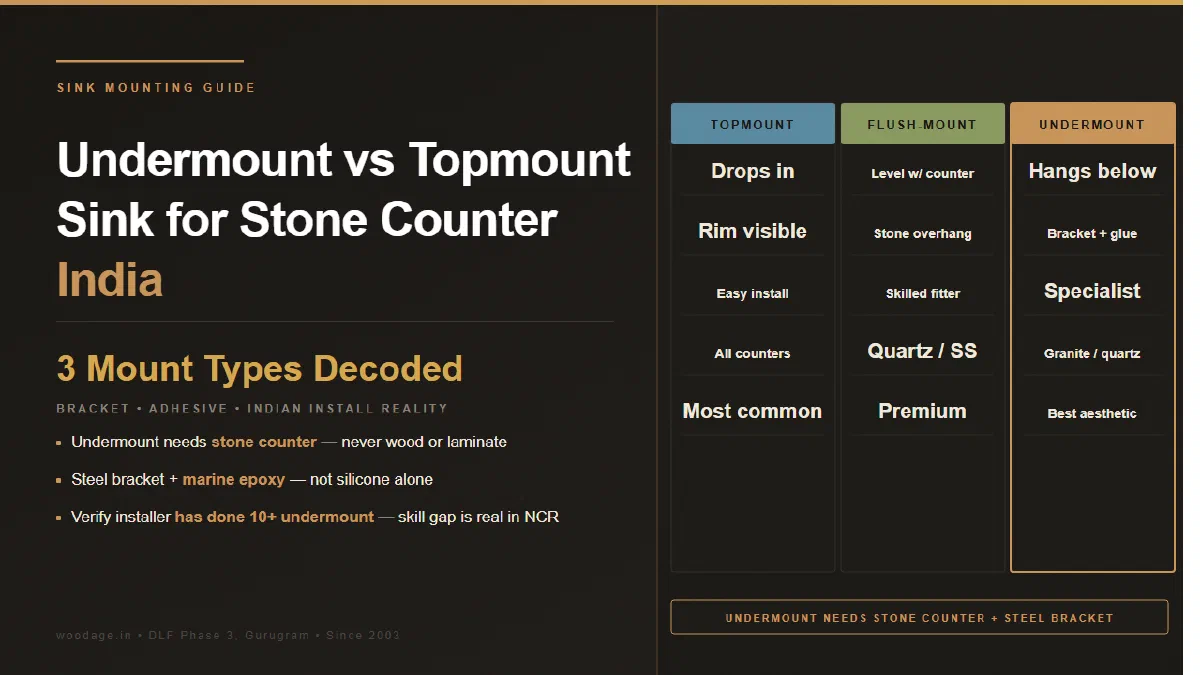
The undermount sink - where the sink hangs below the countertop with no rim visible above - is the premium aesthetic choice for stone countertops. A topmount sink drops in from above and rests its rim on the counter; a flush-mount sits at counter level with neither rim above nor stone overhang; an undermount hangs entirely below. Each has specific requirements for the counter material, the cabinet structure, the bracket system and the installer’s skill - and choosing wrong creates either visible imperfection or, worse, a sink that detaches from the counter under load.
WoodAge (woodage.in) is a factory-direct modular kitchen and custom furniture manufacturer in Gurugram (Gurgaon), serving Delhi NCR since 2003.
This guide covers what makes each mounting style work, the bracket and adhesive systems used in NCR, and the realistic skill availability for proper undermount installation in Gurgaon.
The Three Mounting Styles
1. Topmount (Drop-In) Sink
The most common mounting style in Indian kitchens.
How it works:
- A hole is cut in the countertop matching the sink’s exterior dimensions
- The sink drops in from above
- A rim around the sink’s edge rests on the countertop surface
- Silicone seals the joint between rim and counter
Pros:
- Simplest installation
- Works with any countertop material (granite, quartz, sintered stone, laminate, even plywood with laminate)
- Most economical
- Replacement is straightforward (lift out, drop new sink in)
- Standard installation skill widely available
Cons:
- Visible rim collects crumbs and water at the joint
- Cleaning requires wiping debris from rim onto sink
- Rim acts as a barrier when sweeping water from counter to sink
- Aesthetic less premium than undermount
2. Undermount Sink
The premium aesthetic for stone countertops.
How it works:
- The countertop is cut with the sink hole, but slightly smaller than the sink’s interior
- The sink is mounted below the counter, attached by brackets and stone-suitable adhesive
- The counter’s stone overhangs into the sink basin slightly (10 to 15 mm typical)
- No rim is visible above the counter
Pros:
- Premium aesthetic - clean, continuous counter surface
- Easy cleaning - water and debris sweep directly into sink
- Counter can be wiped without rim obstruction
- Modern, high-end look standard in luxury kitchens
Cons:
- Requires stone or solid-surface countertop (not laminate or wood)
- Higher installation cost (skilled labor, brackets, adhesive)
- Harder to replace later (requires re-cutting counter or removing sink from below)
- If improperly installed, sink can detach from counter under load
- Not all NCR fabricators have the skill
3. Flush-Mount (Tile-In) Sink
Less common; sink rim sits flush with counter surface.
How it works:
- Counter cut precisely to receive sink rim
- Sink positioned with rim at exact counter height
- Joint sealed with epoxy or stone adhesive
Pros:
- Continuous counter surface
- No visible rim or hanging element
- Aesthetic between topmount and undermount
Cons:
- Requires very precise stone cutting (specialised fabricator)
- Limited sink models suitable for this method
- Most expensive installation
- Less common in Indian residential
Best for: Premium installations where neither rim nor undermount aesthetic is desired.
The Counter Material Constraint
Stone Counters (Granite, Quartz, Sintered Stone)
All three mounting styles work, but undermount specifically requires:
Granite:
- 20 mm minimum thickness; 30 mm preferred for undermount
- Can be undermounted; common in NCR
- Edge must be polished if visible at sink rim
Quartz (Engineered Stone - Caesarstone, Silestone, Quartzforms, Marbo):
- 20 mm minimum thickness; 30 mm standard for premium
- Excellent for undermount; very stable
- Wide colour and pattern range
Sintered Stone (Dekton, Lapitec, Neolith, Inalco):
- 12 mm or 20 mm thickness
- Can undermount but installation requires specialised skill
- Highest premium pricing
Marble:
- Can undermount but staining and acid sensitivity make this less practical for kitchens
- Premium aesthetic; high maintenance
Composite or Solid Surface Counters (Corian, Hi-MACS)
- Undermount possible; sink is often integrated into the counter (seamless)
- Topmount works well
Laminate Counters
- Topmount only. Laminate edges are vulnerable to water; undermount exposes the substrate.
- Granite tile counters with laminate substrate also limited to topmount.
Wood / Butcher Block Counters
- Topmount only. Wood not suitable for undermount due to moisture exposure.
Sink Materials That Work With Each Mounting Style
| Sink Material | Topmount | Undermount | Flush Mount |
|---|---|---|---|
| Stainless Steel (304) | ✓ | ✓ | Limited |
| Stainless Steel (Premium 16-gauge) | ✓ | ✓ | ✓ |
| Granite Composite (Blanco, Franke) | ✓ | ✓ | Limited |
| Cast Iron / Enamel | ✓ | Heavy; specialized brackets | Limited |
| Fireclay / Ceramic | ✓ | Possible; specialised | Limited |
| Copper | ✓ | Possible; high maintenance | Limited |
For Indian high-flame, hot-pan kitchens: stainless steel 16-gauge is the standard for both undermount and topmount; granite composite is a premium alternative.
What India’s Sink Standard Covers, and What It Leaves to the Installer (IS 13983)
India’s standard for domestic stainless-steel sinks, IS 13983:1994, Stainless Steel Sinks for Domestic Purposes, which BIS lists as active, reaffirmed in 2019 and carrying four amendments (BIS catalogue), defines two installation types. A sit-on sink rests on its base unit with aprons that continue the cabinet sides; an inset sink fits into a worktop cut-out and projects above the surface only by its formed edge, which is the topmount sink described above. The standard has no undermount type, and it states that it does not specify methods of supporting, fixing or sealing sinks. For an undermount installation, the brackets, adhesive and support in this guide therefore rest on the sink maker’s instructions and the written BOQ, not on the standard.
| IS 13983 requirement | Value |
|---|---|
| Material | Austenitic stainless steel, grade 304 (X04Cr19Ni9) or 302 (X07Cr18Ni9), to IS 5522 |
| Sheet thickness | At least 1.00 mm nominal before forming, and at least 0.75 mm at any point after forming |
| Bowl depth | At least 150 mm (the smaller bowl of some double-bowl types may be 100 mm) |
| Bowl size | At least 370 × 320 mm inside for a rectangular bowl (Amendment 2 of 2006; the 1994 text said 380 × 340 mm), or 360 mm for a round bowl |
| Tap holes | None; two 30 ± 2 mm holes at 180 ± 2 mm centres (300 ± 2 mm for round bowls) for pillar taps; or one 35 ± 2 mm hole for a high-outlet mixer |
The standard also lists what the buyer should state when ordering: sit-on or inset, the sink type, tap holes or none, overflow or none, and the surface finish. Put the same five items on the quotation.
“16-gauge” is a gauge number rather than a unit, while IS 13983 states thickness in millimetres, so ask for the sheet thickness in mm on the quotation. The public copy linked here carries amendments 1 and 2 only; if a later amendment matters to your order, ask the sink maker for its BIS licence details and the current text.
Undermount Bracket and Adhesive Systems
The technical heart of undermount installation. Done properly, the sink hangs securely for decades; done poorly, it detaches.
Bracket Types
| Bracket Type | How It Works | When Used |
|---|---|---|
| Wall-mounted brackets | Brackets fixed to cabinet sides support sink corners | Standard for stone undermount; sink hangs from brackets |
| Bottom-mounted brackets (frame) | Steel frame in cabinet bottom holds sink | For very heavy sinks (cast iron, fireclay) |
| Stone clip system | Specialised clips that grip stone and sink | Premium installations; fewer cabinet modifications |
| Adhesive-only mounting | Bonded with high-strength stone adhesive (epoxy or polyurethane) | Lighter sinks; requires smooth contact surface |
Recommended Adhesive Systems
For NCR stone undermount installations:
- Epoxy adhesive (e.g., Norton, Akemi, Bond Mech): two-part epoxy designed for stone-to-metal bonding
- Polyurethane adhesive (e.g., Sikaflex 11FC, Sikaflex 220): flexible; better impact absorption
- Silicone-based (kitchen grade): for the perimeter seal where stone meets sink (water seal, not structural)
What Holds the Sink
The sink is supported by a combination of:
- Brackets/clips - provides 60 to 80% of the support
- Adhesive - provides 20 to 40% of the support + waterproof seal
- Sealant - provides 100% of the water seal, ~5% of structural support
The combination matters. Adhesive alone fails over time as adhesive ages and water cycles past it. Brackets-alone can transfer too much stress to the sink edges.
Installation Requirements for Undermount
Cabinet Structure
The under-sink cabinet must support the bracket system:
- Solid cabinet sides: brackets need substantial bonding to the sides
- Reinforced bottom: waterproof base in case of leak
- Adequate clearance: sink + plumbing + drainage trap all fit in 600 mm cabinet height
Counter Cut
The stone counter must be cut precisely:
- Hole sized to allow sink basin + 10 mm overhang of stone on each side
- Edges polished (visible from inside the basin)
- Hole positioned within the cabinet’s structural support
- Diamond cutting required (skilled stone fabricator)
Drying Time
- Adhesive cure: 24 to 72 hours minimum before water contact
- Full structural strength: 7 days for full chemical cure
- During this time, the sink should not be loaded
Skill Availability in NCR
Quality undermount installation requires:
- Stone fabricator with diamond cutting equipment and undermount experience
- Sink installer trained in bracket placement and adhesive application
- Cabinet maker who has prepared the cabinet correctly
In NCR, this skill combination is concentrated in:
- DLF Phase 1 to 3 (mature kitchen renovation industry)
- Greater Kailash and South Delhi (premium fabricators)
- Some high-end Gurgaon installers serving M3M, DLF Crest, Sobha, Tata premium projects
For mid-tier and budget installations, undermount skill availability is limited; topmount is the practical choice.
Common Undermount Failures
Failure 1: Sink Detachment Under Load
A heavy pot in the sink causes the brackets to fail; the sink drops 5 to 10 mm or detaches entirely.
Cause: Improper bracket installation; insufficient adhesive cure time; inadequate stone thickness.
Failure 2: Visible Adhesive Smear
Excess epoxy or silicone visible around the sink rim - looks unfinished.
Cause: Sloppy installation; experienced fabricator would clean excess immediately.
Failure 3: Water Seepage Behind Sink
Water gets between sink and counter; eventually drips into cabinet.
Cause: Sealant failure; uneven sink surface; improper sealing.
Failure 4: Counter Overhang Cracking
The 10 mm stone overhang into the sink basin cracks under impact (heavy pot, dropped utensil).
Cause: Granite is more vulnerable than quartz; impact transfers stress through the overhang.
Failure 5: Bracket Visible from Inside Cabinet
Mounting brackets protrude into the cabinet space; obstruct stored items.
Cause: Wrong bracket model selected; should have been low-profile.
Topmount Installation - The Standard Approach
For most NCR kitchens, topmount installation is the practical choice.
Standard Topmount Installation Steps
- Cut counter to sink template (stone fabricator or carpenter cuts the hole)
- Apply silicone bead around the underside of the sink rim
- Lower sink into hole; check positioning and level
- Wipe excess silicone immediately with a clean cloth and isopropyl alcohol
- Tighten any clip mechanisms (some sinks have clips that pull rim against counter)
- Allow 24-hour cure before connecting plumbing
Key Tips for Quality Topmount
- Use kitchen-grade silicone (not bathroom silicone - kitchen silicone is mould-resistant)
- Cut counter precisely; gap-filling silicone is not a fix for poor cuts
- Position sink centrally in the cabinet (not too close to edges)
- Verify the cabinet bottom and sides are square; mis-aligned cabinets cause sink mis-alignment
Specifying Sink Mounting on Your Quotation
Treat the sink cut-out as a separate approval from the cabinet drawing. Put the exact sink model, its manufacturer’s current template and the chosen mounting/reveal detail on the same approval record. Ask the fabricator to distinguish the outer sink size, bowl opening and actual stone cut-out; those are not interchangeable measurements. Record who supplies the template and who confirms it against the delivered sink before cutting.
Before accepting an undermount arrangement, ask the installer to demonstrate the proposed access route to clips, supports, waste fittings and the tap connection. A photograph of an empty cabinet is not proof that those parts remain reachable after the bowl, drawers and plumbing are fitted. Product-specific support, adhesive and curing instructions control; a generic web example must not replace the selected sink and countertop manufacturers’ requirements.
For undermount installation, insert this language:
“Sink: Stainless steel 16-gauge undermount sink, model [brand and model number]. Mounting: bracket-and-adhesive system using stainless steel brackets and two-part epoxy adhesive (Norton/Akemi). Counter cut tolerance: ±2 mm. Stone overhang into sink basin: 10 to 15 mm. Sealant: kitchen-grade silicone at perimeter. Installation by certified stone fabricator with documented undermount installation experience. 5-year warranty on sink mounting integrity (no detachment, no seepage).”
For topmount:
“Sink: Stainless steel 16-gauge topmount sink, model [brand and model number]. Mounting: standard topmount with silicone bead between sink rim and counter. Counter cut precise to template; gaps between sink and counter sealed with kitchen-grade silicone. 2-year warranty on sink installation.”
What to Verify at Installation
Pre-Installation
- Sink model matches specification
- Sink dimensions verified against counter cut template
- Counter material verified (thickness, edge quality)
- Cabinet structure verified for bracket mounting (undermount only)
- Adhesive type confirmed
- Installer experience verified
During Installation
- Sink positioned correctly
- Brackets properly placed (undermount only)
- Adhesive applied evenly; no excess
- Sealant applied at all joints
Post-Installation
- Sink level (no slope or tilt)
- No visible adhesive or sealant excess
- Drain connection sealed
- Pressure test (fill sink, drain, check for leaks below)
- 24-hour cure before regular use
Mistakes to Avoid
1. Undermount on Inadequate Counter
12 mm granite tiles attempted undermount fails. Need 20 mm minimum, 30 mm preferred.
2. Skipping Adhesive Cure Time
Connecting plumbing 4 hours after installation = sink moves under water pressure, damages seal.
3. Generic Brackets
Generic stainless steel brackets don’t match sink-specific mounting holes. Use sink manufacturer’s recommended bracket system.
4. Inadequate Cabinet Structure
Soft, particle-board cabinet sides cannot support brackets reliably. Solid plywood or HDHMR sides are required.
5. Mis-Sized Counter Cut
Cutting too large means insufficient stone overhang; cutting too small means sink doesn’t fit. Templates must be precise.
6. Wrong Adhesive Choice
Using bathroom-grade silicone for stone undermount adhesive is a significant downgrade. Specify epoxy or polyurethane stone-rated adhesive.
7. No Drainage Plan
Some undermount installations neglect proper P-trap or bottle trap routing. Plan drainage with installer.
8. Not Accounting for Future Maintenance
If the dishwasher needs replacement, can the new model fit without dismantling the sink? Plan with future appliance dimensions in mind.
See also: For a factory-direct kitchen from the Gurugram unit, see WoodAge’s modular kitchen manufacturer in Gurgaon.
Frequently Asked Questions
Is undermount worth the premium for an Indian kitchen?
For premium installations on quality stone counters, yes - the aesthetic and ease of cleaning are worth it. For mid-range installations or laminate/composite counters, topmount is the practical choice.
Can I switch from topmount to undermount later?
Difficult. The counter must be re-cut, possibly replaced. Cabinet may need modification. Sink must match the new mounting style. Better to choose carefully at the start.
What’s the typical lifespan of an undermount installation?
With quality brackets, proper adhesive, and good installation: 20 to 25 years before any replacement is needed. The sink itself usually outlasts the installation.
Does undermount sink need different plumbing?
No - the drain connection is the same. Standard P-trap or bottle trap fits any sink mounting style.
Can quartz countertop have undermount sink?
Yes, and it’s actually one of the most popular pairings. Quartz is dimensionally stable, less prone to cracking under sink edge stress than granite.
What about for granite counters with patterns?
Standard granite undermount works fine. The polished edge of the cut hole will be visible; have the fabricator polish it carefully.
Is undermount safe for cast iron sinks?
Yes, but requires reinforced bracket system. Cast iron sinks weigh 30+ kg; specialised heavy-duty brackets and stronger adhesive needed.
What if my fabricator hasn’t done undermount before?
Don’t be the test case. Use a fabricator with documented undermount experience; ask for past project photos and references. Stone undermount installation has a learning curve.
Should I buy the sink before the counter?
Yes - the counter must be cut to match the sink dimensions exactly. Have the sink on-site or with measured templates before counter fabrication.
What about for sintered stone counters?
Sintered stone (Dekton, Lapitec) undermount works well due to extreme strength of the material. Same skill requirements; same adhesive and bracket systems.
Is there an Indian Standard for kitchen sinks?
Yes, for stainless-steel sinks. IS 13983:1994 calls for grade 304 or 302 austenitic stainless steel, sheet at least 1.00 mm thick before forming and 0.75 mm after, and bowls at least 150 mm deep. It covers sit-on and inset (topmount) sinks only and does not specify how sinks are fixed or sealed, so undermount installation follows the sink maker’s instructions.
Top mount vs undermount sink: which should I choose for a stone countertop?
A top mount sink, also written topmount or called drop-in, rests its rim on the counter, so it suits any counter material and is the easiest to replace; IS 13983 calls it an inset sink. An undermount sink hangs below a stone counter at least 20 mm thick, 30 mm preferred, for a rim-free wipe-in edge, but depends on brackets, adhesive and a full cure time.
What are the disadvantages of an undermount sink?
It needs a stone or solid-surface counter, costs more to install because of brackets, adhesive and skilled stone fabrication, and is harder to replace later, since the counter may need re-cutting. If installed badly it can detach under load, and its adhesive needs 24 to 72 hours before water contact and about 7 days to reach full strength.
Related Guides From WoodAge
- Kitchen Sink Buying Guide for Indian Cooking - Sink selection covers material, gauge, bowl configuration before mounting style.
- Kitchen Plumbing Points Before Cabinets: NCR Checklist - Drainage planning for any sink mounting style.
- How to Read a Modular Kitchen Quotation - Sink mounting is often vague in quotations; this guide tells you how to specify clearly.
- Modular Kitchen Warranty in India 2026 - Sink installation warranty terms.
- Edge Banding for Modular Kitchens - Edge banding around sink area must be PUR-grade for moisture resistance.
- Seepage and Waterproofing Around Modular Kitchen - Sink installation is the most water-vulnerable point in a kitchen.
- Godrej Aristocrat Sector 49 Modular Kitchen Guide - Godrej Aristocrat Sector 49 features premium apartments with quality specifications. This guide covers floor-plan-aware design, society fit-out rules, common renovation patterns, and material recommendations for these flats.
WoodAge
16 SCO, Saraswati Vihar, Chakkarpur, Gurugram 122002
Phone: +91-9910318044
Email: info@woodage.in
Website: woodage.in
Last reviewed: June 2026. Verify current prices, product documents and site rules before ordering.