

Upgrade Wardrobe Interiors Without Replacing the Carcass
Add drawers or pull-outs to an existing wardrobe only after checking clear openings, hinge intrusion and carcass condition. Use a measured retrofit checklist.

- Arpit Sahni
- 8 min read

Quick answer: Existing wardrobes can accept new drawers or pull-outs when the carcass is sound and the usable opening, mounting surfaces and door movement suit the selected accessory. Measure inside the opened wardrobe, not just between its outer sides. Hinges, sliding-door overlap and skirting can obstruct a drawer that appears to fit on paper.
WoodAge is a factory-direct furniture and interiors manufacturer in Gurugram, working since 2003. This component-level survey distinguishes a practical storage upgrade from a full replacement. The key is compatibility, not buying an accessory labelled “standard size.”
Survey the usable opening
Measure clear width at the front and rear, usable depth and the available height. Note shelves, runners, hinges, door handles and anything projecting into the drawer path. Check the door at the opening angle the room actually permits.
For a sliding wardrobe, the accessible opening can be much smaller than the full carcass width. A drawer behind an overlapping panel may remain blocked even when the wardrobe door reaches its stop.
| Survey item | Record before choosing hardware |
|---|---|
| Carcass condition | Loose joints, damage, swelling and fixing suitability |
| Clear opening | Narrowest unobstructed width and its location |
| Usable depth | Space after back panel, services and required hardware clearance |
| Door movement | Real opening angle or sliding overlap |
| Mounting surface | Material, thickness and access for specified fasteners |
| Stored items | Dimensions, intended load and frequency of access |
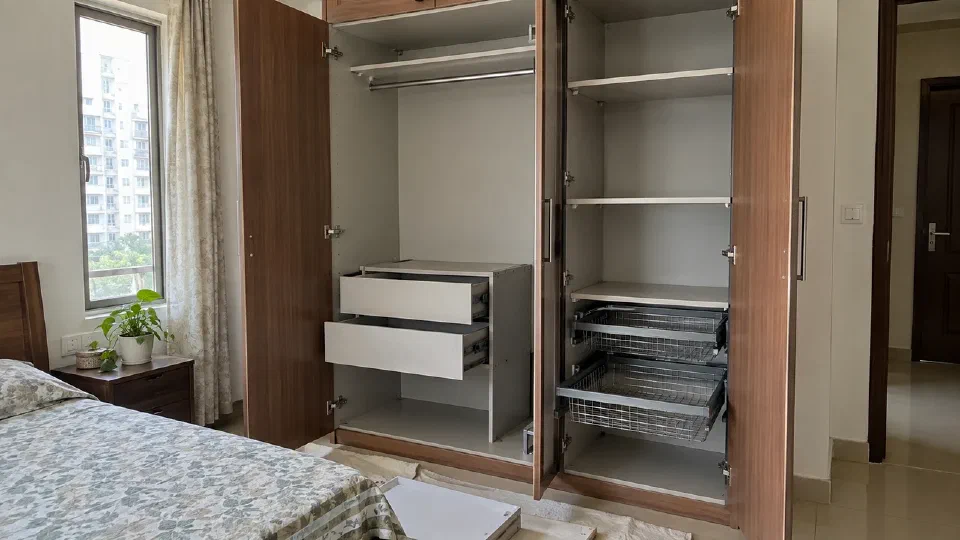
A nominal width is not the drawer width
Illustrative example: a 600 mm external cabinet with two 18 mm sides has a theoretical internal width of 564 mm before any liner or obstruction. That does not mean a 564 mm drawer fits. Runner clearances, box construction and hinge intrusion must be taken from the selected system.
The next calculation is a path check, not another cabinet-width subtraction. Measure the clear passage with the door at its actual stop and compare it with the proposed drawer front and handle. For example, if a hypothetical 564 mm internal bay offers only 520 mm of unobstructed front passage, a 540 mm drawer front cannot be pulled through that opening even though it fits between the side panels. The numbers are illustrative; record the three real measurements and the selected runner’s installation drawing before sizing a box.
Do not subtract a generic channel allowance found online and send the result to production. Different side-mounted, undermount and drawer-box systems use different planning dimensions.
Check the hinge before adding an internal drawer
An internal drawer must clear the open door as well as the cabinet. Blum’s SPACE TOWER application illustrates coordinated internal pull-outs, and its assembly and planning guidance identifies a zero-protrusion hinge arrangement. That specific application is not proof that every wide-angle hinge or existing wardrobe will work.
A spacer may resolve an obstruction in some designs, but it reduces usable width and needs an appropriate fixing arrangement. A hinge replacement may introduce new cup or plate requirements. Compare the whole modification before buying parts.
Blum’s SPACE TOWER planning guidance places a zero-protrusion hinge above the lowest pull-out so that its example can use the lower cabinet space. That is a useful demonstration of why hinge position, not just opening angle, matters. It is not an instruction to move a hinge on an existing wardrobe without checking the front, carcass and new hardware together.
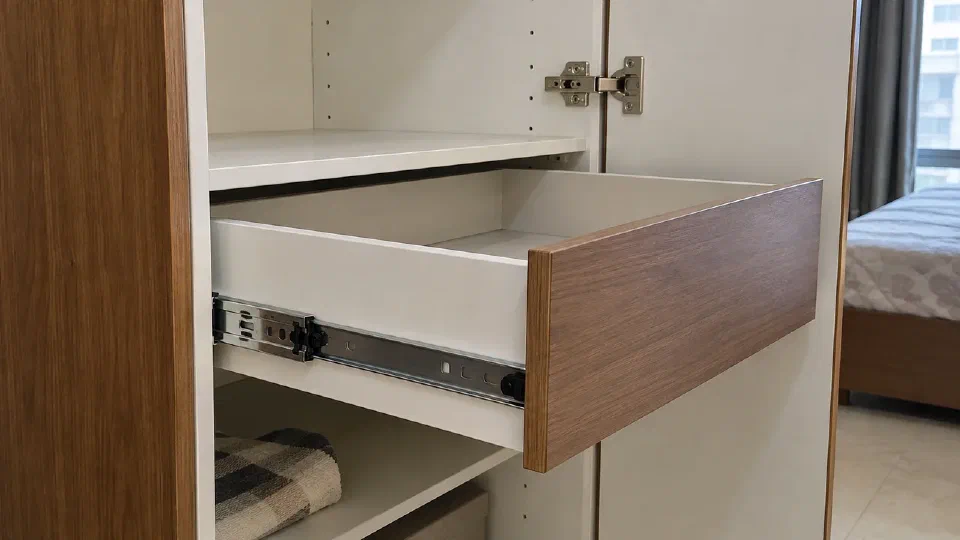
Choose the smallest useful intervention
Sometimes relocating an adjustable shelf or changing hanging allocation solves the problem without a pull-out. For accessories, measure the actual trousers, baskets or folded items they must hold. A mechanism that consumes much of the available space can provide less useful storage than a plain shelf.
Avoid cutting structural members or enlarging damaged fixing holes to accommodate an accessory. Have a fabricator assess repairs and the proposed load. An accessory’s catalogue rating does not certify the old carcass.
What to check in retrofit acceptance
Before ordering, tape a full-size outline of the proposed drawer front and travel in the opened wardrobe. Move the door through its permitted range and verify access to the handle and contents. This catches a blocked pull-out even where the catalogue’s nominal cabinet width appears to match.
Record the accessory code, required internal dimensions, mounting method and retained components. Include removal, hole repairs, finish making good and disposal in the quote. Check whether a finish match is realistic before promising an invisible alteration.
At handover, operate each drawer with the wardrobe doors in their normal positions. Check clearance, access and the intended contents within the manufacturer’s conditions. Keep the exact product instructions for adjustment and later replacement.
Keep a simple go, modify or stop record. Go when the carcass is sound, the selected runner fits its measured fixing surfaces and the full drawer path clears the door. Modify when a documented spacer or different front changes the path without weakening the mounting. Stop when the drawer cannot pass the door opening, the fixing zone is damaged or the proposed contents exceed the verified system conditions. Blum’s SPACE TOWER planning shows why hinge position is part of a pull-out design, but the decision for an old wardrobe needs its own measured drawing.
Measure the real internal width, then size the drawer
Ball-bearing runners tolerate very little error. Accuride’s guidance on drawer slide side space is to allow 0.2 to 0.5 mm more than the slide’s thickness on each side; for a 12.7 mm slide, that is 12.9 to 13.2 mm.
Illustrative arithmetic: a wardrobe section measures 600 mm outside. If its sides are an 18 mm board with 1 mm laminate on each face, each side is about 20 mm thick and the internal width is 600 − 40 = 560 mm. With 12.7 mm slides, the drawer box must be 560 − 2 x (12.9 to 13.2) = 533.6 to 534.2 mm wide. Assuming nominal 18 mm sides would give 564 mm inside and a box about 4 mm too wide to fit. Measure the actual carcass at the front, middle and back before ordering, because older carcasses are rarely perfectly parallel.
Plywood thickness itself varies within its standard: IS 303, a BIS standard, permits ±5% on general-purpose plywood of 6 mm and above, about ±0.9 mm on an 18 mm board. That is one more reason to measure, not calculate from the label.
Evidence and Verification Notes
The side-space figures are quoted from Accuride’s published guidance, checked in September 2026, and apply to ball-bearing slides of that type; other runner systems publish their own formulas. The width arithmetic uses stated assumptions, and the IS 303 tolerance is from its 1989 edition. Runner types are compared in telescopic vs Quadro vs InnoTech drawer channels. Hinge plates, runners and carcass joints can be inspected on a WoodAge factory visit.
Frequently Asked Questions
Can drawers be added behind sliding doors?
Yes, where their fronts and travel fit within the actual accessible opening. Measure the overlap and stop positions first; overall wardrobe width is not enough.
Can a soft-close drawer be fitted to any cupboard?
No. Soft close is a motion feature. The runner’s installation dimensions, mounting surfaces, depth and intended load still need to match.
When is replacement preferable?
When the carcass is damaged, the required access cannot be achieved or the accumulated retrofit work is unsuitable for the existing construction. Compare written scopes rather than assuming a new accessory is always cheaper.
Can the existing shelf holes be reused for drawer runners?
Only if their position, spacing and condition match the selected runner’s fixing instructions and the drawer path clears the door. A row of holes by itself does not prove compatible depth, setback or load. Record the exact runner code and inspect the substrate before reusing holes.
Will a standard-size drawer fit any wardrobe?
No. Check internal width, depth, height, hinge intrusion, door opening and fixing condition against the exact runner and drawer instructions.
Why inspect the existing carcass before an upgrade?
Loose joints, moisture damage, distorted panels or weak fixing zones can make an accessory unsafe or short-lived. Repair, redesign or replace the affected structure first.
Drilling and fitting in an occupied flat also falls under the society’s work-hour rules in many Gurugram buildings, so book the retrofit visit inside those hours.
How much side clearance do drawer runners need?
It depends on the runner system. For ball-bearing slides, Accuride advises a side space 0.2 to 0.5 mm wider than the slide on each side, so 12.9 to 13.2 mm for a 12.7 mm slide. Concealed runner systems publish their own internal-width formulas, so use the maker’s figure for the chosen model.
For a project in Gurugram or Delhi NCR, use WoodAge’s wardrobe planning to discuss the measured requirement and written scope. Product suitability and the final BOQ must be confirmed for the actual order.
Related Guides From WoodAge
- Wardrobe dimensions - for door, carcass and room measurements.
- Sliding wardrobe hardware guide - for a separate example of track and roller specification.
- Hardware substitution audit - for matching installed items to named codes.
- Cabinet board failure guide - for swelling, loose fittings and substrate damage.
- Membrane Shutters: Uses, Limits and Buying Checks - Useful next reading on hardware planning, costs, materials, or execution.
- Rental and Airbnb Ready Interiors in Gurgaon: Durable Furniture Choices for Service Apartments - Useful next reading on hardware planning, costs, materials, or execution.