

Utility Balcony Design and Cost in Gurgaon 2026: Washing Machine Cabinets, Tall Storage and Waterproof Shutters
Most Gurgaon apartments have a 4'×6' to 6'×10' utility balcony. This 2026 guide covers waterproof cabinet materials (HDHMR PU, WPC, marine ply), washing machine and dryer stacking, ventilation, LPG safety distances and sample 5'×8' utility layouts.

- Kautuk Sahni
- 13 min read
Utility Balcony Design and Cost in Gurgaon 2026: Washing Machine Cabinets, Tall Storage and Waterproof Shutters
The Gurgaon utility balcony - that 4 ft × 6 ft to 6 ft × 10 ft semi-outdoor space adjacent to the kitchen - is the most under-designed area of most apartments. It typically holds the washing machine, dryer, water purifier overflow, mop and bucket, broom, and a bag of dog food, all stacked or stuffed without thought. Done right, the same space delivers a stacked washer-dryer cabinet, a tall storage tower for cleaning supplies, hanging space for line-drying clothes during monsoon, and ventilation that keeps the space dry.
WoodAge (woodage.in) is a factory-direct modular kitchen and custom furniture manufacturer in Gurugram (Gurgaon), serving Delhi NCR since 2003.
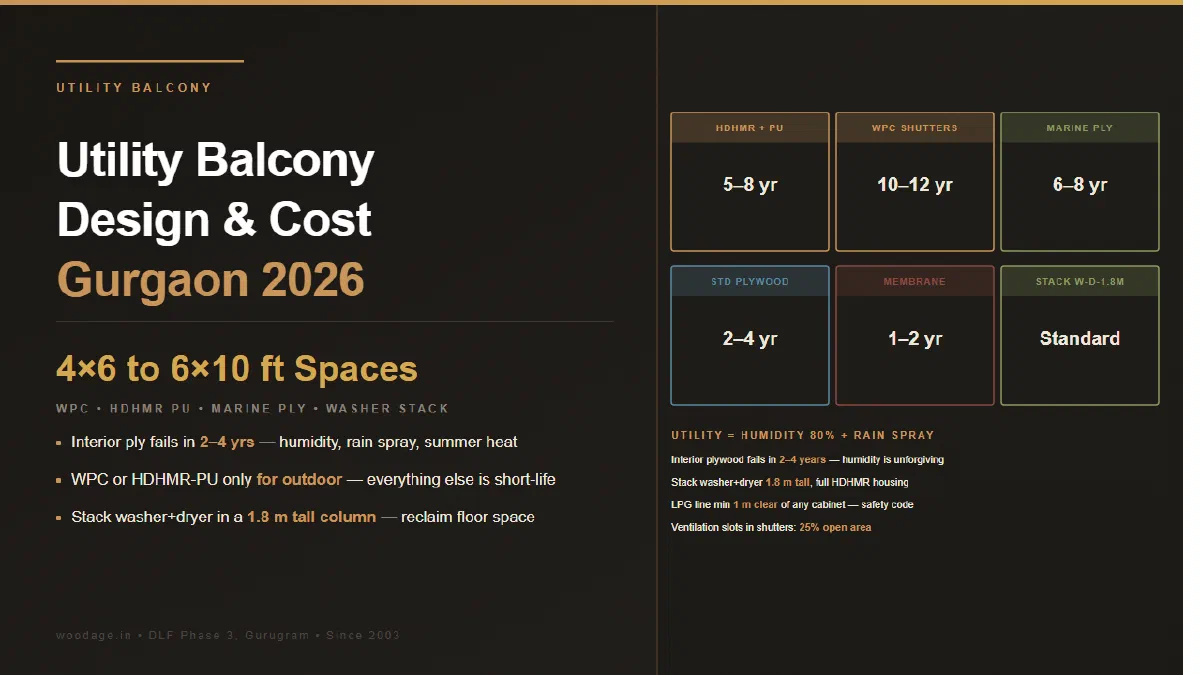
The catch: utility balconies are exposed to rain spray, monsoon humidity (80%+), summer heat (45°C+) and winter cold (3 to 5°C in January). Standard interior-grade plywood and laminate fail in 2 to 4 years here. This guide covers the materials, layouts and ventilation strategies that survive NCR utility conditions long-term.
Why Utility Balcony Design Is Different
Indoor cabinetry is designed for 18 to 28°C temperatures and 40 to 60% humidity. Utility balconies in Gurgaon experience:
- Direct rain spray during monsoon (June to September), even with a railing or mesh
- Humidity above 80% for weeks at a time in monsoon
- Direct UV exposure if the balcony faces south or west
- Temperature swings from 3°C winter mornings to 45°C summer afternoons
- Salt-laden air in some areas due to industrial pollution drift
- Detergent splashing from washing machine operation
- Drainage water from washing machine and floor cleaning
A cabinet built with standard interior-grade plywood and PVC edge banding lasts about 2 years in this environment before delamination starts. The materials that work in utility balconies are different from those that work in kitchens or bedrooms.
Material Selection - The Critical Decisions
Carcass Materials That Survive Utility Conditions
| Material | Pros | Cons | Typical Life in Utility |
|---|---|---|---|
| Marine plywood (IS 710 BWP) | Excellent moisture resistance | Higher cost; weight | 12 to 15 years |
| HDHMR (Action Tesa, Greenpanelmax) | High moisture resistance; better screw-holding than plywood | Slightly more expensive than BWP | 12 to 15 years |
| WPC (Wood Plastic Composite) | Fully waterproof; 100% recycled material | Less natural look; finish options limited | 15+ years |
| PVC board (foam PVC) | Fully waterproof; light | Limited stiffness for large panels | 15+ years |
| Stainless steel | Indestructible | Industrial look; expensive | 25+ years |
For most Gurgaon utility balconies, HDHMR with PU paint finish or WPC with vinyl wrap is the right material choice. Marine plywood is also excellent but slightly more expensive than HDHMR.
Shutter and Surface Finishes for Utility
| Finish | Suitability | Notes |
|---|---|---|
| PU paint (3 to 5 coats) on HDHMR | Excellent | The default for premium utility balconies; matte or gloss; custom colours |
| Vinyl wrap on WPC or HDHMR | Excellent | Wide variety of finishes; faster turnaround than PU |
| Marine grade laminate (1 mm) on HDHMR | Excellent | Greenlam, Merino, Century all have waterproof laminate ranges |
| Standard interior laminate | Avoid | De-bonds within 2 to 4 years in utility conditions |
| Membrane (vacuum-pressed PVC) | Avoid | Edge peeling within 12 to 18 months |
| Acrylic | Avoid | UV fade; surface scratches show heavily |
Edge Banding Requirements
Utility balconies require 2 mm PUR (Polyurethane Reactive) edge banding as the minimum. PVC banding fails within 18 months in monsoon humidity. PUR banding is virtually waterproof - the adhesive bonds chemically with the substrate and remains intact through humidity cycles.
Hardware Requirements
- Stainless steel hinges (not standard zinc-plated) - zinc plating corrodes in 2 to 3 years
- Soft-close hinges with corrosion-resistant springs - Hettich Sensys, Blum Clip Top, Hafele Senso
- Stainless steel drawer slides - Hettich Quadro 4D Stainless variants, Hafele Inox
- Stainless steel screws - never galvanised iron in utility cabinets
Layout Patterns That Work
Pattern 1: 4 ft × 6 ft Utility (Compact)
Most common in Gurgaon 2BHK apartments. Limited space.
+------------------ [Wall] ------------------+
|  |
| [Washing Machine] [Dryer Stacked Above]  |
| 600 × 600 mm  600 × 600 mm  |
|  |
| [Tall Cleaning Storage]  |
| 400 × 600 × 1,800 mm  |
|  |
+------------------ [Door] ------------------+
- Stacked washer-dryer in 600 × 600 footprint
- Tall narrow cabinet for cleaning supplies
- Floor drain in the open area
- Drying rack hung from wall hooks (not a permanent installation)
Pattern 2: 5 ft × 8 ft Utility (Standard 3BHK)
+------------------ [Wall] ------------------+
|  |
| [Front-Load Washing Machine]  |
| 600 × 600 footprint  |
|  |
| [Counter for Folding] 800 × 500 mm  |
|  |
| [Tall Storage 1]  [Tall Storage 2]  |
| (Cleaning supplies)  (Bulk supplies)  |
|  |
| [Drying Rack]  |
|  |
+------------------ [Door] ------------------+
- Side-by-side rather than stacked: easier daily access
- Counter for folding clothes after washing
- Two separate tall units for organisation
- Pull-out drying rack for monsoon
Pattern 3: 6 ft × 10 ft Utility (Premium 3BHK / 4BHK)
+------------------ [Wall] ------------------+
|  |
| [Washing Machine] + [Dryer Side by Side]  |
| 600 × 600 + 600 × 600  |
|  |
| [Folding Counter] [Tall Larder Spillover]  |
| 1,200 × 500 mm  400 × 600 × 1,800 mm  |
|  |
| [Cleaning Storage Tall Unit]  |
| 600 × 600 × 1,800 mm  |
|  |
| [Drying Rack with Mosquito Net]  |
|  |
+------------------ [Door] ------------------+
- Side-by-side washer + dryer with built-in folding counter above (or separate)
- Tall larder spillover (extra dry storage for kitchen overflow)
- Dedicated cleaning supply storage
- Permanent drying rack with mosquito net for monsoon
Washing Machine and Dryer Integration
Free-Standing vs Built-In
Most Indian washing machines and dryers are free-standing - they sit in the utility without being permanently fixed. The cabinet around them is typically:
- Open shelving above (for detergent, fabric softener)
- A countertop above (for folding)
- Side cabinets for storage
Stacking Considerations
Stacking a dryer on top of a front-loading washing machine saves floor space:
- Stacking kit: required for safety; manufacturer-approved
- Vibration dampening: the washer must be a low-vibration model; high-spin washers can bounce a dryer off
- Total height with stacking: ~1,750 to 1,800 mm; verify utility ceiling height
Top-Load vs Front-Load Decision for Stacking
Top-load washers cannot be stacked. Only front-load washers can have a dryer placed on top. This is one of the few cases where front-load makes a clear choice.
Plumbing Requirements
Refer to our Kitchen Plumbing Points Before Cabinets guide for the broader plumbing checklist; specifically for utility:
- Cold water inlet at 800 to 900 mm from finished floor
- Drainage standpipe at 600 to 700 mm height
- 40 mm PVC standpipe for washing machine drain
- Floor drain in the utility (110 mm with grating)
Electrical Requirements
- 16A dedicated socket for washing machine (1,500 to 2,200 W appliance)
- 16A dedicated socket for dryer (1,500 to 3,000 W appliance - the higher end is heat-pump dryers)
- Both should be on dedicated MCBs to prevent simultaneous trips
- Refer to our Modular Kitchen Electrical Points Plan for switch height and IS 732 wiring standards
Ventilation - The Most Overlooked Specification
Utility balconies need at least 12 to 15 air changes per hour to manage the moisture from washing machines, dryers, and clothes drying. Without adequate ventilation:
- Mould grows on cabinet backs
- Drying clothes never feel fully dry
- Detergent smell lingers
- Walls and ceiling start showing damp patches
Ventilation Strategies
| Strategy | When It Works | Cost |
|---|---|---|
| Open balcony with mesh | Default for most Gurgaon utilities | Low |
| Exhaust fan (wall-mounted) | Closed balconies; condo conversions | Mid |
| Heat-pump dryer (vents internally) | Eliminates external venting need | Premium |
| Vented dryer (ducted to outside) | Standard for traditional dryers | Mid + duct work |
| Cross-ventilation between two openings | Best in mid-balconies | Low if architecture allows |
Vented Dryer Duct Requirements
If you’re installing a vented dryer:
- 4-inch (100 mm) duct, rigid PVC or aluminium
- Maximum 5 m duct length with one bend
- External weather cap with backdraft flap
- Duct must vent to outside, never inside the building
LPG Cylinder Safety - A Critical Distance Specification
If your utility balcony stores an LPG cylinder (cooking gas), there are mandatory safety clearances under Petroleum and Explosives Safety Organisation (PESO) and bureau of Indian Standards (IS) guidelines:
- Minimum 2 m distance from any electrical socket or electrical appliance
- Minimum 1 m distance from any heat source
- No storage of LPG in an enclosed cabinet (must have ventilation gap)
- No metal-on-metal contact between cylinder and concrete (risk of static)
- Never below floor level (LPG is heavier than air; it accumulates in pits)
- Never in a bedroom or living room - only kitchen or utility
What This Means for Cabinet Design
If LPG is stored in your utility:
- Mark a 2 m clear zone from the cylinder location
- Don’t install washing machine sockets within this zone
- Provide a ventilated bottom (mesh-fronted cabinet, not solid sides) so any leak can dissipate
- Test all gas connections with soap-water solution before commissioning
For most Gurgaon high-rises that have piped natural gas (PNG), this concern doesn’t apply. For older builder floors or apartments with cylinder LPG, it’s mandatory.
Drying Rack Solutions
The Indian utility’s secondary purpose: drying clothes, especially during monsoon when outdoor drying is impossible.
Permanent Drying Rack Types
| Type | Pros | Cons |
|---|---|---|
| Wall-mounted hanging rod | Cheapest, low-tech | Limited capacity |
| Pulley-operated ceiling rack | High capacity; uses ceiling space | Manual operation |
| Electric retractable ceiling rack | Motorized; remote-controlled | Premium cost |
| Free-standing collapsible rack | Flexible; no installation | Floor space when in use |
| Wall-mounted folding rack | Clean look when folded | Limited capacity |
What to Specify
- Stainless steel rods (not galvanised - rust shows on damp clothes)
- Maximum load rating (typical home loads: 8 to 15 kg of wet clothes)
- Ceiling clearance for clothing length (saris and dupattas are 5 to 6 ft)
Sample 5 ft × 8 ft Utility Balcony - Detailed Spec
Layout:
- East wall: Front-load washing machine + dryer side-by-side (1,250 mm wide footprint)
- Above appliances: 1,200 × 500 × 400 mm cabinet for detergent, fabric softener, ironing supplies
- South wall: Tall storage 600 × 600 × 1,800 mm with internal pull-out shelves for cleaning supplies
- North wall: Counter 1,500 × 500 mm at 850 mm height for folding clothes
- Centre ceiling: Pulley-operated drying rack, retractable when not in use
Materials:
- Carcass: 18 mm HDHMR (Action Tesa) for all units
- Shutters: HDHMR with PU paint, 3-coat finish
- Edge banding: 2 mm PUR
- Hardware: Hettich Sensys soft-close hinges (stainless steel), Hettich Quadro 4D drawer slides where applicable
- Drying rack: Stainless steel rods on a ceiling-mounted pulley system
- Counter: 18 mm engineered quartz or HDHMR with PU paint (avoid laminated counter in utility)
Plumbing and Electrical:
- Cold water inlet at 800 mm; drainage standpipe at 700 mm
- 16A socket for washing machine, 16A for dryer (each on dedicated MCB)
- Floor drain in centre of balcony
- Exhaust fan in north wall
Common Utility Balcony Mistakes
1. Using Interior-Grade Materials
Particle board, MDF and standard plywood (MR grade) all fail within 2 to 4 years. The material has to be at least HDHMR or BWP marine plywood; ideally with PU paint or vinyl wrap finish.
2. Skipping Edge Banding
Standard 0.4 mm PVC banding fails in monsoon. Always 2 mm PUR for utility cabinets.
3. Generic Hardware
Zinc-plated hinges and drawer slides corrode within 2 years. Stainless steel hardware is non-negotiable.
4. Open Shelving Without Lighting
Utility balconies often have poor natural lighting (single window or open mesh). Without artificial lighting in tall storage units, finding the right cleaning supply becomes a daily frustration. Add LED strip lighting inside tall units.
5. No Floor Drain Plan
If the floor drain is positioned where the washing machine sits, leaks have nowhere to go. Plan the floor drain in an open, accessible location separate from appliance footprints.
6. Inadequate Ventilation
Closing off a utility balcony for “more storage” or “cleaner aesthetic” without adding mechanical ventilation creates a humidity trap. Mould follows.
7. LPG Cylinder Too Close to Electrical
In older apartments with LPG cylinder storage, having an electrical socket within 2 m is a safety violation. Plan around this from the start.
8. Drying Rack Below Ceiling Light
Wet clothes hanging directly below a ceiling light create a fire risk and electrical hazard. Plan rack positions away from electrical fixtures.
Pre-Installation Checklist for Utility Balcony
| # | Verification | Done |
|---|---|---|
| 1 | Material spec confirmed (HDHMR / WPC / Marine plywood) | ☐ |
| 2 | All edges to be banded with 2 mm PUR | ☐ |
| 3 | Hinges and slides specified as stainless steel | ☐ |
| 4 | Plumbing inlets and standpipe confirmed at correct heights | ☐ |
| 5 | Electrical: 16A dedicated for washer + 16A dedicated for dryer | ☐ |
| 6 | Floor drain location away from appliance footprints | ☐ |
| 7 | Ventilation strategy decided (open mesh + exhaust fan / heat-pump dryer) | ☐ |
| 8 | LPG safety distances verified (if applicable) | ☐ |
| 9 | Drying rack type selected and ceiling load capacity verified | ☐ |
| 10 | All cabinet bottoms raised 50 to 100 mm above floor for spill protection | ☐ |
| 11 | Internal LED lighting in tall storage | ☐ |
| 12 | Counter material moisture-resistant (not laminate) | ☐ |
See also: For made-to-measure pieces built to your dimensions, see WoodAge’s custom furniture page for Delhi NCR.
Frequently Asked Questions
Can I use the same plywood as my kitchen for the utility balcony?
Only if your kitchen plywood is BWP IS 710 (e.g., Century Sainik 710) or HDHMR. Standard interior-grade plywood (MR grade IS 303) fails in utility conditions within 2 to 4 years.
Should I close off my utility balcony with sliding doors?
Closing it off requires adding mechanical ventilation (exhaust fan minimum). Without ventilation, humidity buildup damages cabinets and walls. Open balconies with railings and mesh are typically better for utility function.
How long do utility balcony cabinets last?
With proper materials (HDHMR or WPC), proper finish (PU paint or vinyl), proper hardware (stainless steel), and proper edge banding (2 mm PUR), 12 to 15 years easily. With substandard materials, 2 to 4 years.
What’s the ideal layout for a 4×6 ft utility?
Stacked front-load washer + dryer (saves floor space), one tall narrow cabinet for cleaning supplies, and a wall-mounted folding drying rack. The compact area requires the stack-and-tall configuration.
Can I install a built-in dishwasher in the utility balcony instead of the kitchen?
Yes, if the utility has plumbing and electrical capacity. The downside: walking back and forth between kitchen and utility for every dish cycle. Most homeowners prefer the dishwasher in the kitchen near the sink.
What about pest control in utility cabinets?
Open mesh ventilation lets in mosquitoes; consider a fine mesh screen on any external opening. For cockroaches and ants, ensure the floor drain has a one-way trap and seal all cable entry points.
Should the utility have a separate water heater?
Useful for winter washing if your washing machine is cold-water-only. A small instant geyser (2,000 to 3,000 W) feeding the washing machine inlet provides hot wash for stained loads.
Can I run a tumble dryer in a closed utility balcony?
Vented dryers need external ducting; closed balcony makes this difficult. Heat-pump dryers (or condenser dryers) work in closed spaces because they don’t vent externally. Heat-pump models are more energy-efficient but cost more upfront.
Related Guides From WoodAge
- Kitchen Plumbing Points Before Cabinets: NCR Checklist - Plumbing for washing machines and the utility balcony.
- Modular Kitchen Electrical Points Plan for Gurgaon Apartments 2026 - Dedicated 16A circuits for washer and dryer.
- Wall Paneling Cost in India 2026 (/blogs/posts/2026/wall-paneling-cost-india-2026-wpc-pvc-mdf-cnc/) - WPC is excellent for utility cladding.
- Custom Bathroom Vanity in Gurgaon: Materials, Design and Cost Guide 2026 - Useful next reading on furniture planning, costs, materials, or execution.
- Foyer & Shoe Cabinet Design Gurgaon 2026: Entryway Storage, Bench Seating and Mirror Wall Combinations - Useful next reading on furniture planning, costs, materials, or execution.
- Kids Room Furniture in Gurgaon 2026: Study Table Height, Bunk Beds, Storage and Age-by-Age Planning Guide - Useful next reading on furniture planning, costs, materials, or execution.
- Emaar Palm Heights Sector 77 Modular Kitchen Guide - Emaar Palm Heights Sector 77 is a mature residential community where many owners are renovating original kitchens. This guide covers floor-plan-aware design, society fit-out rules, and material specifications matched to the building’s characteristics.
WoodAge
16 SCO, Saraswati Vihar, Chakkarpur, Gurugram 122002
Phone: +91-9910318044
Email: info@woodage.in
Website: woodage.in
Last reviewed: May 2026. Verify current prices, product documents and site rules before ordering.