

Vastu for Furniture: Bed, Wardrobe, Mirror and Main Door
Apply vastu in a finished flat through furniture, not walls: bed, wardrobe, mirror, study desk, pooja unit and entrance placement, with clearances and a chakra method.

- Kautuk Sahni
- 13 min read
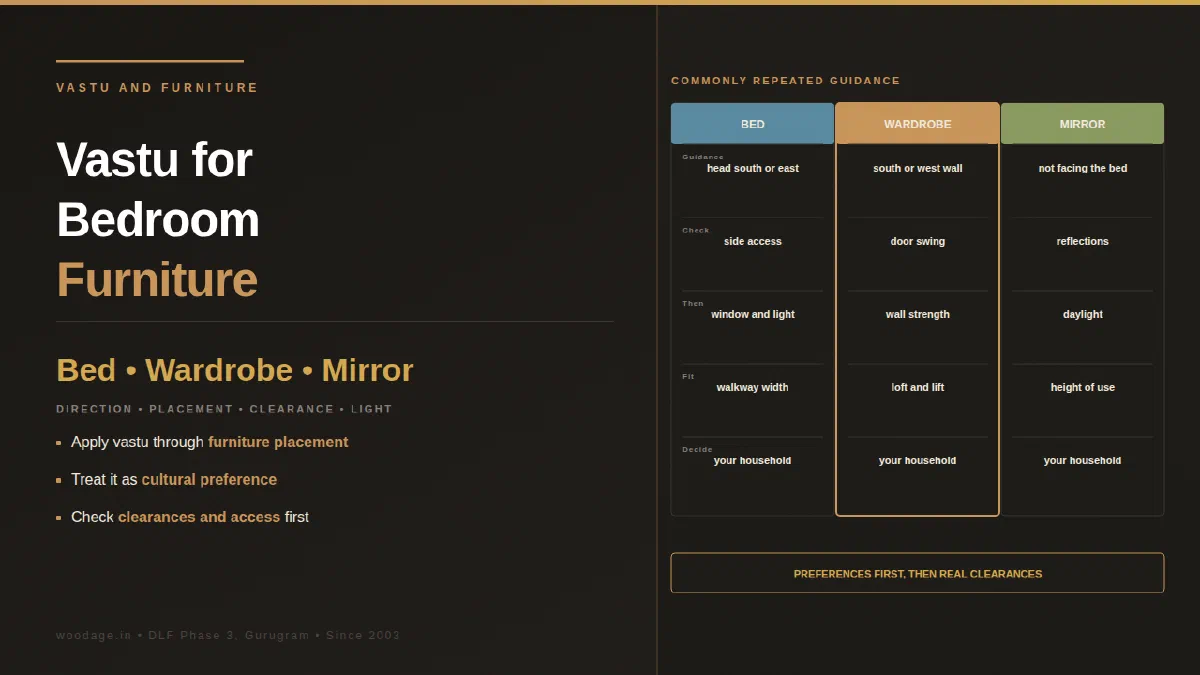
Vastu for Furniture: Bed, Wardrobe, Mirror and Main-Door Placement Without Civil Work
In a finished flat, vastu is applied through furniture, not walls. The guidance commonly repeated: sleep with the head to the south or east, keep heavy wardrobes on the south or west walls, keep mirrors from facing the bed, place the pooja unit in the north-east, and keep the entrance clear and well lit. Treat these as cultural preferences, and check each one against clearances, daylight and access.
WoodAge is a factory-direct modular kitchen, wardrobe and custom furniture manufacturer operating since 2003 and based at 16 SCO, Saraswati Vihar, Chakkarpur, Gurugram 122002. In Gurugram’s apartment towers the room positions and the main door are fixed by the builder, so the questions buyers actually bring to a furniture layout are smaller and more practical: which wall takes the wardrobe, which way the bed faces, where the mirror goes and what to do when the preferred wall has the window.
This guide answers those questions for the furniture you can move or build. Kitchen placement is covered in the vastu guide for modular kitchens and mandir design in the pooja room and CNC jali guide. To check a whole plan zone by zone, use WoodAge’s free Vastu interior planner.
Quick answer: common vastu guidance and the practical check
| Furniture | Common vastu guidance | Practical check | If the room will not allow it |
|---|---|---|---|
| Bed | Head to the south first, east second; north discouraged | 600 mm minimum walkway on each open side and at the foot, 750 mm comfortable | Use east; keep the headboard off a window wall |
| Master bedroom | South-west of the home preferred | Fixed by the builder in a flat | Apply the bed and wardrobe guidance inside the room you have |
| Wardrobe | Heavy storage on the south, west or south-west walls | 900 mm or more clear in front of a sliding wardrobe; full swing space for hinged shutters | Use the west wall, or split storage between two walls |
| Mirror | Not facing the bed; north or east walls preferred | Check window and lamp glare at night | Put the mirror inside a shutter or on a sliding panel |
| Dressing table | Same guidance as the mirror | Light from the side, not behind | Place it beside the wardrobe on the same wall |
| Study desk | Sit facing east or north | Daylight from the side, not behind the screen | Face the wall with the least screen glare |
| Pooja unit | North-east first; east or north next; not on a toilet wall or under stairs | Ventilation for lamps and incense | Move to the east or north wall of the living room |
| Shoe storage | Not directly facing the entrance; south-west of the hall | Society corridors are usually exit routes | Build a closed shoe unit beside the door, inside the flat |
| Heavy furniture generally | South and west; lighter pieces north and east | Structural loads are not affected by this choice | Keep circulation clear first |
| Centre of the home | Keep open or lightly loaded | Natural circulation space | Avoid a heavy storage block in the middle of the living room |
The bed and wardrobe clearances come from WoodAge’s bed size guide. They are the numbers to keep when vastu and space compete.
Classical texts, modern practice and why sources disagree
Vastu is a traditional framework for arranging buildings and rooms. Classical treatises such as the Manasara, available in P. K. Acharya’s English translation, and the Mayamata deal mainly with site, building and room layout. Many furniture-level rules, such as mirrors facing beds or shoe-rack positions, come from modern practice guides, which is why two websites can give different answers for the same wardrobe.
WoodAge’s planner follows this split openly: it names the classical texts and modern schools it draws from and labels disagreement where they differ. Its own FAQ states that directional rules and claimed life outcomes are not established scientific predictions. This page takes the same line. It reports what the guidance says, never what it will do for health, money or relationships, and it pairs each rule with a practical check.
How to place a vastu chakra on your floor plan
The search “vastu chakra on floor plan” usually comes from someone holding a builder’s plan. The method is geometric:
- Use a scaled plan of the flat itself, not the tower brochure. Mark the occupied boundary: rooms and balconies, not the common corridor. Plans for new-possession flats in New Gurgaon or on Dwarka Expressway usually carry a north arrow; confirm it on site before relying on it.
- Find north. Stand in the middle of the living room with a phone compass, away from the fridge, steel almirahs and speakers. Take readings at two or three spots; steel in RCC walls can deflect a phone compass.
- Correct for true north if your planner asks for it. In Delhi the difference between magnetic and true north is small, about a degree east under the current world magnetic model; the NOAA declination calculator gives the exact value for your location. A 16-zone chakra uses sectors of 22.5 degrees, so a local compass error from steel matters more than declination.
- Find the centre (Brahmasthan). For a rectangular plan, the diagonals cross at the centre. For an L-shaped or irregular flat, practitioners differ on the method, so record which one you used.
- Overlay the chakra. Draw 16 sectors of 22.5 degrees from the centre, starting from north, and label them: N, NNE, NE, ENE, E, ESE, SE, SSE, S, SSW, SW, WSW, W, WNW, NW, NNW.
- Mark the furniture, not only the rooms. The bed head, the wardrobe wall, the mirror and the pooja unit are the pieces you can still move.
The WoodAge Vastu planner does steps 4 to 6 on an uploaded plan and asks you to confirm north and the centre, because an automated read of a plan can be wrong.
Bedroom: bed, wardrobe and mirror without moving a wall
The bed. Head to the south is the classical first choice and east the common second choice; north is discouraged. In a 10 × 12 ft room, a queen bed is the honest fit with 600 mm walkways, and turning the bed to satisfy a direction must not cut a walkway below that. If only a window wall faces south, a solid, padded headboard helps, but check that the window can still be opened and cleaned.
The wardrobe. South, west and south-west walls are the most repeated guidance for heavy storage. Before fixing the wall, check three things: the air-conditioner position, the switchboard behind the wardrobe, and whether the wall is damp. An external wall with seepage is a worse home for a wardrobe than any direction; diagnose it first with the ground-floor moisture checklist. Standard depths and heights are in the wardrobe dimensions guide.
The mirror. One widely repeated rule is that a mirror should not reflect the bed. There is also a practical reason: a large mirror opposite a window or bedside lamp can throw light across the bed at night. If the only wardrobe wall faces the bed, three furniture answers work:
- a full-length mirror fixed on the inside of a hinged shutter;
- a mirror on one sliding panel that can be parked behind a solid panel;
- a separate dressing mirror on a side wall.
Mirror and glass shutter options are compared in glass wardrobe shutters.
Study desk, pooja unit and TV wall
Study desk. Sitting to face east or north is the common guidance. For eyesight and screens, daylight from the side is better than a window behind the screen or behind the chair, which causes glare or reflections. When the two conflict, reduce glare first; a screen facing a bright window is hard on the eyes whatever the direction.
Pooja unit. North-east is the classical first choice, with east and north next. The unit should not share a wall with a toilet or sit under a staircase. In a flat without a separate room, a wall-mounted or floor-standing mandir on the north-east or east wall of the living room is the usual answer; lamps and incense need ventilation and a heat-safe shelf above the flame. Sizes and materials are covered in the pooja room and CNC jali guide.
TV wall. Sources vary on television placement. Decide it by viewing distance, window glare and the power and data points, and apply direction only as a tiebreaker.
Main door and entrance furniture
The main door of a flat cannot be moved, and the classical guidance on entrance direction (north, east and north-east favoured; south-west most cautioned) is a question for buying a flat, not for furnishing it. What furniture can do at the entrance:
- Keep the approach clear. Nothing heavy directly inside the door; the first metre should feel open.
- Light it. A well-lit entrance is the common vastu advice and a safety basic.
- Close the shoe storage. A closed shoe unit beside the door, rather than an open rack facing it, satisfies the usual guidance and hides clutter.
- Keep the corridor clear. In a residential tower the common corridor is part of the means of escape that the National Building Code plans for, and societies commonly ask residents not to keep racks or furniture there. Check your society’s rules before putting anything outside the door; the society fit-out rules guide covers what RWAs usually control.
- Name plate and door finish. These are finish choices with no clearance impact; lock and door construction are covered in the main door lock guide.
Where vastu and practical planning conflict
| Conflict | Better resolution |
|---|---|
| The south wall is the only window wall | Put the wardrobe on the west wall; keep the window usable |
| Head to the south blocks the bedroom door swing | Use east as the second choice |
| The only wardrobe wall faces the bed | Mirror inside a shutter or on a sliding panel |
| North-east wall of the living room backs onto a toilet | Put the pooja unit on the east or north wall |
| The south-west wall is damp | Fix the damp first; a wardrobe hides and worsens it |
| The centre of the living room holds the dining table | Keep the table; avoid adding a heavy storage block there |
The rule behind this table is simple: never trade a walkway, a window, an electrical point or a damp wall for a direction. The first three are daily use; the last one destroys furniture.
Before you commit to a layout
- Mark north and the centre on the plan, and note the method you used.
- Place the bed, wardrobe and mirror, then check the 600 mm and 900 mm clearances.
- Mark switchboards, AC units and windows on the furniture walls.
- Check every wardrobe wall for damp before production.
- Confirm shutter swing or sliding clearance against the bed and doors.
- Run the plan through the Vastu planner if you want a zone-by-zone read.
- Record the final layout on the drawing that goes to production.
Evidence and Verification Notes
The traditional guidance on this page summarises points that recur across the classical texts named by WoodAge’s Vastu planner and modern practice guides, and it matches the planner’s own FAQ on bedroom, entrance, pooja and sleeping direction. Where sources disagree, the page says so instead of choosing a winner. No health, wealth or relationship outcome is claimed, because none can be verified.
The clearances are WoodAge’s published planning figures from its bed size guide. The magnetic-declination note uses NOAA’s World Magnetic Model calculator; confirm the value for your address. Society rules on corridors vary, so read your own RWA’s rules. Once the layout is fixed, turn it into a measured wardrobe drawing through the Gurugram wardrobe manufacturer page, or send the plan with a quote request for a furniture layout review.
Frequently Asked Questions
Which direction should my head be when sleeping, according to vastu?
Head to the south is the classical first choice, with east as the common second choice, and north is discouraged. This is traditional guidance, not a medical claim. If the south orientation cuts a walkway below 600 mm or blocks the door, use east and keep the room usable.
Where should the wardrobe be placed in a bedroom as per vastu?
The most repeated guidance puts heavy storage on the south, west or south-west walls. Before fixing it, check that the wall is not damp, that switchboards and the AC are not behind it, and that there is at least 900 mm clear in front of a sliding wardrobe or full swing space for hinged shutters.
Can a mirror face the bed?
The common vastu rule says no, and there is a practical reason too: a mirror opposite a window or lamp can reflect light across the bed at night. If the only wardrobe wall faces the bed, fix the mirror inside a hinged shutter, put it on a sliding panel you can cover, or use a side-wall dressing mirror.
How do I put a vastu chakra on my floor plan?
Use a scaled plan of your flat, find north with a phone compass away from steel furniture, and mark the centre of the plan. Draw 16 sectors of 22.5 degrees from the centre, starting at north, and label them. Then mark the bed head, wardrobe, mirror and pooja unit. WoodAge’s Vastu planner automates the overlay.
Does the difference between magnetic north and true north matter for vastu?
Only a little in Delhi NCR. The declination there is about one degree east under the current world magnetic model, while each sector of a 16-zone chakra spans 22.5 degrees. A phone compass disturbed by steel in walls or appliances can be off by more, so take several readings in open spots.
Where should the shoe rack be kept as per vastu?
The common guidance is not to place it directly facing the main door and to prefer the south-west of the hall. A closed shoe cabinet beside the door, inside the flat, satisfies the usual versions. Keeping a rack in the society corridor usually conflicts with exit-route rules, so check your RWA first.
Can vastu corrections be done without demolition?
In a flat, most practical changes are furniture changes: the direction of the bed, the wall for the wardrobe, the mirror position, the pooja unit location and the entrance arrangement. Room positions and the main door stay as built. Any change to walls, plumbing or gas needs professional review, not a vastu remedy.
Which direction should a study table face?
Facing east or north is the common guidance. For comfort, keep daylight coming from the side rather than from behind the screen or behind the chair, which causes glare. If direction and glare conflict, reduce the glare first and use direction as the tiebreaker.
Is vastu scientifically proven?
No. Vastu is a traditional cultural and spatial framework. Some of its advice overlaps with good practice on daylight, ventilation and circulation, but its directional rules and claimed outcomes are not established scientific predictions. Use it as a preference layer on top of clearances, safety and access.
Related Guides From WoodAge
- Vastu Shastra for Modular Kitchens - Hob, sink and platform placement.
- Pooja Room and CNC Jali Design - Mandir sizes, materials and patterns.
- Bed Size Guide for Indian Bedrooms - Walkway clearances behind the rules above.
- Standard Wardrobe Dimensions India - Depths and heights for the wardrobe wall.
- Master Bedroom Interior Design in Gurgaon - Bed wall, ceiling and wardrobe layout.
- Glass Wardrobe Shutters - Mirror and glass shutter options.
Get a Factory-Direct Quote
If you are planning interiors in Gurgaon or Delhi NCR, WoodAge can help you convert the idea into a measurable BOQ: exact material grade, hardware model, finish code, timeline and warranty terms before production starts.
WoodAge
16 SCO, Saraswati Vihar, Chakkarpur, Gurugram 122002
Phone: +91-9910318044
Email: info@woodage.in
Website: woodage.in