

Wall Putty vs Primer: What Each Layer Does
Learn when wall putty and primer are needed, what each layer does, the correct sequence, applicable BIS references and how to compare a painting specification.

- Arpit Sahni
- 12 min read

Putty and Primer: The Two Layers Everyone Tries to Skip
Putty and primer do different jobs. Putty corrects minor surface irregularity; primer supports adhesion and controls substrate suction for the specified paint system. Neither should be added or skipped by slogan. Inspect the wall, then follow the exact putty, primer and topcoat manufacturer’s sequence, coverage and curing instructions.
WoodAge is a factory-direct modular kitchen and custom furniture manufacturer operating since 2003 and based at 16 SCO, Saraswati Vihar, Chakkarpur, Gurugram 122002. WoodAge does not sell wall coatings. This guide turns the pre-paint sequence into a checkable specification around interior woodwork.
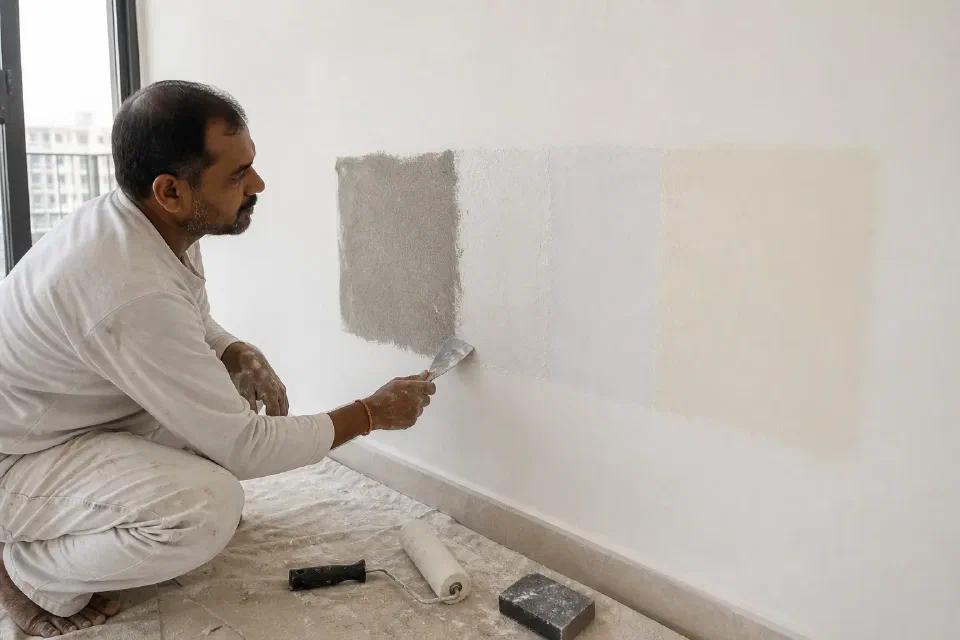
What each layer is actually for
| Layer | Job | What happens without it |
|---|---|---|
| Surface repair and curing | Stable, dry, sound substrate | Moisture from fresh plaster pushes the film off later, in patches |
| Wall putty | Fills pores and minor undulations, closes the surface | Suction is uneven, more topcoat is absorbed, the finish looks blotchy in raking light |
| Primer | Bonds paint to the substrate, seals residual absorbency | Poor adhesion, higher topcoat consumption, uneven sheen |
| Topcoat, two coats | Colour, sheen and protection | One coat rarely gives an even film over a colour change |
The important idea: putty and primer are system layers, not interchangeable decoration. Do not claim they always cost less than absorbed topcoat without measuring the wall and the named products. Compare the specified coverage, coat count and pack price for the actual substrate.
Painting without putty: when you genuinely can skip it
Putty can reasonably be skipped when the existing painted wall is already sound, smooth and compatible with the named repaint system. It is not automatically required. Record the wall condition and the product manufacturer’s preparation route instead of adding a layer by habit.
Putty is necessary when:
- The wall is newly plastered and has open pores.
- The surface has undulations, trowel marks or minor cracks.
- The inspected wall needs full-surface levelling rather than local repair; a colour change alone does not prove putty is required.
- You want a smooth premium finish, especially in gloss or high-sheen.
Putty can reasonably be skipped when:
- The existing painted wall is sound, smooth and in good condition, and you are repainting a similar shade.
- You are applying a texture finish that is meant to be irregular.
- The surface is already a smooth board or panel, such as gypsum, which needs jointing compound rather than cement putty.
Primer, by contrast, is far harder to justify skipping. On any fresh putty, fresh plaster or bare surface, primer is doing real adhesion work. On a sound existing painted wall being recoated in a similar shade, a primer coat is sometimes omitted by experienced painters. On anything new, do not omit it.
Delhi NCR wall-condition decision record
The correct system is not determined by whether the address is in Vasant Kunj, Malviya Nagar, Greater Kailash, Gurgaon or on Dwarka Expressway. Record the substrate and defect:
| Observed condition | Evidence before coating | Decision boundary |
|---|---|---|
| New plaster in a possession flat | Completion or cure record, moisture condition and manufacturer readiness criteria | Do not cover a substrate the coating system says is not ready |
| Sound existing emulsion | Adhesion check, cleanliness, gloss and local defects | Full-wall putty may be unnecessary; primer still follows the named repaint system |
| Active damp or efflorescence | Source diagnosis, repair record and dry-condition confirmation | Coating is blocked until the moisture source is addressed |
| Hairline or movement crack | Width, length, recurrence and substrate movement assessment | Putty is not a structural crack repair |
| Premium sheen under side light | Signed sample area and raking-light acceptance | Surface tolerance must be agreed before the final coat |
This table prevents a contractor from selling one universal putty-plus-primer package for every wall, while still blocking shortcuts on a new or unstable substrate.
Cement putty or acrylic putty
Indian buyers meet two families and are rarely told the difference.
| White cement based putty | Acrylic putty | |
|---|---|---|
| Base | White cement with polymers | Acrylic emulsion |
| Typical use | Interior and exterior masonry | Mostly interior |
| Water resistance | Better on exterior masonry | Lower |
| Finish | Hard, sandable | Smoother, more flexible |
| Application | Needs curing discipline | Easier, dries faster |
| Cost | Generally lower per kg | Generally higher |
For most Indian interior walls over cement plaster, a white cement based putty is the conventional choice. Acrylic putty is used where a very smooth finish is wanted or over surfaces where cement putty bonds poorly. Follow the manufacturer’s recommendation for the specific substrate rather than a general rule.
The Indian Standards to quote in a painting contract
Putty and paint both have BIS specifications, and naming them converts a vague quote into a checkable one. Very few Indian painting quotes reference any of these.
| Material | Indian Standard | What it covers |
|---|---|---|
| White cement based polymeric putty | IS 17545:2021 | Requirements, sampling and test methods for white cement based polymeric putty used as a skim coat on internal or external plastered surfaces |
| Premixed polymer-modified cement mortar | IS 14817 | A separate repair or mortar family that may appear in specifications; it is not a substitute label for IS 17545 putty |
| White Portland cement | IS 8042 | The base binder in white cement putty |
| Plastic emulsion paint | IS 15489:2024 implementation circular | Current plastic emulsion paint specification; the 2013 edition was withdrawn after the implementation period |
Note that IS 17545 explicitly covers putty used on internal or external plastered surfaces, which is why a putty choice and a paint-grade choice are two separate decisions. Getting the putty right does not make an interior emulsion suitable for an exterior wall. Map each exposure and coat-system line using the painting BOQ checklist, then use the live wall paint comparison guide for the product-family decision.
The sequence that actually works
- Confirm the substrate is cured and dry enough for the named system. Ask for the substrate check rather than relying only on elapsed days.
- Repair. Cracks, chipped corners, gaps around conduits and electrical boxes.
- Check for damp. Do not proceed over an active damp patch, and find the source first. The diagnostic sequence is in the ground-floor moisture checklist.
- Primer, if the putty system requires it under putty. Some systems specify a primer coat before putty on certain substrates. Follow the data sheet.
- Putty in the coat count and thickness stated by its data sheet, with the prescribed sanding and drying.
- Primer over the prepared putty or substrate, as required by the system. Asian Paints’ current FAQ explicitly says primer over putty is necessary.
- Topcoat in the stated coat count. Many current systems specify two coats, but the exact line controls.
For where painting sits relative to modular installation, see the interior work sequence master plan. The short version: putty, primer and first coat before the kitchen goes in, final coat after snagging.
How this shows up in a quote, and how it gets cut
A lump-sum or per sq ft painting quote with no layer breakdown cannot be reconciled to product coverage, coat count or substrate preparation. Convert it into the fields below before comparison.
Three reductions that a line-item quote should make visible:
- Fewer putty coats than the named system specifies. Check containers and dry-film preparation rather than assuming two is universal.
- Primer omitted or substituted, even though the topcoat system requires it.
- Topcoat diluted outside the manufacturer’s range. Record the permitted dilution and containers used.
Ask for these five fields in writing:
| Field | Adequate | Inadequate |
|---|---|---|
| Putty product and number of coats | Named product and coat count from its current data sheet | “Putty as required” |
| Primer product and coats | Named product, one coat | Not mentioned |
| Topcoat product line and coats | Named line and system-specific coat count | “Premium emulsion” |
| Litres allowed for the job | A number | Absent |
| Sanding and repair scope | Described | Absent |
The equivalent line-item discipline for woodwork is in the interior quote review guide.
How much putty and primer a flat actually needs
Putty is sold by weight, primer and paint by volume, and the wall is measured in square feet. That mismatch is where quotes become unverifiable.
Do not convert carpet area to paint quantity with a universal multiplier. Measure wall and ceiling faces, subtract openings according to the quote’s stated rule, and keep the measured schedule. A 1,000 sq ft flat can produce very different paintable areas depending on room count, height and openings.
From there:
- Take the coverage figure from the product data sheet, expressed as sq ft per kg for putty and sq ft per litre for primer. Manufacturers publish both.
- Apply the named system’s coat count. Do not assume one sequence fits every new plaster or repaint condition.
- Add for sanding loss. Putty is sanded back between coats, so consumed weight exceeds the theoretical figure.
- Ask the contractor for the kg and litres allowed, and write those numbers into the quote.
The reason this matters: putty and primer are the two layers where quantity reduction is invisible on the day and expensive later. A quote stating “putty and primer as required” cannot be checked against anything. A quote stating a brand, a coat count and a quantity can.
What goes wrong on new plaster specifically
New Gurugram possession flats have a particular failure pattern worth naming, because it is not a product problem.
Plaster moisture. Fresh plaster carries construction moisture that migrates outward as it cures. Paint applied over insufficiently cured plaster traps that moisture, and it later pushes the film off in blisters or patches. Ask how long the plaster has been standing before agreeing a painting start date.
Alkalinity. Fresh cement plaster is strongly alkaline, which can attack an unsuitable coating. Emulsion specifications including IS 15489 address alkali resistance for exactly this reason, and a correct primer is part of that defence.
Efflorescence. White salt deposits appearing on the surface indicate moisture moving through the wall and carrying salts with it. Painting over active efflorescence traps the problem. Find the moisture source first, using the sequence in the ground-floor moisture checklist.
All three argue for the same thing: do not compress the pre-paint stage to hit a possession deadline. The full ordering is in the interior work sequence master plan.
What to Check Before Approving Putty and Primer
The empty container check. Ask that empty putty, primer and paint containers be left on site until sign-off. Count them against the quoted litres and kilograms and photograph batch labels. This supports traceability, although it cannot by itself prove applied film thickness.
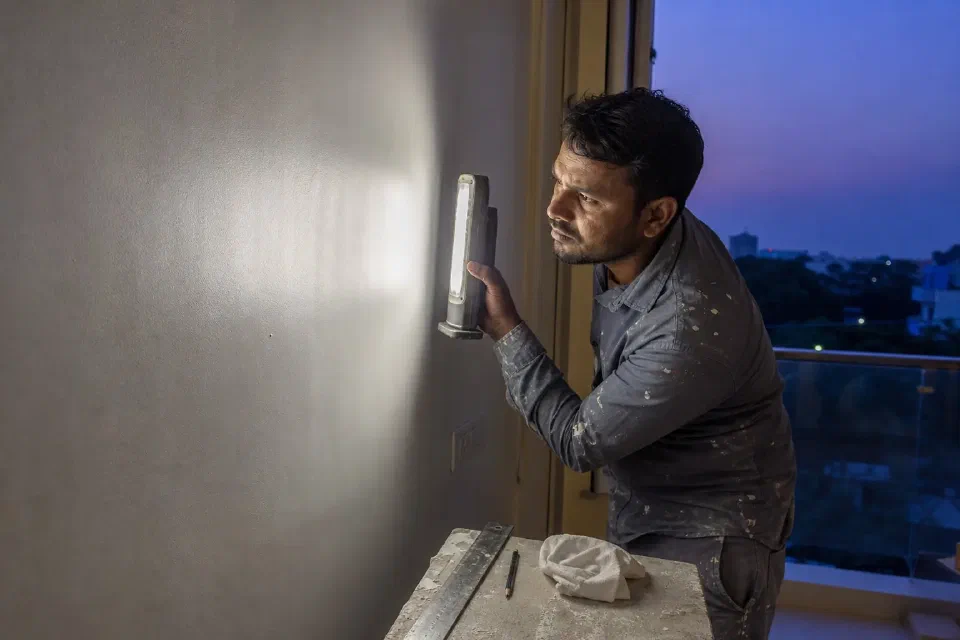
The raking light check. After the final coat has dried, hold a torch almost flat against the wall and look along the surface. Undulations, roller marks, missed patches and putty defects that are invisible under room lighting show up immediately. Do this before final payment, alongside the rest of the full home snag list.
Evidence and Verification Notes
Standards, layer functions and manufacturer instructions in this guide were checked against the linked BIS and product documents in August 2026. IS 17545 applies to the covered white-cement putty category; it does not make every acrylic product equivalent or prescribe one repaint method for every wall. Recheck the selected primer, putty and topcoat data sheets together because compatibility belongs to the full system.
Drying intervals, coverage and material quantities are planning estimates until substrate moisture, temperature, humidity, ventilation, layer thickness and measured area are known. The final BOQ should state the inspected condition, repair scope, named products, coat count, recoat criteria, sample approval and exclusions. Do not conceal active dampness with additional putty or primer.
Sequence the coating scope around cabinetry through the factory-direct interiors planning page. A Gurugram factory visit is useful for coordinating woodwork finish samples and interfaces, while wall-system approval still belongs to the measured substrate and named coating documents.
Frequently Asked Questions
Is wall putty necessary before painting?
It depends on surface condition and the coating system. Putty is commonly used on new plaster to correct minor undulations and prepare an even surface. A sound, smooth existing painted wall may need only local repair. Follow the named manufacturer’s substrate instructions.
Can I paint without primer?
Use primer whenever the named system requires it. Asian Paints states that primer over putty is necessary in its current FAQ, while repaint systems can differ by condition and product. Do not let a first topcoat be relabelled as primer.
What is the difference between primer and putty?
Putty is a filler that levels and closes the surface. Primer is a coating that bonds the topcoat to that surface and seals residual absorbency. They do different jobs and one does not replace the other. Putty goes first, primer goes over it, topcoat goes over that.
Which is better, cement putty or acrylic putty?
Choose from the exact substrate and coating system. IS 17545:2021 covers white cement based polymeric putty for internal or external plastered surfaces. An acrylic product needs its own current manufacturer data for approved substrate, layer thickness, drying, sanding and topcoat compatibility. Compare named products rather than assuming one universal cost or flexibility advantage.
Does skipping putty save money?
Only a measured system comparison can answer that. On a smooth repaint, full-wall putty may be unnecessary. On rough or porous plaster, omitting required preparation can increase topcoat demand and worsen uniformity. Compare measured area, product coverage, coat count, pack price and labour.
How many coats of putty should be applied?
Use the coat count, maximum thickness, drying time and sanding method in the exact putty data sheet for the substrate. Many systems specify two coats, but writing the named product and its instructions into the quote is stronger than a universal number.
Can primer be skipped on a previously painted wall?
Only the inspected substrate and the named repaint system can answer that. A sound compatible coating may need cleaning, sanding and local repair, while chalking, stains, exposed putty, repairs or a product change can require spot or full priming. Record the condition and follow the current manufacturer data sheet instead of using one repaint rule for every wall.
How long should putty and primer dry before the next coat?
Use the minimum drying or recoating interval and environmental limits in the current data sheet for the exact product. Temperature, humidity, ventilation, layer thickness and substrate moisture can extend the interval. A surface that feels dry is not proof that the specified recoat condition has been reached.
Related Guides From WoodAge
- Painting BOQ Checklist - Exposure zoning, measured area and the complete coat system.
- Asian Paints vs Berger vs Nerolac vs Dulux vs Birla Opus - Brand and tier comparison.
- Distemper vs APEX vs Royale vs Velvet Touch vs Enamel - The full product-type comparison.
- Interior Work Sequence for a New Gurgaon Flat - When painting happens around installation.
- Full Home Interior Snag List - Wall and finish checks before final payment.
- Ground-Floor Moisture Checklist - Do not paint over an active damp problem.
Get a Factory-Direct Quote
If you are planning interiors in Gurgaon or Delhi NCR, WoodAge can help you convert the idea into a measurable BOQ: exact material grade, hardware model, finish code, timeline and warranty terms before production starts.
WoodAge
16 SCO, Saraswati Vihar, Chakkarpur, Gurugram 122002
Phone: +91-9910318044
Email: info@woodage.in
Website: woodage.in