

Wardrobe Interior Layout for Indian Clothing 2026: Sarees, Suits, Kurtas and the Right Shelves-to-Rods Ratio
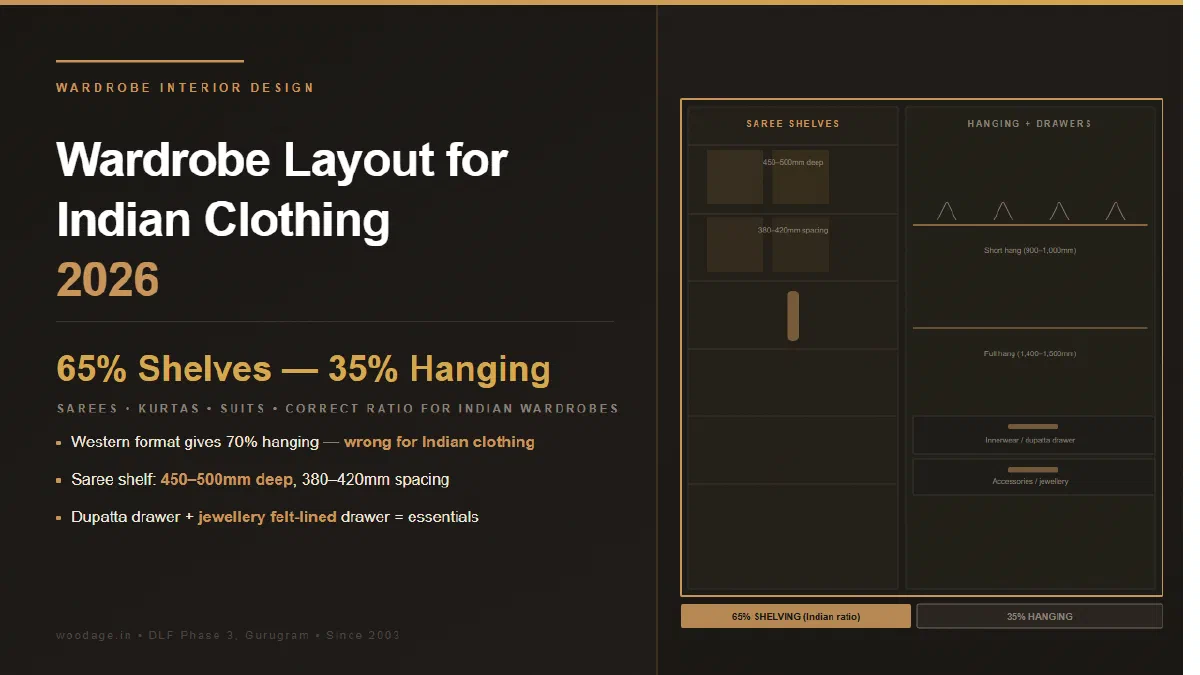
Most wardrobe interiors are designed using Western clothing assumptions: 60 percent hanging space. An Indian wardrobe needs the opposite: 60 percent shelving for sarees, folded kurtas, dhotis, dupattas and 40 percent hanging for suits, salwar sets. This guide gives specific shelf spacing, rod heights, drawer depths, and accessory recommendations for Indian clothing storage in Gurgaon apartment wardrobes.

- Kautuk Sahni
- 9 min read
Wardrobe Interior Layout for Indian Clothing 2026: Sarees, Suits, Kurtas and the Right Shelves-to-Rods Ratio
Catalogue wardrobe interiors often start from a hanging-heavy template: two rods, a few shelves and a small drawer section. That layout may not fit a household storing sarees, folded kurtas, salwar dupattas, dhotis and Western casuals. For the worked inventories in this guide, test a starting allocation of 60 to 65 percent shelving and 35 to 40 percent hanging, then replace the ratio with counts and measurements from the people who will use the wardrobe.
Quick answer: Start with the household’s actual clothing count, not a fixed catalogue interior. Treat the 60 to 65 percent shelf allocation as a planning example to test against your inventory, not a national average.
WoodAge (woodage.in) is a factory-direct modular kitchen and custom furniture manufacturer in Gurugram (Gurgaon), serving Delhi NCR since 2003.
Scope of this page: This guide owns the inside allocation question: shelves, rods, drawers and accessories for an actual clothing inventory. Overall wardrobe width, height, depth, shutter geometry and bedroom clearances must be resolved first in the project drawing. The ratios and garment counts below are planning examples, not a claim about every Indian household.
Count full-length garments, short hanging pieces, folded stacks, innerwear drawers, luggage and seasonal overflow separately. Then size shelves and rods from measured stack heights, garment drops and hanger widths, leaving access space instead of forcing the example ratio.
Why Indian Wardrobes Need Different Interior Planning
Consider what an average Indian household stores in a wardrobe. For an adult woman: 6 to 20 sarees each folded to a 30 by 40 cm stack, 8 to 15 salwar kameez mostly folded, 4 to 10 lehengas or party wear on hangers, jeans and Western clothing, 15 to 25 dupattas, and 8 to 12 innerwear sets.
For an adult man: 5 to 10 suits or formal trousers hanging, 15 to 20 shirts, 8 to 15 kurta-pyjama sets folded, and 6 to 10 jeans and casual trousers.
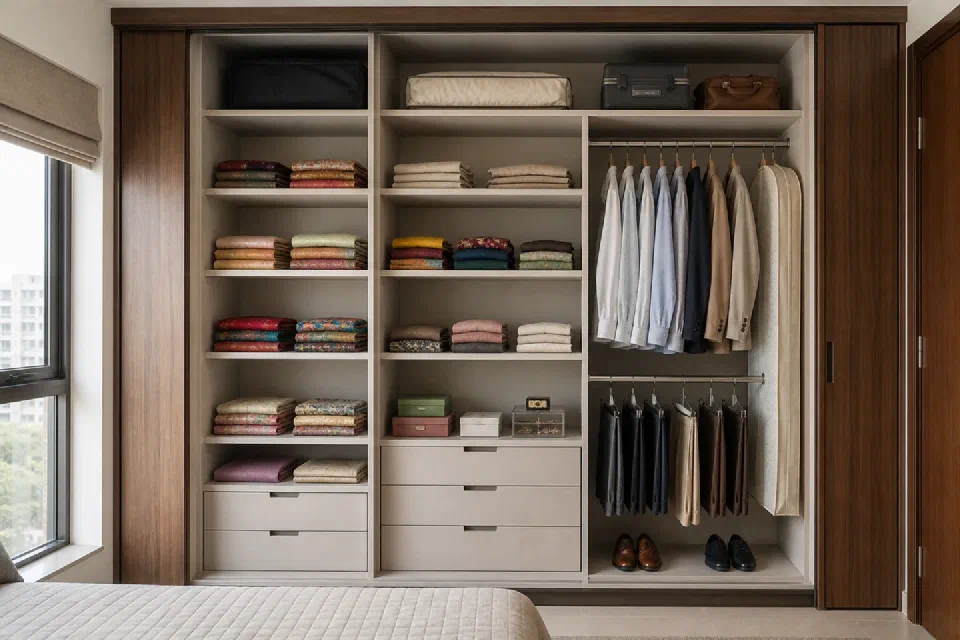
A standard European wardrobe interior with 70 percent hanging space would mean 6 to 8 sarees lying crumpled on one shelf. A well-designed Indian wardrobe interior with properly sized shelf compartments gives each saree dedicated shelf space.
The Correct Shelves-to-Rods Ratio for Indian Wardrobes
| Household Type | Recommended Shelf Space | Recommended Hanging Space |
|---|---|---|
| Adult woman, traditional clothing dominant | 65 to 70 percent | 30 to 35 percent |
| Adult man, mixed Indian and Western | 50 to 55 percent | 45 to 50 percent |
| Couple sharing wardrobe | 55 to 60 percent | 40 to 45 percent |
| Children’s wardrobe (ages 4 to 14) | 70 to 75 percent | 25 to 30 percent |
| Guest room wardrobe | 40 percent | 60 percent |
| Walk-in wardrobe | 55 percent | 45 percent |
Shelf Dimensions for Indian Clothing: The Numbers That Matter
Saree Shelf Specifications
A neatly folded saree typically measures 280 to 320mm wide and 380 to 420mm deep. The standard shelf height between two saree shelves is 350 to 400mm. A wardrobe section with 5 to 6 properly spaced saree shelves can store 10 to 15 sarees comfortably.
Common mistake: builders and entry-level wardrobe manufacturers space shelves at 250 to 280mm, which is too shallow for sarees and causes them to hang over the edge.
Correct saree shelf specifications: Depth 450 to 500mm, height between shelves 380 to 420mm, width per section 600 to 800mm.
Salwar Kameez and Kurta Shelf Specifications
Folded salwar sets and kurtas are approximately 300 to 350mm wide and 350 to 400mm deep. These can be stored on shelves slightly shallower than saree shelves.
Correct kurta shelf specifications: Depth 400 to 450mm, height between shelves 320 to 380mm.
Shirt and Trouser Hanging
For shirts and kurtas on hangers, the hanging rod should be at least 1,000mm high from the wardrobe floor. For suits, blazers, and long kurtas, the hanging section needs 1,400 to 1,500mm from rod to floor.
Double-rod hanging (for shirts only): Two rods stacked vertically at approximately 1,000mm and 1,900mm from the floor allow double the hanging capacity for shirts, light kurtas, and children’s clothing.
Drawer Specifications for Indian Wardrobes
Innerwear drawer (shallow, 80 to 100mm deep): Each adult needs 1 to 2 drawers for innerwear. Shallow drawers with internal dividers keep underwear and socks organised.
Jewellery drawer (very shallow, 50 to 80mm deep, felt-lined): Jhumkas, bangles, and earrings need a shallow dedicated drawer. A felt lining prevents scratching.
Dupatta drawer (medium, 120 to 150mm deep): A dedicated medium-depth drawer with the full width of the wardrobe section can hold 15 to 20 dupattas without crushing.
General clothing drawer (deep, 180 to 220mm deep): For winter woollens, bulky sweaters, and folded jeans during off-season.
Drawer and Accessory Fit Test
Do not approve only the visible drawer-front width. Test the clear internal width after side panels, runners and dividers, then check the selected accessory’s current installation drawing.
| Item to store | Design input | What to test before production |
|---|---|---|
| Bangles, jewellery and watches | Tray compartment size and lock requirement | Largest item, lining thickness and full drawer opening |
| Dupattas and scarves | Folded stack height and frequency of use | Drawer clear height after runner and bottom panel |
| Trousers | Folded stack or pull-out hanger choice | Garment width, handle clearance and rated accessory load |
| Sarees | Shelf stack or dedicated hanger choice | Folded depth, stack height and access without pulling the full pile |
| Suitcases | Actual largest case dimensions | Loft opening, shutter path and lifting clearance |
| Shoes | Pair count and largest shoe size | Shelf depth, ventilation and separation from clothing |
Record the garment or object size rather than relying on an accessory name. A sari hanger, trouser rack or jewellery tray can consume more clear width than its catalogue label suggests once hinges, runners and side clearances are included.
Wardrobe Interior Layout for Common Gurgaon Apartment Configurations
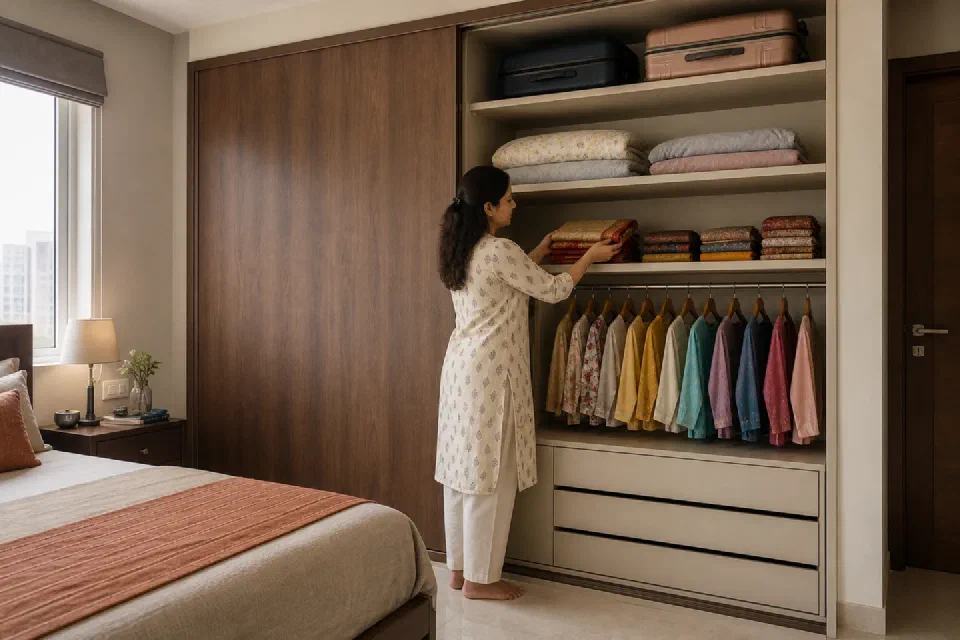
Typical 2BHK Master Bedroom (Wardrobe: 2,400mm wide)
| Section | Width | Interior Configuration |
|---|---|---|
| Lady’s section | 1,200mm | 6 saree shelves, 2 salwar shelves, 3 drawers |
| Gentleman’s section | 800mm | Double-rod hanging, 1 shelf for accessories |
| Common tall section | 400mm | Single long-hang rod for suits and formal kurtas |
Wardrobe Interior Accessories Worth Buying
Trouser rack (hanging): A pull-out trouser rack stores 8 to 12 trousers individually without crease. From Hettich: Rs 3,500 to Rs 7,000.
Sari hanger unit: Dedicated sari hangers allow storing sarees vertically rather than stacking horizontally. A sari hanger unit holds 15 to 20 sarees in a narrow 300mm column. Cost: Rs 3,000 to Rs 8,000.
Lockable drawer: One small lockable drawer for jewellery, valuables, or passports. Cost: Rs 2,000 to Rs 5,000 including lock.
Motion-sensor LED strip inside wardrobe: Battery-operated LED strip that illuminates the inside of the wardrobe when the door is opened. Cost: Rs 1,500 to Rs 4,000.
See also: For a factory-direct wardrobe with a line-by-line BOQ, see WoodAge’s Gurgaon wardrobe factory.
Frequently Asked Questions
How much space does each saree need in a wardrobe?
A neatly folded saree occupies approximately 300mm wide by 400mm deep by 50 to 70mm tall. A correctly sized saree shelf (450mm deep, 380 to 420mm high between shelves) can hold 2 to 3 sarees per shelf position without stacking problems.
What is the correct wardrobe depth for Indian clothing?
600mm is standard and works well for sarees, hanging clothing, and folded garments. Wardrobes shallower than 550mm create problems for hanging clothing and for neatly storing folded sarees.
Should I get a sliding or hinged wardrobe for a small Gurgaon bedroom?
Sliding wardrobes are better for small bedrooms where door clearance is a constraint. A 3-metre sliding wardrobe needs zero clearance for doors. Hinged wardrobes provide better access to the full width of each section.
How do I store lehengas in a wardrobe without crushing?
Long lehengas need a minimum 1,400 to 1,500mm hanging space from rod to floor. Store them individually on good quality padded hangers. A dedicated tall section of 400 to 500mm width with a single full-length hang rod is sufficient for 3 to 5 lehengas.
What is the difference between an Indian wardrobe interior and a standard wardrobe interior?
A standard (European-format) wardrobe interior allocates 60 to 70 percent of space to hanging rods and 30 to 40 percent to shelves. An Indian wardrobe interior should reverse this ratio: 60 to 65 percent shelving (for folded Indian garments) and 35 to 40 percent hanging. The shelf dimensions are also larger in an Indian wardrobe (450 to 500mm deep versus 350 to 400mm in standard wardrobes) to accommodate folded sarees without overhang.
WoodAge designs wardrobe interiors for Indian households, not European assumptions.
16 SCO, Saraswati Vihar, Chakkarpur, Gurugram 122002 Phone: +91-9910318044 | info@woodage.in | woodage.in
How to Use This Guide Before You Decide
Use this guide to plan wardrobe internals before selecting shutter style. Count sarees, suits, folded clothes, hanging shirts, shoes, bags, seasonal bedding, and jewellery first, then decide shelves, drawers, rods, lofts, and accessories.
Evidence and Verification
The dimensional recommendations on this page are planning references, not a substitute for measuring the user’s garments, hangers and reach. IIT Guwahati’s Indian anthropometry resource explains why Indian body dimensions and intended user groups matter in ergonomic design. For the finished storage unit, BIS guidance for IS 17634:2022 covers stability, strength, shelf deflection and durability tests. IS 17634 does not prescribe this page’s shelves-to-rods ratio, so do not present compliance with the standard as proof that a wardrobe layout fits a particular household.
At drawing approval, verify five items: one measured hanger, the longest garment, one representative folded stack, drawer clear opening after hardware and the user’s comfortable reach. Record the final shelf pitches and rod heights in the signed drawing so later site changes remain visible.
Accuracy and Update Notes
This guide is reviewed for Gurgaon and Delhi NCR interior decisions. Prices, dimensions, brand availability, warranty terms, and site conditions can change by project, so treat the ranges and comparisons as planning guidance and confirm final specifications with an itemised quote and site inspection before ordering.
Related Guides From WoodAge
- Home Interior Design Cost in Gurgaon 2026 - Wardrobes typically represent 20 to 25 percent of a complete home interior budget.
- Space-Saving Furniture for Gurgaon Apartments 2026 - Multi-function storage beds and under-bed drawers can supplement wardrobe space.
- New Gurgaon Apartment Interior Planning 2026 - When to order wardrobes relative to possession and how to sequence wardrobe installation.
- Modular Wardrobe Cost in Gurgaon 2026: Sliding, Hinged and Walk-In Prices Compared - Useful next reading on hardware planning, costs, materials, or execution.
- Kitchen and Wardrobe Lighting Plan: Profile Lights, Drawer Sensors and Under-Cabinet Lighting - Useful next reading on hardware planning, costs, materials, or execution.
- Interior Specification Sheet Template: Boards, Laminate Codes, Hardware, Countertop and Warranty - Useful next reading on hardware planning, costs, materials, or execution.
- DLF Arbour Sector 63 Modular Kitchen Guide - DLF Arbour Sector 63 features luxury apartments with high ceilings and premium specifications. This guide covers floor-plan-aware kitchen design, society fit-out rules, and luxury material recommendations for these flats.
WoodAge
16 SCO, Saraswati Vihar, Chakkarpur, Gurugram 122002
Phone: +91-9910318044
Email: info@woodage.in
Website: woodage.in
Interior designs verified and updated May 2026.