

Why a Bed Squeaks: Joints, Slats, Legs or the Floor
Trace bed squeaks to joints, slats, legs or the floor before applying a remedy. Use an unloaded inspection and a clear fault record for the service team.

- Arpit Sahni
- 8 min read

Quick answer: A bed squeak can come from frame joints, slat contact, loose connectors, legs, floor contact or the mattress assembly. Isolate the sound before lubricating or replacing parts. Inspect an unloaded bed according to its instructions, and stop using it if a supporting member is cracked, detached or visibly unstable.
WoodAge is a factory-direct furniture and interiors manufacturer in Gurugram, working since 2003. A useful service request identifies where movement occurs and under what conditions, rather than reporting only that the whole bed is noisy.
First distinguish noise from structural movement
Record when the noise began: after a move, reassembly, mattress change or a period of use. Inspect visible damage and whether the bed rocks. Keep children away during inspection, and do not crawl beneath a loaded or unsupported storage-bed platform.
| Observation | Area to inspect | Avoid assuming |
|---|---|---|
| Noise near one corner | Joint, connector and leg contact | That the mattress is the source |
| Sound along a slat support | Slat location, holder and contact | That all slats need replacing |
| Rocking on the floor | Feet, centre support and floor level | That tightening every screw fixes it |
| Noise after relocation | Assembly sequence and missing parts | That old connector holes remain sound |
| Cracked rail or detached support | Structural assessment | That padding will make it safe |
Work through one area at a time
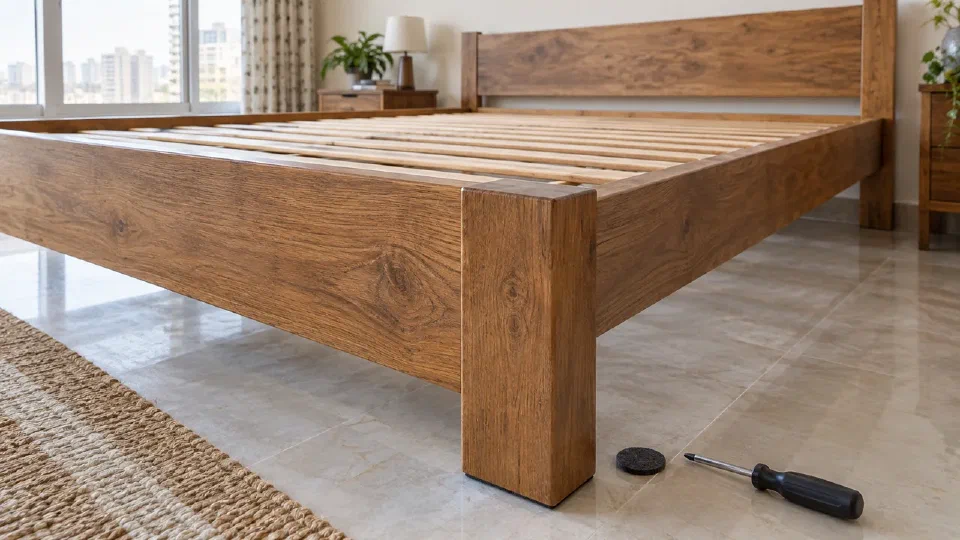
Before moving the mattress, check accessible external contacts: whether the headboard touches a wall or skirting, a drawer rubs, or a leg loses firm floor contact. IKEA Denmark’s bed-noise advice includes wall/skirting and floor contact among possible causes. If an external contact can be safely separated without altering the bed, repeat the same ordinary movement and record whether the sound changes. That isolates a contact; it does not clear a damaged frame.
With suitable help, remove bedding and the mattress as the product instructions allow. Keep the mattress supported and clean. Inspect the now-visible base, slats and connectors without dismantling a tensioned or lifting mechanism.
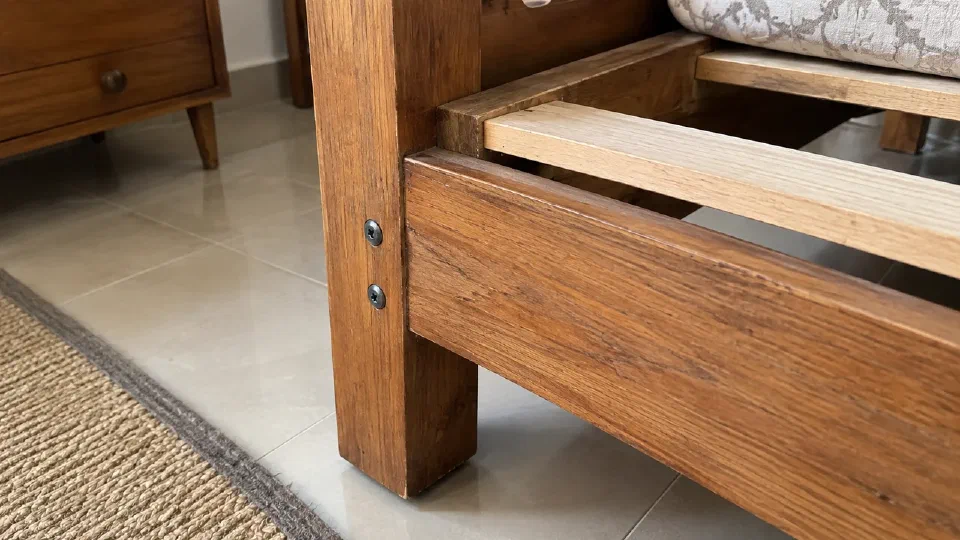
Check whether the specified hardware is present and correctly located. Tighten only according to the manufacturer’s method; overtightening can damage threads or crush the fixing area. An incorrect screw is not made suitable by tightening it harder.
Confirm that slats sit in their intended holders and that supporting members meet their designed contact points. A missing centre leg or misplaced rail may create movement that is not solved by adding lubricant.
IKEA’s bed-noise guidance identifies wood slats rubbing against metal rails as one possible squeak source in its beds. That is a contact diagnosis, not evidence that every noisy bed needs a new slat. Record which slat or joint moves during a controlled, ordinary-use check so a repairer can distinguish friction from a failed support.
Make the record repeatable: note whether the noise happens with the mattress removed, whether it happens only when a person changes position, and the corner or slat line where it is loudest. If the bare frame is quiet but the assembled bed is noisy, the mattress, its contact with the base and load-dependent frame movement remain separate possibilities. A quiet unloaded test does not clear a cracked or loose support for use.
Lubricant is not a universal repair
Use only the lubricant and application method permitted for the identified component. Oil can affect finishes, fabric or components for which it was not intended. Do not spray an unidentified mechanism or place slippery material at a structural connection.
For gas springs in storage beds, Stabilus’s service guidance states that its gas springs are maintenance free and do not need oiling. This is another reason to identify the component before applying a general squeak remedy.
What to ask the repairer
Arrange assessment for cracked timber, elongated or damaged fixing holes, missing proprietary connectors, recurring joint movement or an uncertain lift mechanism. Request a written description of the fault and repair, including any replacement parts.
Do not cover a damaged joint with upholstery or padding merely to suppress the sound. Noise reduction and restored structural performance are different outcomes.
Check the repaired bed under ordinary use
Reassemble according to the instructions, confirm that the bed is level and stable, and repeat the original activity that produced the noise without improvised overloads. Check the mattress-base compatibility as well. IKEA’s slatted-base information illustrates that the base is a specified component, not an arbitrary collection of timber strips.
Keep a service record: bed model or construction, fault location, photographs, replacement part numbers, work completed and warranty terms. If the noise returns, that record is more useful than repeating the same tightening step indefinitely.
Know the joint before tightening it
Beds built to be taken apart use bolts, knock-down fittings or brackets at their corners rather than permanent glue, and each loosens in its own way:
| Joint type | Where it is used | How it loosens | Typical repair route |
|---|---|---|---|
| Bed bolts with barrel nuts | Solid-wood beds, side rails into posts | Timber shrinks in dry months and the bolt loses tension | Re-tighten to the maker’s method; check the barrel nut is not stripping the wood |
| Knock-down fittings (cam and dowel) | Board-built and storage beds | Repeated racking wears the fitting’s grip | Re-tighten; a repairer may add glued and screwed corner blocks |
| Metal brackets and hooks | Many ready-made beds | Hooks wear or bend; screws pull out of the timber | Replacement with the specified bracket, fixed into sound timber |
| Mortise and tenon with bolts | Better solid-wood beds | Rarely, if the bolt is kept tight | Re-tighten the bolt |
Seasonal timing is a clue. Delhi NCR swings from dry months to monsoon humidity, and timber moves with it, so a bolted bed that was quiet in August can loosen and creak in a dry winter. A check after each season change is a reasonable routine.
Where wood still rubs on wood. If a joint is confirmed tight and sound and the noise comes from two wooden faces rubbing, such as slat ends in their holders, a little paraffin wax on the contact faces can quieten it, where the maker’s care instructions allow. Keep it off threads, connectors, gas springs and anything structural; wax does not repair movement.
In Gurugram flats, from Sohna Road towers to older DLF phases, a bed that was reassembled after a move is a common place to start: check the assembly sequence and that every connector went back.
Evidence and Verification Notes
The joint descriptions reflect standard furniture construction and are meant to help locate a fault, not to replace the maker’s instructions. Seasonal movement follows from timber’s response to humidity described in the US Forest Products Laboratory’s Wood Handbook chapter on moisture relations. Ready-made adult beds within India’s furniture quality control order must meet IS 17635, a BIS standard, and carry the ISI mark. No product test is claimed. Bed joints and rails can be inspected on a WoodAge factory visit.
Frequently Asked Questions
Does WD-40 fix a squeaky wooden bed?
It is not a general solution. First identify the moving interface and follow the product’s care instructions. A lubricant cannot restore a broken rail or stripped fixing.
Should every connector be tightened as much as possible?
No. Follow the assembly method and any specified torque. Excessive force can damage the connection and make later repair more difficult.
Can a squeak be harmless?
Sometimes, but sound alone cannot establish safety. Inspect for movement, damage and missing support before treating it as a minor contact noise.
Why test the frame without the mattress when practical?
An inspection with removable bedding and the mattress off, where the maker permits it, can help separate mattress contact from visible slat, joint, leg and floor problems. Do not load an exposed base, test a damaged frame or dismantle an unfamiliar lift mechanism. If the source remains unclear, give the service team the observations and let them test it safely.
Can the floor cause a bed to squeak?
Yes. An uneven or moving contact can rock the frame and load joints differently. Record each foot location and floor condition before altering the bed.
What if the noise returns after a repair?
Compare the new sound and location with the original service record. Repeated loosening or movement at the same joint needs inspection of the fixing and supporting material, not another round of blind tightening. Stop use if stability or a structural member is in doubt.
Why does my wooden bed creak more in winter?
Timber shrinks slightly as the air dries, so a bolted joint can lose tension in dry months and start to move. Check and re-tighten the bolts to the maker’s method after the season changes, and look for worn or stripped fixing holes if the same joint keeps loosening.
For a project in Gurugram or Delhi NCR, use WoodAge’s custom furniture service to discuss the measured requirement and written scope. Product suitability and the final BOQ must be confirmed for the actual order.
Related Guides From WoodAge
- Storage bed mechanisms - for comparing hydraulic, box and drawer arrangements.
- Bed size guide - for matching the base to the mattress and room.
- Storage bed and headboard guide - for the complete bed specification.
- Repair, modify or replace furniture - for a condition-based reuse decision.
- Storage Bed Lift Problems: Safe Checks Before a Service Call - Useful next reading on furniture planning, costs, materials, or execution.
- Replace a Bathroom Vanity Without Unnecessary Tile Damage - Useful next reading on furniture planning, costs, materials, or execution.