

Why a Sofa Sags: Cushions, Seat Support or Frame Damage
Diagnose a sagging sofa by separating cushion wear, seat support and frame damage. Record the fault before paying for foam replacement or upholstery.

- Arpit Sahni
- 9 min read
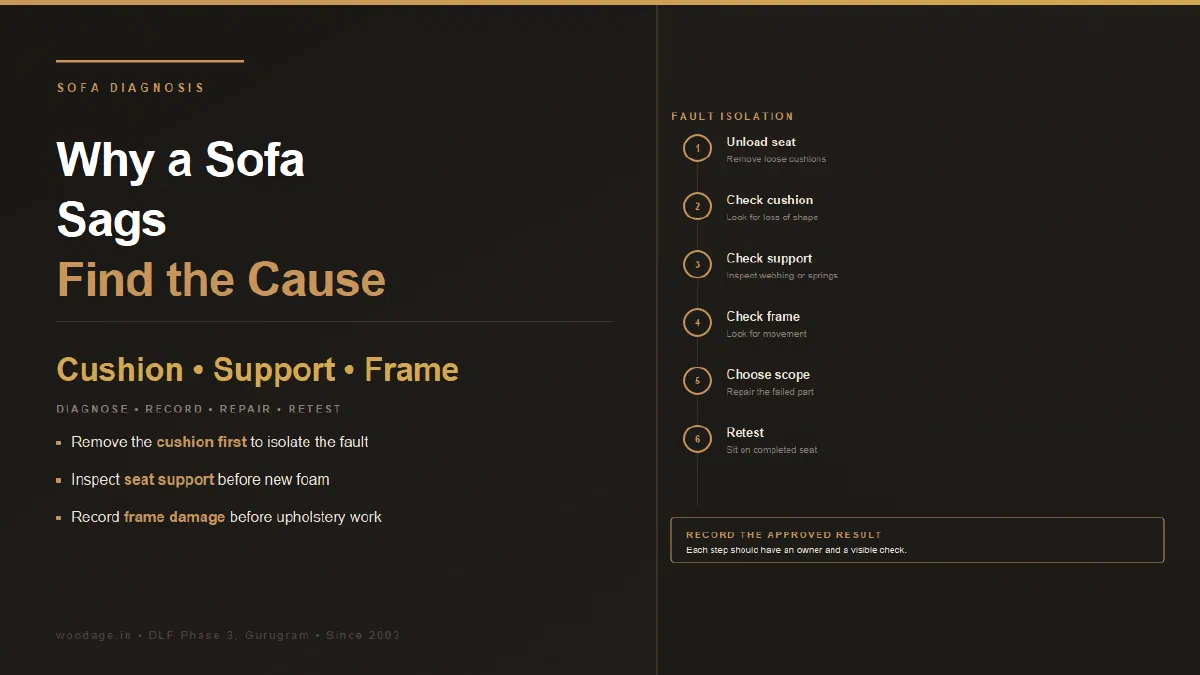
Quick answer: A sagging sofa may have a compressed cushion, a failed seat-support component, a damaged frame or more than one fault. Replacing foam before locating the movement can waste money. Inspect safely, record whether the depression follows a removable cushion, and have the support and frame assessed before approving repairs.
WoodAge is a factory-direct furniture and interiors manufacturer in Gurugram, working since 2003. This guide helps a buyer request a meaningful inspection and repair scope. It does not assume every sofa can be repaired economically or that all sofa-production stages are performed in-house.
Separate the removable cushion from the support
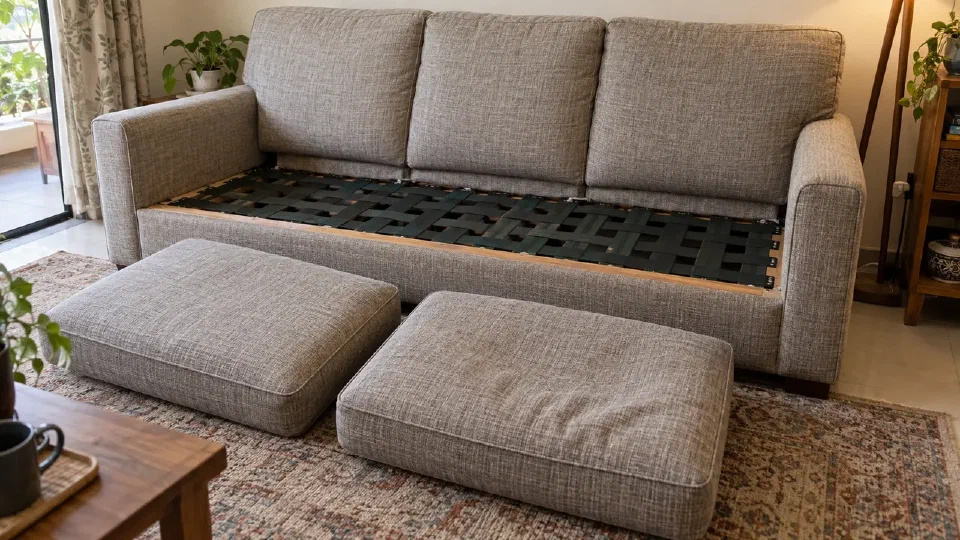
If the sofa has loose cushions and its care instructions permit moving them, photograph their positions and compare them off the seat. Do not cut upholstery or the dust cover simply to investigate. Fixed cushions and powered mechanisms need an appropriate service assessment.
| Observation | What it can suggest | What still needs checking |
|---|---|---|
| Depression follows a removable cushion | Cushion construction or wear contributes | Whether underlying support also deteriorated |
| Depression stays in the same seat position | Support or frame may contribute | Attachments, rails and local damage |
| New noise or visible movement | A connection or component needs inspection | Exact source and repair method |
| Sofa rocks on the floor | Legs, connectors or floor contact may contribute | Frame alignment and support condition |
| Several seats soften similarly | A shared construction or use issue is possible | Product history and component condition |
These observations narrow the inspection; they do not establish a warranty cause. Stop using a seat with a broken rail, exposed sharp component or unstable support until assessed.
A useful before-and-after check: number the removable cushions and photograph the empty seat deck from the same angle. If two cushions have identical dimensions and their care instructions permit swapping, exchange only those two, sit normally and note whether the low spot moves with the cushion or stays at the same frame position. A moving low spot suggests that the insert or cover contributes; a fixed low spot calls for support and frame inspection. Both layers can be faulty at once. Do not swap non-matching inserts or use a powered seat for this test. This is a triage record, not a diagnosis.
What to ask the repairer to record
Ask the technician to name the affected part: cushion core, wrap, spring attachment, webbing, rail, joint, leg or connector. A quotation saying only “sofa foam repair” can omit the actual fault.
Request photographs where the repair exposes the construction, with permission and without private household details. Ask what will be reused, replaced and re-covered, and how the repair will be checked before the upholstery is closed.
The Polyurethane Foam Association distinguishes firmness, support and fatigue. This matters because loss of comfortable support cannot be diagnosed from a density label alone. Replacing one foam grade with a higher density does not establish that the suspension or frame has been repaired.
PFA describes foam fatigue tests as repeated compression with firmness and height measured before and after. Such data concern the tested foam sample and conditions; they cannot identify a broken rail or loose webbing in an installed sofa. Ask the repairer to compare the removed cushion with the bare support, where access and product design permit, and record any separate defect in each layer. Do not treat a quick squeeze of the cushion as an equivalent laboratory test.
Compare repair and replacement on the same scope
If the sofa must leave a Gurugram tower for repair, give the repairer the service-lift dimensions and the society’s gate-pass rules before collection is booked. Get separate lines for inspection, transport, opening and closing upholstery, structural repair, support components, cushion work and new fabric if needed. Confirm whether the repairer can match an existing cover, and whether replacement cushions will differ visibly or in feel.
Repair can be sensible when the underlying structure is sound and the affected components are accessible. Replacement may be more practical when several systems are damaged, parts are unavailable or the intended use has changed. A fixed repair-cost percentage is not a universal rule.
Before agreeing to a full recover, ask for two stages: inspection and opening work to establish the fault, then an authorised repair for each confirmed layer. The repairer should record attachment and rail condition before ordering only foam or fabric. Separate confirmed cushion work from conditional suspension or frame work, and agree who approves a second fault found after opening. Record whether the old cover can be reused. This prevents a low insert-only quote from concealing the cost of restoring support at the original low spot.
Do not assume a board placed below the cushions restores the original design. It changes the support surface, may affect comfort and can conceal a fault. Ask whether a proposed modification is compatible with the sofa rather than accepting it as an automatic cure.
After the repair
Check the repaired position and neighbouring seats under ordinary use. Compare alignment, noise, rocking and cushion recovery with the recorded fault. Follow the supplied care instructions for cushion rotation and cleaning; these vary by construction.
Keep the repair description, replaced-part details and written warranty. A repair warranty should explain what it covers rather than promising that the complete old sofa is now new.
Know which suspension your sofa has
Three common seat-support systems, and how each sags:
| Suspension | What it looks like | How it typically fails | What to ask the repairer |
|---|---|---|---|
| Jute webbing | Woven fibre straps across the seat frame | Stretches and sags with sustained use | Whether replacement with a stronger system suits the frame |
| Elastic webbing | Stretched rubber straps, closely spaced | Loses tension over time; straps pull from their fixings | Strap spacing, tension and fixing method |
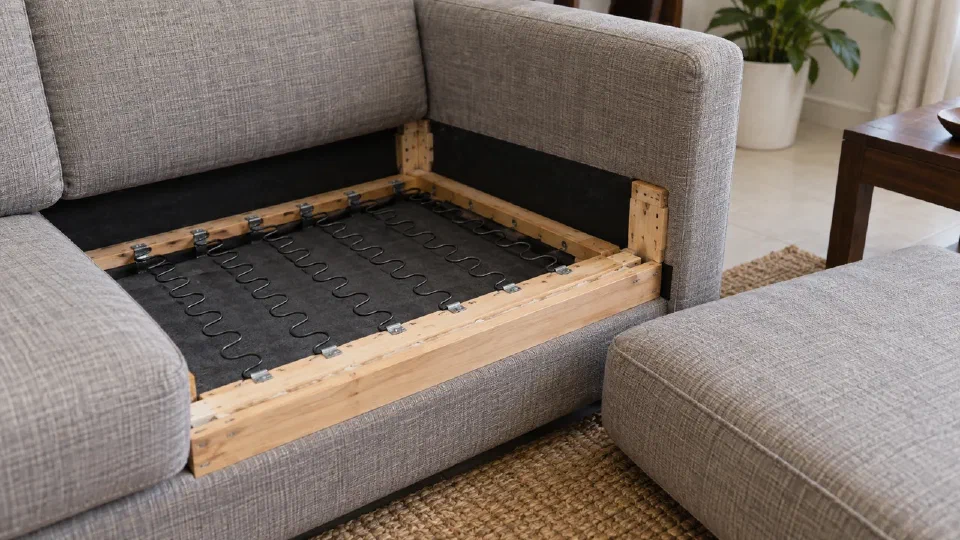
| Sinuous (zigzag) springs | Wire springs running front to back, clipped to the rails | Clips loosen, springs creak, weak rails flex | Rail condition, clip type and anti-noise sleeves |
Sinuous springs put a sustained pull on the front and back rails, so a rail that has cracked or pulled away will let the seat dip even with new foam on top.
Three frame checks you can do without opening the sofa
- The twist test. Lift one front corner a few centimetres. If the opposite front leg stays on the floor, the frame is rigid; if both front legs lift together as the frame twists, the joints have loosened.
- The arm and back test. Push each arm and the back firmly sideways. Movement or a click points to a loose joint or a cracked rail.
- The sound test. Sit and shift your weight. A crack, creak or grinding sound under the seat points to the frame or suspension, not the foam.
Stop the tests if anything moves sharply or breaks; they are for describing the fault to a repairer, not for repairing it.
If a rail is replaced, specify its material. Where a repairer proposes a plywood rail, ask for the grade and Indian Standard, such as IS 303 or IS 710, and for an ISI mark whose CM/L number verifies in the BIS Care app. For a new sofa, the European domestic seating standard EN 12520, tested by the methods in EN 1728, is one published benchmark for frame strength and durability; ask whether the model was tested and to which edition.
Evidence and Verification Notes
The suspension descriptions and frame checks reflect standard upholstery practice; they help a buyer describe a fault and are not a substitute for a repairer’s inspection. Foam terms follow the Polyurethane Foam Association’s published guidance, checked in September 2026. WoodAge delivers made-to-order sofa projects against a written specification of frame, foam and upholstery; to see frames and foam layers before ordering, book a WoodAge factory visit. Fabric wear ratings are explained in the sofa fabric guide.
Frequently Asked Questions
Can I fix sagging sofa springs myself?
Some support components are tensioned, concealed or attached to damaged timber. Without the correct construction information, opening or retensioning them can be unsafe and can damage upholstery. Start with a service diagnosis.
How much does sofa-spring repair cost in Gurugram?
An accurate quote needs the sofa construction, fault, access, upholstery work and transport scope. No current local price range was verified for this guide. Send the symptom record and photographs, then compare like-for-like written quotations.
Does a sag after one year prove poor foam?
No. Time alone does not locate the fault or establish the cause. The cushion, support, frame and actual product specification must be checked separately.
Does placing a board under the cushions repair a sagging sofa?
It changes the support surface and may conceal the original fault. Treat it as a design modification, not proof that the suspension or frame has been repaired.
When is reupholstery worth considering?
Consider it after the frame, suspension and cushions are inspected and the full work is itemised. Fabric replacement alone does not correct a failed rail, webbing or spring system.
What is the safest diagnostic order?
Compare removable cushions first, then inspect the accessible support and frame without forcing concealed parts. Record each failed layer separately before approving materials or price.
How do I know if my sofa frame is broken?
Lift one front corner a few centimetres: if the opposite front leg lifts too, the frame is twisting at loosened joints. Push the arms and back sideways and listen for clicks, and sit and shift your weight to hear for cracks. Any movement or sound from the frame needs a repairer’s inspection before new foam is fitted.
For a project in Gurugram or Delhi NCR, use WoodAge’s custom furniture service to discuss the measured requirement and written scope. Product suitability and the final BOQ must be confirmed for the actual order.
Related Guides From WoodAge
- Repair, modify or replace furniture - for a condition-based reuse decision.
- Solid wood versus plywood - for substrate and frame material decisions.
- Sofa fabric guide - for selecting and specifying the upholstery.
- Sofa size and configuration - for the sofa footprint and seating layout.
- Sofa Foam Density vs Firmness: Read the Cushion Specification - Useful next reading on furniture planning, costs, materials, or execution.
- How to Test Sofa Comfort Before a Custom Order - Useful next reading on furniture planning, costs, materials, or execution.