

Why a Wooden Door Sticks: Hinges, Moisture or Floor Levels
Find why a wooden door sticks before planing it. Check hinges, moisture, contact marks and floor levels, with a clear record for the installer.

- Arpit Sahni
- 9 min read

Quick answer: A sticking door can result from hinge movement, a distorted leaf, frame misalignment, moisture changes or a raised floor finish. Find the contact point and inspect the assembly before sanding or planing. Removing material may disguise a fixing problem, exceed the leaf’s trimming allowance or leave a larger gap when conditions change.
WoodAge is a factory-direct furniture and interiors manufacturer in Gurugram, working since 2003. In a Gurugram home, whether in an older DLF phase or a new tower on Sohna Road, rain-season timing is useful evidence, but it is not a diagnosis. This inspection sequence helps a homeowner give a fitter a useful fault description without taking a heavy door apart.
Start with the history and contact point
Record when the fault started and what changed: a new floor, fresh paint, a leaking bathroom, hardware replacement or a period of high humidity. Photograph the closed-door gaps from both sides where accessible.
With the door under normal control, note exactly where it contacts the frame or floor. Do not force a jammed leaf, stand on hardware or release hinges to investigate it.
| Symptom | Possibilities to distinguish | Useful evidence |
|---|---|---|
| One top corner rubs | Hinge movement, frame geometry or leaf distortion | Gap pattern and visible fixing movement |
| Lower edge rubs only along part of the swing | Floor high point, threshold or leaf position | Contact location at different opening positions |
| Latch will not engage but leaf clears | Strike alignment, latch operation or assembly movement | Whether latch retracts freely with the door open |
| Broad seasonal rubbing | Moisture response, paint build-up or frame movement | Timing, exposed edges and evidence of wetting |
| New local blister or soft edge | Finish or material damage requiring inspection | Close photograph and leak history |
These are inspection prompts, not proof of a single cause. A door can have more than one fault.
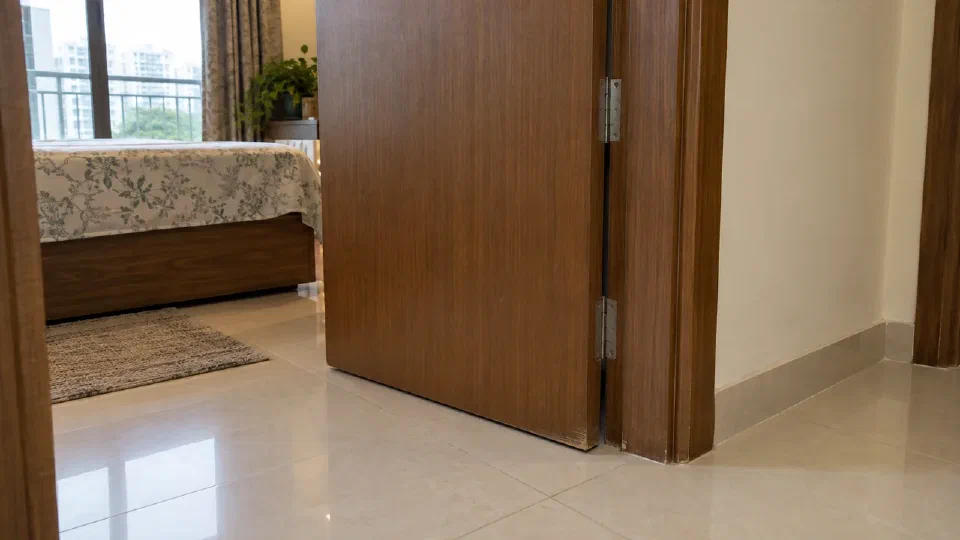
A check you can do without removing the leaf
First clear removable obstructions such as a shifted mat and inspect for loose debris. If normal movement remains possible, hold the handle so the latch stays retracted and move the door gently towards the closed position. If the leaf clears while the latch alone fails to enter its strike, report a latch or alignment fault rather than requesting planing. Keep fingers away from the closing edges.
Next, note the first contact location and whether contact continues through the swing. A bottom edge that catches only above one floor tile warrants a floor-level check. A leaf that fits at one corner but stands proud at another warrants a check for twist and frame alignment. A squeak with no rubbing is a different complaint from a swollen edge.
Give the repairer a pass condition: normal operation, secure fixings, correct latch engagement and the required finish restored. Request an itemised price for diagnosis, adjustment, any permitted machining and refinishing. This makes a local carpenter’s visit charge distinguishable from the cost of a complete repair.
Do not use a heat gun to force a quick dimensional correction or assume a household lubricant suits the finish. The product’s care instructions should determine cleaning and lubrication. The USDA Wood Handbook chapter on moisture control explains that coatings retard moisture-related dimensional changes rather than preventing them. A new coating is therefore not a guarantee that a timber door will never change size.
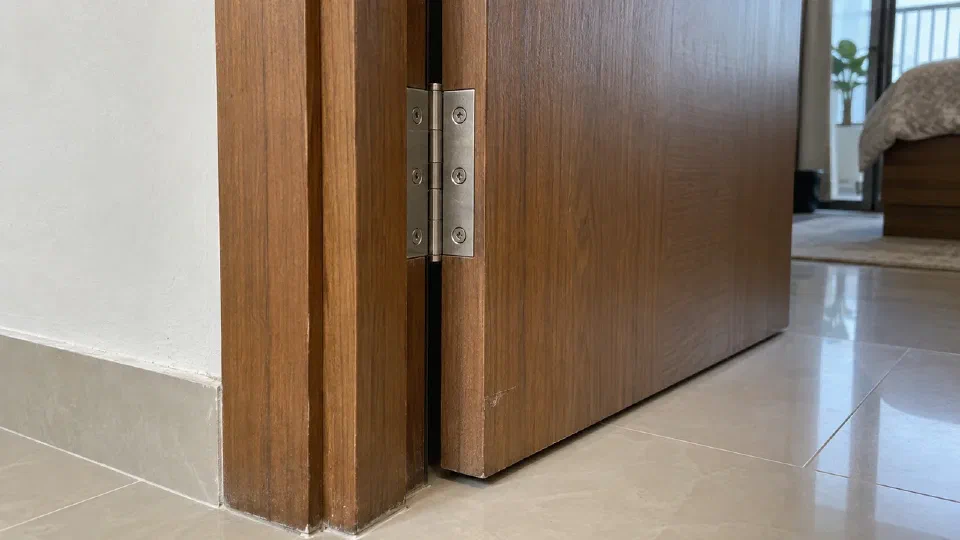
Separate moisture evidence from a moisture story
Wood responds to moisture, but a high meter reading is useful only when the meter is appropriate and correctly set. Species, temperature and measurement method can affect readings. Delmhorst’s correction guidance demonstrates why an unexplained number from one spot is not a diagnosis.
A fitter should distinguish a wetting source from normal dimensional response and inspect the frame as well as the leaf. Coating over an active leak does not remove the water source. Do not assume every swollen door will recover fully, or that every sticking door is swollen.
Use changes over time to narrow the fault
If the door can still be operated safely, record the same contact point at two ordinary times rather than making an immediate cut. Note whether the rubbing is persistent, follows recent floor work, or appears only after wet cleaning or rain. Compare the leaf with the frame: movement at the hinge side, an isolated raised floor spot and a visibly wet bottom edge call for different inspections. A seasonal pattern supports further moisture investigation, but it does not prove the leaf itself is the only part changing.
Photograph the contact mark and the entire perimeter in the same record. Include the closed gap, hinge side and floor finish so a repairer can see whether a local mark sits within a broader alignment problem. If the leaf binds severely or the fixing moves, stop the trial and ask for a service visit. The record is a diagnosis aid, not an instruction to force the door repeatedly.
What to ask the repairer
Ask for a diagnosis stated as an observation: for example, “the upper hinge mounting moves when the leaf is operated,” rather than “monsoon problem.” Request the proposed repair, affected finish and a method of checking the result.
If trimming is proposed, establish the exact leaf construction and the manufacturer’s allowance first. JELD-WEN’s product-dependent trimming limits are a useful warning against a universal “take a few millimetres off” rule. They do not supply an allowance for your door.
A loose fixing may need a repair suited to the actual substrate. Avoid copying advice to fit arbitrarily longer screws: concealed services, fixing depth and the remaining material must be checked. Likewise, wax, oil or a lubricant is not a repair for a cracked member or failing fixing.
A service message you can copy
Room and door ID: __. Fault began: __. Contact point: __. Recent work or leak: __. Leaf construction or supplier: __. Door clears/does not clear when latch is retracted: __. Visible movement or damage: __. Photos attached: closed gaps, contact mark and hinges. Please diagnose before cutting and state any finishing work required.
After repair, test the door through its intended movement and confirm latch operation. Keep the before-and-after record. For a recurring seasonal fault, document the conditions instead of repeatedly removing material.
How strongly humidity drives wood moisture
Wood gains or loses water until it balances with the surrounding air, its equilibrium moisture content. The US Forest Products Laboratory’s Wood Handbook chapter on moisture relations charts that balance against humidity. Near room temperature, approximately:
| Relative humidity of the air | Approximate equilibrium moisture content of wood |
|---|---|
| 30% | About 6% |
| 50% | About 9% |
| 65% | About 12% |
| 80% | About 16% |
| 90% | About 20% |
Delhi NCR moves from dry pre-monsoon months to humid monsoon days, so a timber leaf or frame exposed to outdoor air can change its moisture content by several percentage points in a year. Wood moves most across the grain, so a swelling leaf grows in width and tends to bind along its long vertical edges; rubbing confined to one top corner points first to the hinges, as the table above notes. A finish slows that exchange but does not stop it, and an unfinished top or bottom edge lets moisture in faster than the sealed faces. In a new-possession flat, fresh plaster, screed and tile beds can still be releasing moisture for months, which is one more reason to confirm the contact point before blaming the leaf. These figures explain the mechanism; they do not diagnose your door, which still needs the contact-point inspection above. Where a moisture reading is disputed, the oven-dry method in IS 11215, a BIS standard for measuring the moisture content of timber, is the reference that meters are calibrated against.
Evidence and Verification Notes
The equilibrium moisture values are approximate readings from the Wood Handbook’s chart near room temperature, checked in September 2026. They illustrate how humidity drives moisture content in wood generally; species, coatings and indoor air-conditioning change the result for a particular door.
Frequently Asked Questions
Should I sand a door that sticks after rain?
Not as the first step. Locate the contact and check hinge, frame, floor and wetting conditions. Cutting is a permanent change and must remain within the leaf’s instructions.
Will tightening the top hinge solve it?
Only if the relevant problem is a sound, compatible fixing that has loosened. A stripped hole, damaged frame or distorted leaf needs a different remedy. Stop if the leaf or frame visibly moves unsafely.
When is a service visit preferable to a DIY attempt?
When the leaf is heavy, fixings move, the frame is damaged, an entrance doorset has a rating, or the cause is unclear. Do not remove a heavy leaf without the appropriate equipment and competent help.
What does rubbing at the top corner usually mean?
It can indicate hinge movement, frame distortion, floor change or leaf movement. The contact pattern narrows the inspection, but it does not prove one cause without checking the whole interface.
Can one moisture-meter reading prove the door is swollen?
No. The instrument, settings, material, temperature and comparison locations matter. Treat the reading as one observation alongside visible water sources, gaps and hinge condition.
What should happen if material is removed from a door edge?
The work should stay within the selected product’s written allowance, and any newly exposed area should receive the specified edge treatment. Record the repair and retest normal operation.
Why does my door stick in the monsoon but not in winter?
Timber takes up moisture when the air is humid and releases it when the air is dry. Near room temperature, wood settles at about 9% moisture content at 50% relative humidity and about 16% at 80%, so a leaf or frame can swell across its width in humid months. Check the contact point and hinges before assuming swelling alone.
Will a door that swells in the rain shrink back on its own?
Often partly, as the air dries, but not always fully, and repeated wetting can damage edges and finishes. Find and stop any water source, keep all edges sealed, and record the gaps in a dry month before deciding whether any material should be removed.
For a project in Gurugram or Delhi NCR, use WoodAge’s custom furniture service to discuss the measured requirement and written scope. Product suitability and the final BOQ must be confirmed for the actual order.
Related Guides From WoodAge
- Door material comparison - for leaf construction and surface choices.
- Cabinet board failure guide - for swelling, loose fittings and substrate damage.
- Ground-floor moisture checks - for investigating water exposure before fitting cabinets.
- Interior handover snag list - for recording operation and finish defects.
- Replacing a Room Door While Keeping the Existing Frame - Useful next reading on hardware planning, costs, materials, or execution.
- Sliding and Pocket Doors: Space, Privacy and Wall Planning - Useful next reading on hardware planning, costs, materials, or execution.