

Wood Moisture Meters: Readings, Species and Common Errors
Interpret wood moisture-meter readings using the instrument, species and material context. Keep a repeatable reading log instead of relying on one pass number.

- Arpit Sahni
- 9 min read
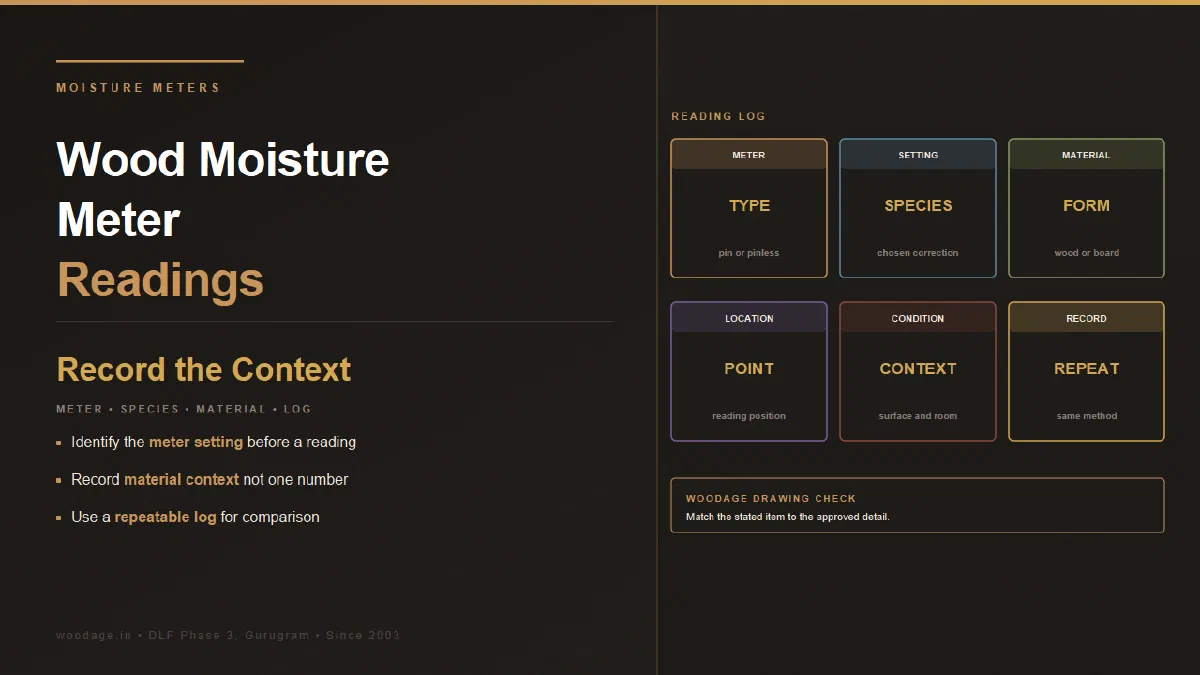
Quick answer: A wood-moisture reading is useful only when the meter, material, settings and measurement method are known. Pin and pinless meters do not use interchangeable corrections. Record species or density settings, locations and conditions, and interpret the results against the timber’s intended use. One unexplained percentage is not a furniture-quality certificate.
WoodAge is a factory-direct furniture and interiors manufacturer in Gurugram, working since 2003. This guide explains how a buyer or fabricator can request a reproducible moisture record. It does not establish that WoodAge performed a particular test or that one moisture percentage suits every NCR room.
Know which instrument is being used
| Meter type | Principle relevant to the user | Key checks |
|---|---|---|
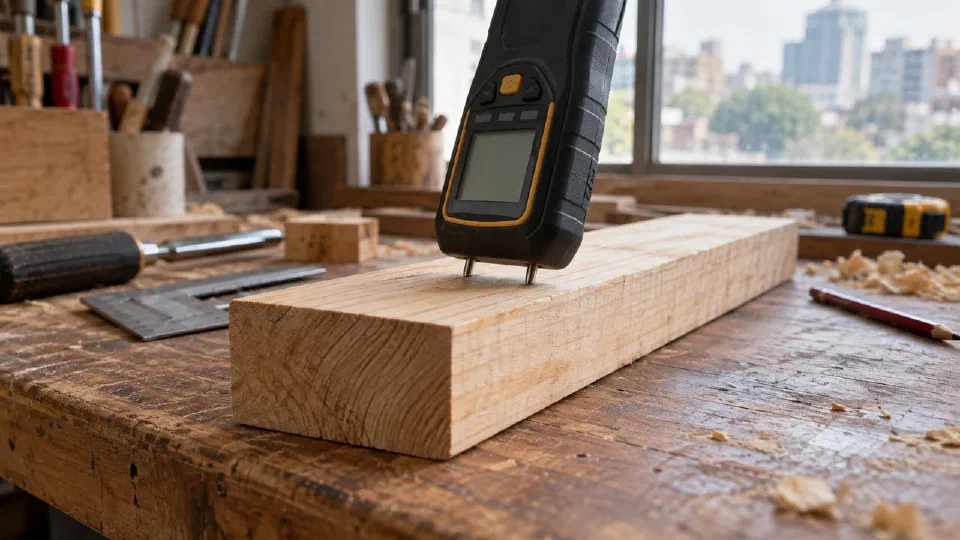
| Pin type | Electrical resistance through the measured material | Species, temperature, electrode and pin conditions |
| Pinless | A sensing field influenced by the material | Correct density setting, thickness, depth and contact requirements |
Delmhorst’s correction tables separate species, temperature, pin and pinless specific-gravity corrections. Wagner’s manual library supplies model-specific instructions and species settings. Do not transfer one manufacturer’s settings into another instrument.
The Delmhorst tables also distinguish corrections already built into a meter from manual corrections. For its pin-type instruments, species, wood temperature and insulated-pin conditions are separate questions; for its TechScan pinless instrument, the published specific-gravity basis is a different correction path. Record the exact meter and electrode before applying a table. Applying a second manual correction to a setting the meter already accounts for can make the reported number less reliable.
What to check before interpreting a reading
Record the meter model and identification, condition check required by its manual, material identification and the selected scale. If species is uncertain, say so rather than choosing the nearest familiar name and presenting the result as exact.
For a comparison over time, record the room temperature and relative humidity if they were measured, along with whether the component had recently been moved, coated or exposed to water. These conditions do not correct a meter reading by themselves. They explain why two readings taken on different days may require investigation before being treated as a change in the wood.
Map measurement locations on the component. Note whether readings are on a face, edge or accessible depth, and follow the manual’s restrictions near edges, metal and other interfering materials. Avoid damaging a finished surface without permission.
Take enough representative readings to describe the component and any suspected variation. The exact method should follow the instrument and the investigation; a random count of readings is not a standard.
Before comparing a later visit with the first, repeat the same marked locations and material face where possible. Note if a coating, veneer, metal fitting or panel thickness has changed the meter’s contact or sensing field. A comparison across different surfaces is a new observation, not automatically a moisture trend.
Copy this log
| Field | Entry |
|---|---|
| Job and component ID | __ |
| Date, location and relevant conditions | __ |
| Material/species and basis of identification | __ |
| Meter model and condition check | __ |
| Scale, species/density setting and corrections | __ |
| Location and measurement depth/method | __ |
| Raw reading | __ |
| Corrected reading and correction source | __ |
| Acceptance basis or reason for investigation | __ |
| Operator and follow-up | __ |
Do not average away a conspicuously different location before investigating it. A local high reading may deserve a closer look, but it does not by itself identify a leak, decay or workmanship failure.
When one point is unexpectedly high, first repeat that point with the same meter mode and contact method. Check the material identification, species or density setting, surface coating, nearby metal and the instrument’s condition check. Then compare adjacent marked points on the same component and an identified control piece where the method permits. If the discrepancy remains, document it and ask a competent specialist to investigate the material and nearby moisture sources. Do not declare the entire cabinet failed from a single unexplained display value.
Solid timber and engineered boards are different
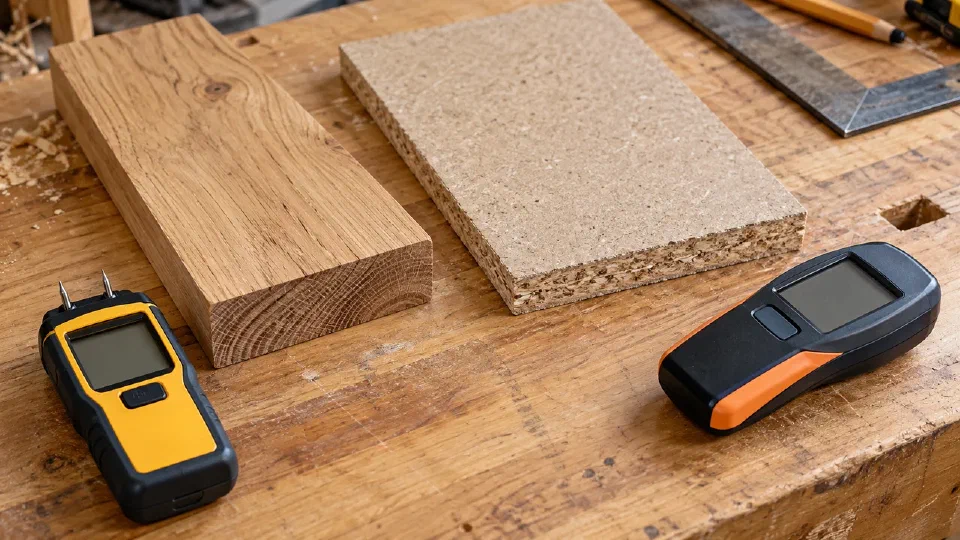
Plywood, MDF, HDHMR and laminated assemblies contain layers or binders that may affect interpretation. Delmhorst’s FAQ discusses material and measurement limitations, including plywood. A solid-wood species correction is not automatically valid for every engineered panel.
First check what the display means. Some pinless instruments show a relative 0 to 100 indication rather than a percentage of water by mass. Extech describes the MO257’s 0 to 100 display as a relative pinless reading. Do not enter a relative value into a log column labelled “% moisture content” or compare it with a timber specification expressed in percent. Record the selected scale and use the exact meter’s manual to interpret it.
If the task is assessing a finished cabinet near a damp wall, a meter reading should be considered alongside the wall, plumbing, exposure and visible condition. The instrument does not establish the cause of damage without that investigation.
Avoid a universal pass percentage
The appropriate acceptance basis depends on the material, expected service environment, product specification and agreed measurement method. Ask the supplier or responsible specialist to state that basis before testing. Do not claim that timber below one number cannot move or crack.
A record should make a later check comparable: same identified instrument or a documented equivalent method, same material basis and mapped locations. A second number from another meter on an unknown setting cannot be treated as proof of deterioration.
The reference method and what wood settles at
When a meter reading is disputed, the reference is the oven-dry method: a sample is weighed, dried and weighed again, and moisture content is the lost water as a percentage of the dry mass. India’s standard methods for timber moisture content are in IS 11215, a BIS standard, and meters are calibrated against that kind of reference. Recommended moisture content for timber by use and climatic zone is set out in IS 287, which has a newer revision to confirm before relying on a figure.
What a reading should be also depends on the air the wood lives in. The US Forest Products Laboratory’s Wood Handbook chapter on moisture relations charts the moisture content wood settles at near room temperature: about 6% at 30% relative humidity, 9% at 50%, 12% at 65%, 16% at 80% and 20% at 90%. A reading of 12% in a Gurugram flat during the monsoon may simply be wood in balance with humid air; the same reading in a dry, air-conditioned room in winter deserves a second look.
| Meter type | Measures | Good for | Limits |
|---|---|---|---|
| Pin | Electrical resistance between two pins | Readings at the pin depth | Leaves small holes; species and temperature corrections |
| Pinless | The wood’s electrical properties through a pad | Fast, non-damaging scanning | Fixed depth; density and surface finish affect it |
Evidence and Verification Notes
The equilibrium moisture values are approximate readings from the Wood Handbook’s chart near room temperature. IS 11215 and IS 287 were checked by title and edition in September 2026. Meter behaviour follows the makers’ published guidance cited above; follow your meter’s manual for corrections. In a new-possession flat, whether on Dwarka Expressway or in an older Gurugram sector, fresh plaster and screed release moisture for months, so readings taken soon after possession can run high for reasons unrelated to the furniture. Species are compared in types of wood for furniture in India, and timber stock can be seen on a WoodAge factory visit.
Frequently Asked Questions
What is an acceptable moisture level for furniture wood?
Use the material specification and intended environment with an appropriate test method. There is no single percentage this guide can responsibly prescribe for every species, construction and indoor condition in Delhi NCR.
Does pinless mean more accurate?
Not universally. Suitability depends on the material, geometry, depth and the instrument’s instructions. Choose the method for the question being investigated.
Can a moisture meter prove that a supplier seasoned the timber correctly?
A reading describes a measurement at a time and location. It is not the complete drying history, and it does not prove every component or its future behaviour. Retain the timber and process records where those claims matter.
When is species correction needed?
It depends on the meter and material. Confirm whether the instrument already applies a setting before adding a manual correction, and do not transfer one maker’s table to another meter.
Why are repeat readings more useful than one number?
Marked locations, stable settings and recorded conditions show whether an observation changes. Readings from different faces or materials are a new comparison, not automatically a trend.
How is wood moisture content measured accurately?
The reference is the oven-dry method: weigh a sample, dry it, weigh it again, and express the lost water as a percentage of the dry mass. India’s methods are in IS 11215. Meters are quicker and non-destructive but depend on species, temperature and depth settings, so use them for comparison and the oven-dry test for disputes.
What moisture content does wood reach in humid weather?
Near room temperature, wood settles at about 12% moisture content in air at 65% relative humidity, about 16% at 80% and about 20% at 90%, according to the Wood Handbook’s chart. That is why readings rise in the monsoon even for well-seasoned timber.
For a project in Gurugram or Delhi NCR, use WoodAge’s custom furniture service to discuss the measured requirement and written scope. Product suitability and the final BOQ must be confirmed for the actual order.
Does WoodAge have a moisture meter for site checks?
Yes. WoodAge’s recorded equipment includes a moisture testing meter, alongside laser levels and a paint thickness gauge for site measurement. A reading matters most on a wall next to a bathroom or an outside face before cabinets are fixed to it, and on boards that have been stored on site. Ask for the reading and where it was taken, and judge it against the guidance on this page rather than a single pass or fail number.
Related Guides From WoodAge
- Edge-banding guide - for protected panel edges and material identification.
- Kitchen material standards - for board-grade and standards checks.
- Cabinet board failure guide - for swelling, loose fittings and substrate damage.
- Ground-floor moisture checks - for investigating water exposure before fitting cabinets.
- Types of Wood for Furniture in India: Sheesham, Teak, Mango, Ash, Rubberwood Compared (2026) - Useful next reading on furniture planning, costs, materials, or execution.
- E0 vs E1 vs E2 Formaldehyde Emission Classes: How to Verify Certificates for Kitchen Boards in India - Useful next reading on furniture planning, costs, materials, or execution.